


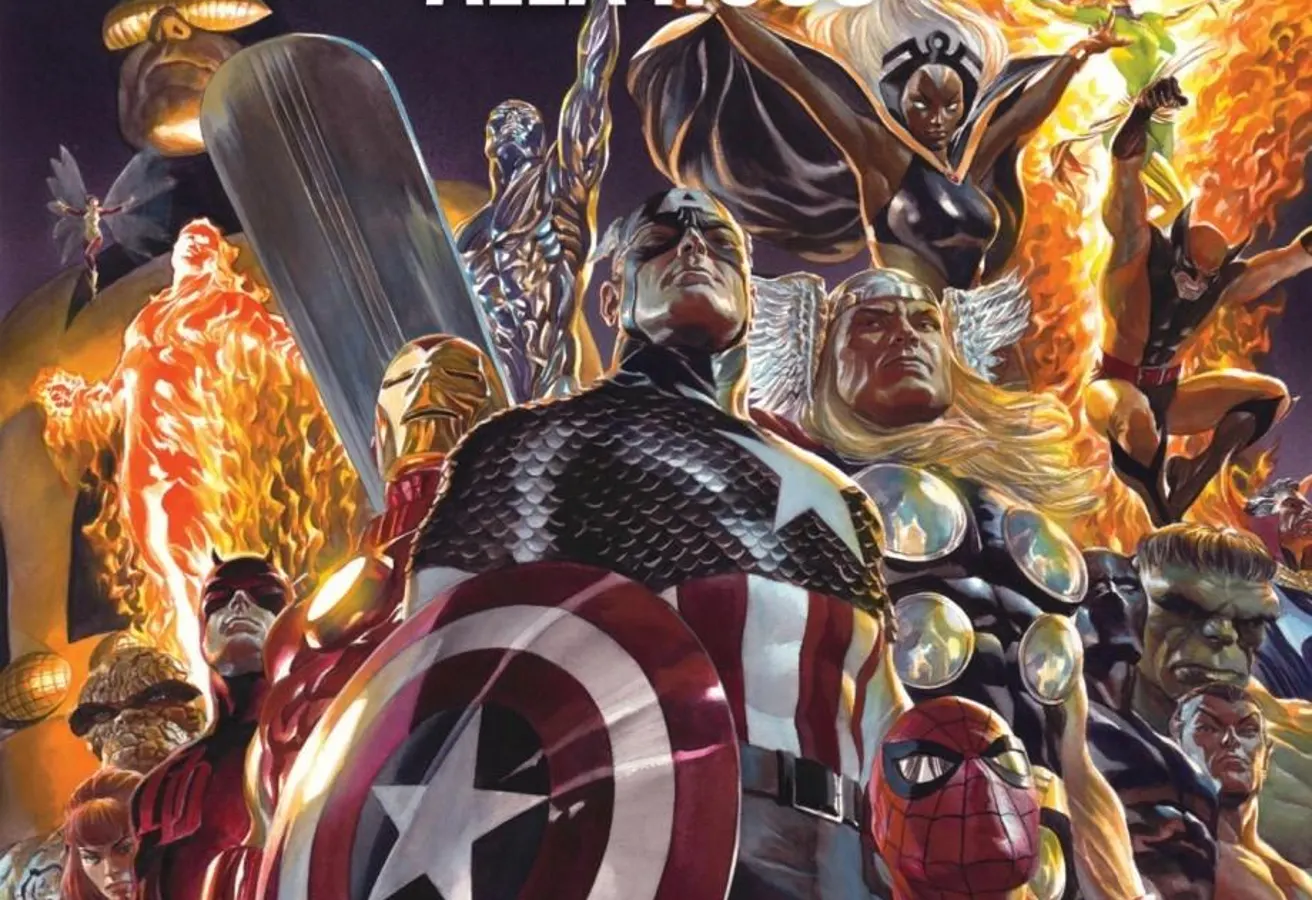

Cover art for ‘Marvel Dimensions’
Courtesy of Marvel/Abrams Books
Alex Ross’s Marvel Dimensions defies definition in a lot of ways.
The first 40-ish pages recap origin stories for Marvel’s most famous heroes, villains, and teams (depicted via Ross’s renowned painted style) before segueing into something else entirely.
“Basically, it was two separate project ideas I combined into one,” Ross told me over a recent Zoom call. “But it’s an intentionally misleading product. When you look at the cover of my book, if it reminds you of something else I’ve painted before, that’s intentional.”
“You give fans what they want, or thought they wanted, and then it becomes something else,” echoed Dimensions editor Charles Kochman. “This book is filled with surprises; turns and subversions of formats; characters and narrators. Alex dreamed big this whole universe and then pulls it all together in a way that all makes sense, but not what you expect from the very beginning … We had a meeting with the larger Marvel team and one of the executives commented that a book like this comes around once in a decade.”
In particular, the Marvel Dimensions cover is meant to evoke Ross and Paul Dini’s JLA: Secret Origins, which explored backstories for the members of DC’s Justice League of America. And just as he did there, Ross impressively distills each character into a handful of panels.
“I wanted to pull back and say, ‘Here are the most essential things to know about them,’” shared the writer/illustrator. “So I didn’t rewrite anybody’s history. I gave you things that often are forgotten, [but also] essential to understanding them.”
Interestingly, Ross doesn’t go for an objective retelling in every case. Spider-Man, The Incredible Hulk, and Doctor Strange, for example, have their tales imparted by J. Jonah Jameson, General Thaddeus “Thunderbolt” Ross, and the Ancient One, respectively. “I want to give a perspective that existed before, [but was] forgotten about these characters,” said the non-general Ross. “Put it back to where these things had begun and give a little bit of a cynical take without rewriting history.”
He also wanted to keep the scope relatively focused, which meant none of the newer Marvel characters—like, say, Deadpool—would be featured.
“I don’t hate Deadpool, but he’s a ‘90s character,” Ross reflected. “And if you’re born as long ago as I was, this all seems very fresh. These are the new-kid characters I’m not working with. I’m representing a Marvel that formed my youth. That was mostly invented in the 1960s and ‘70s, which defined my take here.”
Cover art for ‘Marvel Dimensions’
Courtesy of Marvel/Abrams Books
But where JLA: Secret Origins stuck exclusively to…well origins, Marvel Dimensions goes a step further with a 32-page comic (rendered with pen and ink), set in what might be the darkest and morally reprehensible, yet most fascinating, version of the Marvel Universe ever imagined.
“I was given a lot of faith,” noted Ross. “Enough rope to hang myself with.”
If the mainstream continuity is a tall glass of ice-cold milk, then his parallel reality (cleverly dubbed “The In-Verse”) is a nauseating puddle of sour curds and whey.
Ross confessed he had “tremendous fun” creating this abominable reflection of the Marvel Universe, which utilizes exaggerated caricatures “as a commentary upon either the characters themselves or upon the world [we] live in,” explained the writer/illustrator “We’re in a very weird place in our own history to say, ‘What do we consider bad anymore with what we accept today?’ And so, the corruption of power is a rumination that this study of these characters brings to forth.”
He continued: “I like to get into a space where you are trying to use the medium of communication of the arts as a way to communicate real thoughts and observations of ourselves. And so, a comment about superhumanity is a close cousin to a comment about humanity in general.”
Ross doesn’t have any current plans to write another “In-Verse” story, but is certainly open to the idea, should fans respond positively to Dimensions.
“Stuff I did over at DC with Kingdom Come is regularly brought up amongst their various worlds of universes and futures of their characters and such,” he mused. “I would hope this sees the same kind of treatment and appreciation over time.”
If the sudden appearance of a comic book in the middle of another tome feels jarring to you, then good—that’s exactly what Ross had in mind.
“You’re actually demanded to read it,” he stressed. “If you don’t read it, nothing’s going to make any sense to you. But the fact that it changes art style and format mid-story is meant to be a destabilizing influence that makes you feel like, ‘What am I getting?!’ [We’re] hoping people will go down the rabbit hole with us.”
Added Kochman: “It’s what you hope to be a Sixth Sense kind of moment, where you’ve got to reexamine everything that came before and realize the narrator is different, the characters are different, the agenda of the narrator is different.”
Comic book artist Alex Ross at Comix Revolution on Sept. 6, 2022, in Evanston. Ross wrote and illustrated the new Marvel Comics hardcover graphic novel “Fantastic Four: Full Circle”. (Erin Hooley/Chicago Tribune/Tribune News Service via Getty Images)
TNS
The book’s disparate elements are held together via a framing device centered around X-51 (a.k.a. Machine Man), the android chosen to replace Uatu as Watcher of Earth in Ross and Jim Krueger’s Earth X limited series.
Said Ross, “Instead of trying to go through the omniscient alien narrator of The Watcher, whom I don’t find charming and wouldn’t want to sit and listen to, the humanistic way this artificial intelligence relates to us is just how human he is being and views this stuff. And, of course, he becomes a personal mouthpiece for the author.”
On a macro level, Marvel Dimensions represents the intended goal of Ross’s Marvel Arts line launched in partnership with Abrams ComicArts: “original graphic novels by visionaries.”
“We wanted to seek out the best talent and give a space for them to tell a longer form story that doesn’t have to be a miniseries or folded into the general mythology and chronology of Marvel’s books,” Ross explained. “It could stand apart. It could be from a different time period. It could be a whole other universe take on their properties. We’ve got a myriad number of projects in development with really great artists and writers, who are going to bring some of the things they wouldn’t really get a chance to do in the mainstream to light with us here.”
While Marvel Arts isn’t only limited to creatives who can write and illustrate simultaneously, getting them on board is certainly a priority.
“We’re really focusing on people with a unified vision for their work,” concluded Kochman. “When you have having a writer and an artist [working separately], you have to be on the same page and merge those visions for what that story could be. I like that this line is, with some exceptions, focusing on the writer/artist. I think that becomes a pure narrative; it becomes a pure comic book experience of the singular vision of a creator and we really do want to highlight those creators.”
Marvel Dimensions is now on sale from Abrams ComicArts














Leave a comment