


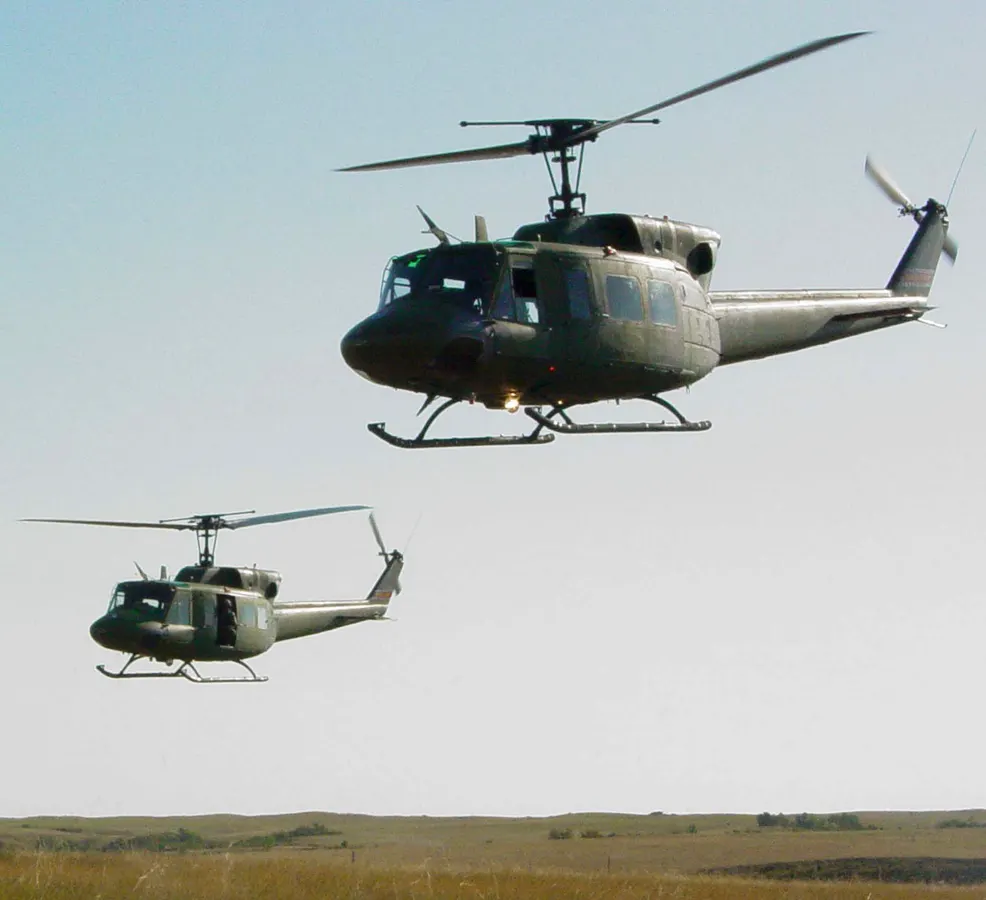

Two U.S. Air Force UH1-N Huey helicopters fly over the prairie during a training exercise in 2004. The Air Force Global Strike Command is divesting its Hueys and replacing them with the MH-139A Grey Wolf. (Photo by Katie Booher/U.S. Air Force via Getty Images)
Getty Images
The UH-1N Huey helicopter, first fielded in the closing stages of the Vietnam War, is vanishing from the U.S. Air Force Global Strike Command after decades of service in what marks the definitive end of the era for a military icon.
Part of the legendary family of Huey helicopters manufactured by Bell, the UH-1N entered Air Force service in 1970 and deployed in search and rescue missions in Vietnam shortly before the war ended.
The light-lift utility helicopter became a hallmark of Cold War operations and has held a leading role in protecting U.S. nuclear weapons convoys and arsenals, including providing security for transports of intercontinental ballistic missiles, or ICBMs.
New Nuclear Guardians
A 582nd Helicopter Group MH-139 Grey Wolf lands at Launch Facility E-10 near Pine Bluffs, Wyoming, Feb. 19, 2026. The MH-139 Grey Wolf is part of Air Force Global Strike Command’s helicopter modernization effort to replace the UH-1N Huey and enhance security response, convoy escort and airlift capabilities across the intercontinental ballistic missile enterprise. (U.S. Air Force photo by Staff Sgt. Michael A. Richmond)
U.S. Air Force
The Air Force Global Strike Command chose the MH-139A Grey Wolf manufactured by Boeing to replace the Huey.
“The modernization of our helicopter fleet with the MH-139A Grey Wolf is a critical investment in the bedrock of our national security. The intercontinental ballistic missile force, the land leg of the nuclear triad, remains the most responsive and stabilizing component of our strategic deterrent,” an Air Force Global Strike Command spokesperson told Forbes.
“The MH-139A Grey Wolf does not carry nuclear weapons. Its primary mission is securing and supporting the ICBM fields,” the spokesperson said.
“The aircraft provides armed aerial overwatch, escorts Minuteman III maintenance and security convoys, and serves as agile transport for Tactical Response Force teams tasked with defending our launch facilities.”
What Can the Wolves Do?
A U.S. Air Force MH-139A Grey Wolf helicopter, from the 908th Flying Training Wing, is equipped with modern technology, such as the FLIR, enhancing situational awareness and mission effectiveness. (U.S. Air Force photo by Senior Airman Kamiyah Burks)
U.S. Air Force
The Wolves completed their first mission as ICBM convoy guardians in January, protecting a column traveling to and from missile facilities across over 100 miles without needing to refuel for six hours.
The Air Force announced that the Wolves achieved official operating capacity on August 10, marking the final chapter for Hueys still flying and opening new doors to air crews in terms of security and mission capabilities.
The Grey Wolf vastly outpaces the Huey in terms of speed, range and overall uses. It flies over 50% faster and can cross vast distances without needing to refuel, giving it distinct tactical advantages. It also has better safety features to protect air crews.
Moreover, the Grey Wolf can carry nearly double the amount of personnel and gear than a Huey and is armed with state-of-the-art modern weapons systems, including technology suitable for targeting and destroying drones.
“The vast area of responsibility for our missile wings spans tens of thousands of square miles. The Grey Wolf fundamentally upgrades our ability to rapidly mass combat power across a dispersed footprint,” the spokesperson explained, adding that “the integrated digital cockpit, sensors, and robust communications networks seamlessly link aircrews with ground forces for unprecedented situational awareness.”
Overhauling Nuclear Launch Sites
The Minuteman III intercontinental ballistic missile was first fielded by the Air Force in 1970. ICBM launch sites are now being overhauled, requiring new protection from the air. (Photo by: HUM Images/Universal Images Group via Getty Images)
HUM Images/Universal Images Group via Getty Images
While change sometimes comes slowly in replacing military aircraft, this transition from old to new is being carried out at a determined pace due to the urgent priority of nuclear security.
It occurs amid a profound shift in U.S. land-based nuclear weapons. The time-honored Minuteman III ICBM – which the Air Force also debuted in 1970 – is ageing out.
This vital nuclear striking weapon is being replaced by the modernized LGM-35A Sentinel. Fielding the new guided missile requires an overhaul of U.S. nuclear missile launch sites.
Wolves are deploying rapidly to protect U.S. nuclear weapons and technology during this critical transition phase, according to information disclosed by the Air Force.
Twilight Of the Hueys
A MH-139A Grey Wolf helicopter flies between two UH-1N Hueys to Malmstrom Air Force Base in January 2025. (U.S. Air Force photo by Senior Airman Mary Bowers)
U.S. Air Force
The transition from Hueys to Wolves is actively underway throughout the Global Strike Command. Progress is farthest along at Malmstrom Air Force Base in Montana, which is now completely fielding Grey Wolves.
The command has begun retiring the legacy Hueys at Malmstrom and expects to fully divest them soon, the spokesperson said.
Two Grey Wolves have already arrived at F.E. Warren Air Force Base in Wyoming, with more on the way continuing into next year. Minot Air Force Base in North Dakota will receive the first of its pack of Grey Wolves next year.
“We are employing a phased approach to fielding the new helicopters and divesting the legacy Hueys to ensure seamless mission continuity,” according to the spokesperson.
“Ultimately, AFGSC will continue a deliberate, phased retirement of the remaining UH-1N fleet over the next few years.”
Larger Demands for Modernization
A U.S. Air Force MH-139 Grey Wolf conducts its first operational mission guarding nuclear weapons convoys in Montana in January 2026 to strengthen nuclear deterrence operations. (U.S. Air Force photo by Airman 1st Class Jack Rodriguez Escamilla)
U.S. Air Force
While the UH-1N Huey earned a proud place in U.S. military history throughout half a century of active service, the changing conditions of warfare is hastening its retirement.
“It has been a distinct privilege to watch the iconic Huey faithfully support our global operations throughout my entire career,” said U.S. Air Force Col. Bryant Bevan, commander of the 582nd Helicopter Group, in a statement, noting that the change “represents a critical leap forward.”
Replacing the Huey signifies growing demand for technological modernization throughout all branches of the U.S. military as the advances of industry outpace the capabilities of inherited weapons systems.
When it comes to protecting national nuclear technology, the importance of getting reliable and updated equipment into the field cannot be underestimated.
“Our core mission at Air Force Global Strike Command is to provide a safe, secure, and credible capability that directly underpins the National Defense Strategy,” the spokesperson said.
“By helping to secure these widespread assets, the Grey Wolf reinforces the credibility of our ICBM force and promotes global stability.”














Leave a comment