


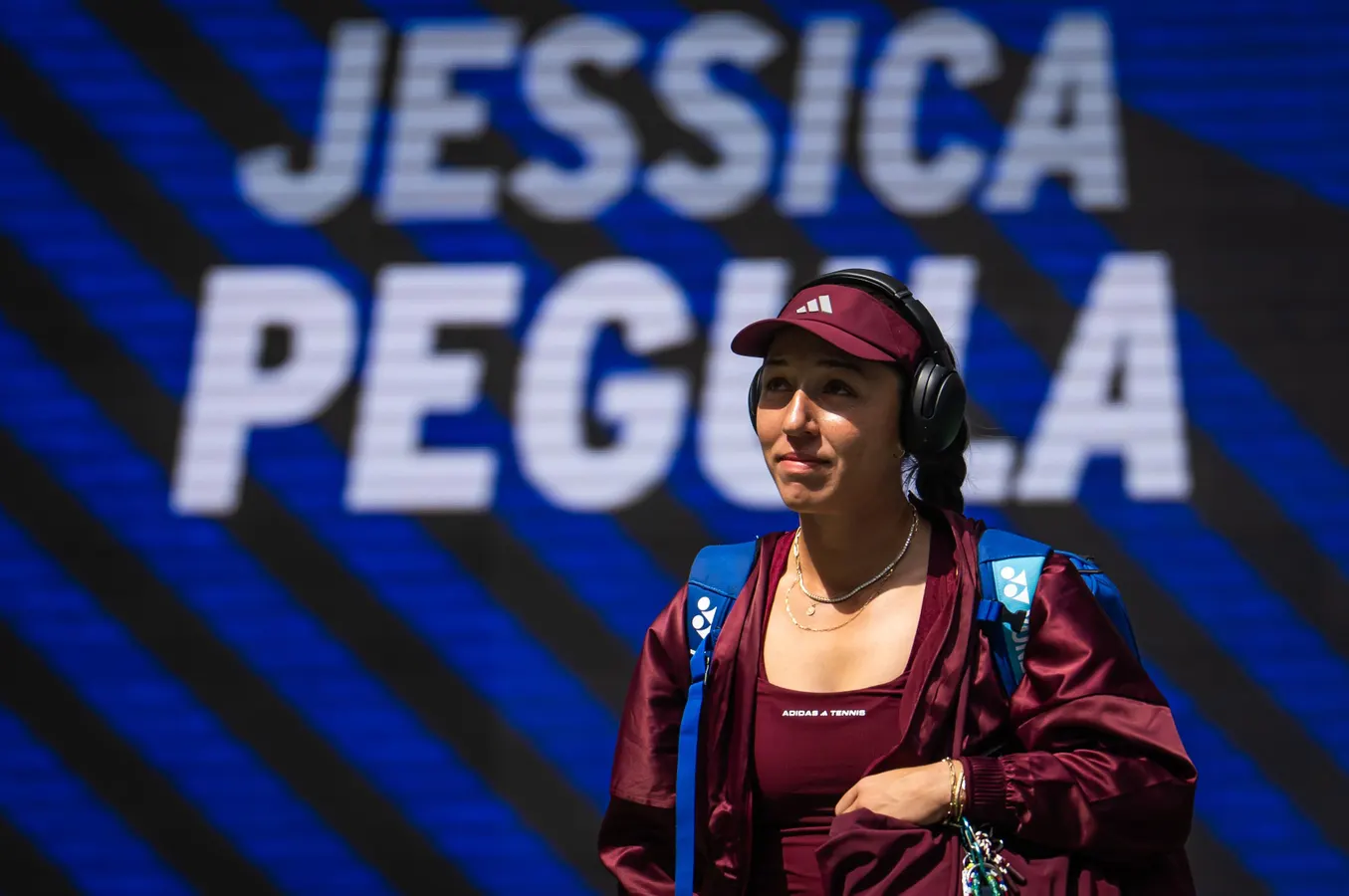

Jessica Pegula of the United States walks onto the court in the first round on Day 1 of the US Open at USTA Billie Jean King National Tennis Center on August 30, 2026 in New York City (Photo by Robert Prange/Getty Images)
Getty Images
Jessica Pegula hovers at the top of the tennis world, extending her reign in the top five as she competes in the 2026 U.S. Open. Analytics offers one of the many tools that gives her an edge. “You can’t argue with data,” Pegula tells me before taking the court in New York. “You are always going into a match looking at what your opponent is doing.”
Pegula, partnered with IBM, has become the face of the brand’s continued effort to promote its analytics-driven fan-facing apps—for the 2026 U.S. Open, IBM announced a Key Moments feature that highlights each match’s turning points and a new Serve Quality metric that features an AI-powered tool and advanced limb-tracing technology to analyze precise mechanics of every serve with 21 data points to generate a Serve Quality score—but all that data helps Pegula on the court.
“I look at the Key Moments, when the momentum is shifting,” she says. That’s when she can really start to understand trends, whether her opponent’s or even her own. Monitoring an opponent’s serve is an easy one. She wants to know their serving patterns, but especially their patterns in certain moments. “I like to look at their tendencies, where they like to serve when the score is a certain way,” she says. She tracks where they serve when winning, or what their favorite serve is when they are down and need a point. In tight matches, she says, knowing a player’s pattern may help anticipate the next ball and earn her a key point.
“In those moments,” she says, “I am really leaning on tendencies through analytics.”
Sometimes she turns the data around. “I use it for myself, to see what patterns I’m stuck in. Sometimes as players you don’t realize what you are doing,” Pegula says. “Of course, I use it to see what my opponent is doing. You always try to find the balance.”
MORE: U.S. Open 2026 Food Scene Debuts New Concepts From Famed Chefs
By looking at specific points in a match, Pegula can get deeper insights. “Where do they like to return off certain serves? How is someone serving against you on big points? You want to neutralize the serve in some way,” she says.
Mining the data becomes even more important when facing someone less familiar. “When you play someone frequently, they maybe are trying to change things,” she says. “When it is someone you haven’t played before you look at what their patterns are and what they like to do. It can take a lot of the guessing out of someone you have never played.”
Pegula says analytics has really grown in popularity and it offers an easy tool that everyone is using. Still, there’s a balance. She wants to walk into a match as prepared as possible but doesn’t want to overthink decisions so she can trust her gut.
MORE: Tennis Helps Drive Asics’ First NYC Sportstyle Popup
When scouting, Pegula does her own work. “I like to get a feel for it,” she says, “to see some patterns, what I feel they are going to do.” Her coaching team dives deep into the data, and then they get together to bounce ideas off each other.
After matches, Pegula spends more time on herself, looking at her own tendencies. “Why was I doing that? Was it strategy, or was I not feeling comfortable? Maybe I need to practice something that is uncomfortable for me,” she says, “so I don’t become too predictable.”
















Leave a comment