


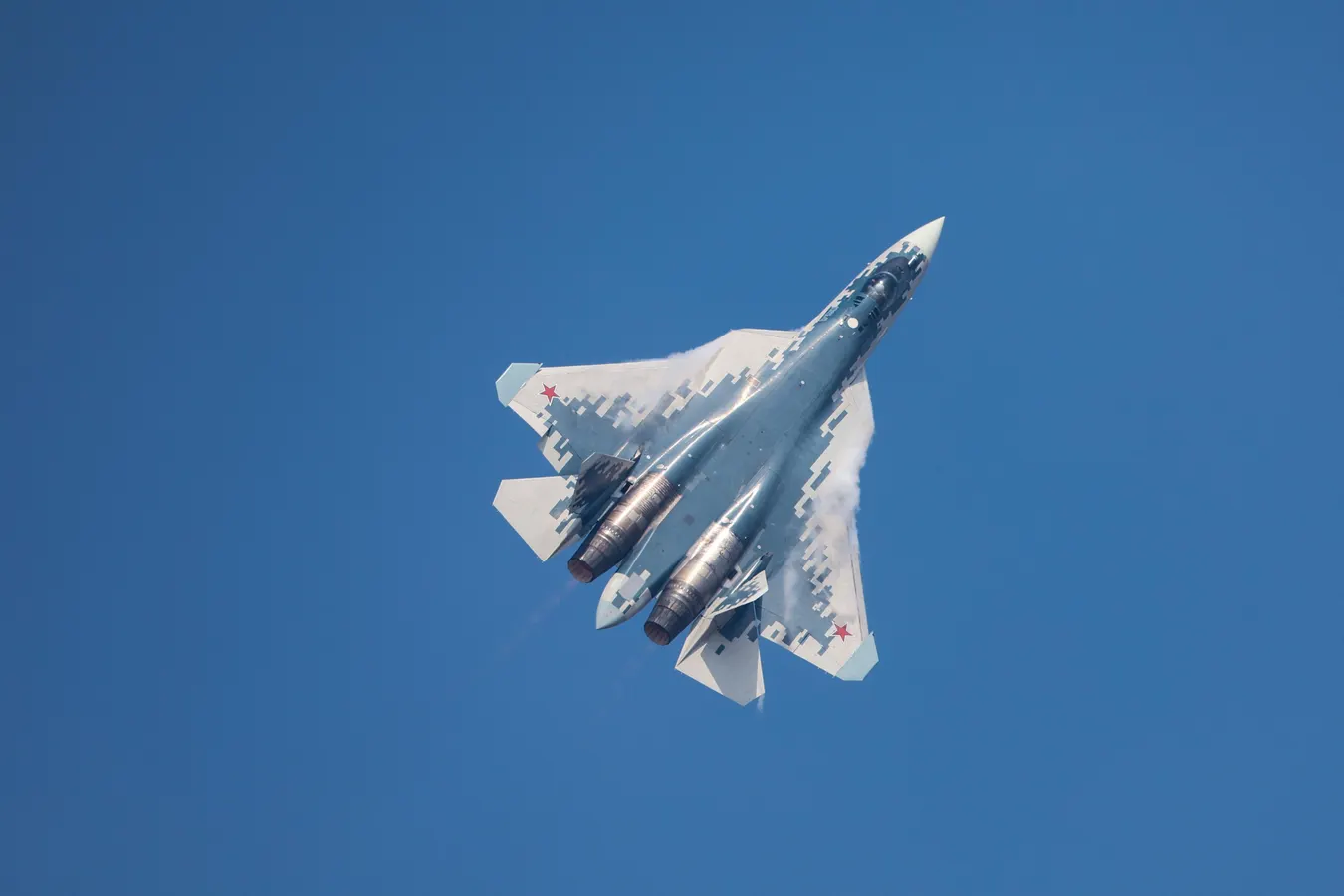

The Russia’s Sukhoi Su-57 stealth fighter jet performs in the sky during the 15th China International Aviation and Aerospace Exhibition, or Airshow China 2024, on November 12, 2024 in Zhuhai, Guangdong Province of China. (Photo by VCG/VCG via Getty Images)
VCG via Getty Images
Russia’s Sukhoi Su-57 (NATO reporting name “Felon”) has dazzled attendees at international air shows since it made its public debut at the MAKS-2019 International Aviation and Space Show seven years ago this week. At that expo, which was held in Zhukovsky, near Moscow, Russia, Rostec chief test pilot Sergey Bogdan flew an aggressive aerial flight demonstration that drew worldwide attention. Since then, the Su-57 has been a favorite at such events.
Unfortunately for Rostec and its export subsidiary, Rosoboronexport – the sole state intermediary agency for Russia’s defense-related exports and imports – the air shows have resulted in increased sales of the fifth-generation stealth fighter.
Yet, on Thursday, Rostec announced that the Su-57E, the export model that is reportedly “equipped with advanced weaponry” never before demonstrated, will be unveiled at the upcoming El Alamein International Airshow 2026 in Egypt.
“As part of the flight program, the aircraft will perform aerobatic maneuvers,” Rostec, the Russian state-owned military industrial conglomerate, said in a statement to TASS.
“Now this aircraft is also conquering export markets,” the statement continued. “Deliveries are already underway to foreign partners who fully understand the advantages of this aircraft. New variants of the fighter are becoming even more effective and formidable. In Egypt, we are presenting an export version with entirely new armament, on display for the first time.”
Foreign Buyers Are Far And Few Between
To date, Algeria is the only confirmed international buyer and future operator of the Su-57E. There are reports that initial deliveries have begun and Algerian pilots are now being trained in Russia.
Still, Algiers’ program of record is for just 14 Su-57Es, worth roughly $2 billion. It is hardly a sizeable order, at least considering the hundreds of Lockheed Martin F-35 Lightning IIs that are now operated by more than a dozen nations around the world.
There is speculation that Kazakhstan, a former Soviet republic and the last one to officially declare its independence from the USSR, could also be on track to adopt the Russian-made stealth fighter. The Central Asian nation already exclusively operates Soviet/Russian-made combat aircraft, and Astana retains close ties with Moscow.
Both Russia and Kazakhstan are members of the Collective Security Treaty Organization (CSTO) and have signed a comprehensive alliance. In addition, the countries share a 4,500-mile land border, and Kazakhstan relies heavily on Russian transit routes for its oil and trade, with both being members of the Eurasian Economic Union (EAEU).
One reason such a deal might not happen is that Kazakhstan has been actively diversifying its partnerships, which has included greater economic and diplomatic ties with China, the European Union, Türkiye (Turkey) and the United States, as it seeks to safeguard national sovereignty.
However, Astana must see that there is no path forward to the Kazakhstan Air Force ever operating the F-35 Lightning II, as Washington would never approve such a deal. Beijing has been making inroads in Central Asia, selling aircraft to two other former Soviet republics. That included J-17 Block 3 fighters to Azerbaijan and J-10C combat aircraft to Uzbekistan. The modern Chinese aircraft replaced the legacy MiG-29s that each former Soviet republic had inherited nearly 35 years ago after the end of the Cold War.
Beijing has touted its J-35 fifth-generation fighter as a lower-cost alternative to the Lightning II in emerging markets.
Rostec Looking To Africa And the Middle East
Even as Russia may already be offering the Su-57E to Kazakhstan, next week’s expo will be an opportunity for Rostec to connect with states in Africa and the Middle East.
The inaugural El Alamein International Airshow was held in September 2024 at the Egyptian coastal city’s international airport. This year marks just its second edition, but it is fully supported by the Egyptian Ministry of Defence, Egyptian Air Force, Ministry of Civil Aviation, and the Egyptian Space Agency.
Rostec and Rosoboronexport are likely to come away disappointed again.
It is unlikely that Egypt would ever consider the Su-57 as it seeks to maintain good relations with the United States. Given the per-unit cost of $140 million, most sub-Saharan and regional African nations simply don’t have the money to buy the aircraft. Beyond the upfront investment, operating an advanced stealth fighter requires sophisticated infrastructure, specialized pilot training, and continuous logistical support that only a handful of well-funded continental militaries can support. That explains why the F-35 has been primarily adopted by nations in Europe, along with Japan, South Korea and Singapore.
Algeria remains one of the largest military spenders in Africa, fueled by substantial oil and gas revenues and further supported by a heavily modernized, Russia-aligned defense budget.
Morocco, its neighbor and regional rival, could be the first African nation to adopt the F-35 Lightning II.
The situation may be no better for Rostec in the Middle East, as few nations may risk the ire of Washington by adopting the Su-57, and many are likely holding out hope for the F-35 instead.
India Has All But Slammed The Door On The Su-57
Russia has repeatedly courted India, but this summer Defence Secretary Rajesh Kumar Singh confirmed that New Delhi will not pursue new Sukhoi variants. That announcement followed offers of co-production and technology sharing opportunities.
That leaves Russia with few options for its aircraft.
Yet, we can likely expect it to continue to fly at international air shows. That seems to be what the Su-57 does best. At least when it isn’t being mocked on social media!
















Leave a comment