


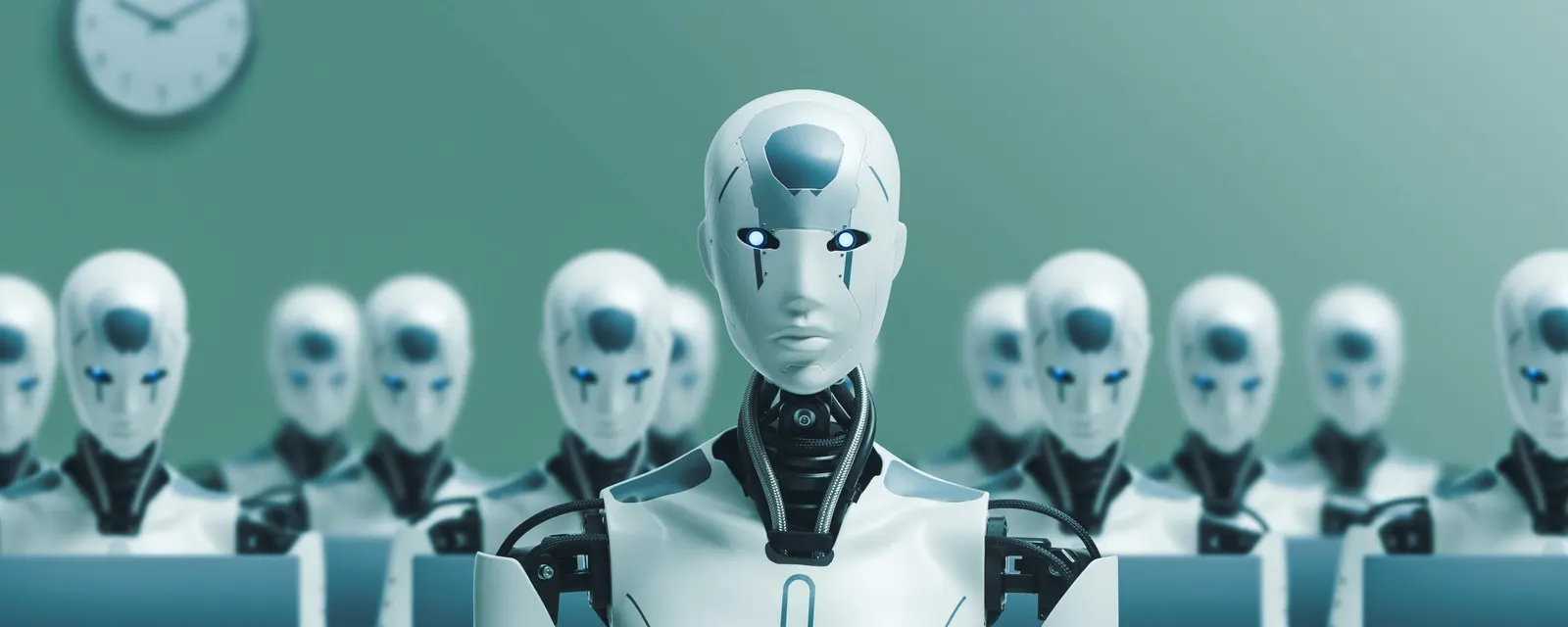

OpenAI CEO Sam Altman confirmed that the company is building a humanoid robot, not just the physical AI to power it.
getty
OpenAI is building a humanoid robot, CEO Sam Altman confirmed. Asked on the Sources podcast whether the company’s robotics push meant it was pursuing a humanoid or a data-center machine, he didn’t hedge. “Both,” he said. “We will definitely do a humanoid. We will do other form factors as well.”
But Altman seems to think making robot bodies is easier than making great physical AI to drive them. “I think all of that is less important than really figuring out like the brain that makes the robot work,” he added.
This is a significant step in the humanoid-robot space and the AI space.
We officially have one of the two companies with the most capital, the most compute and the most credibility in AI deciding that owning the brain is not enough, and that building bodies of physical robots is critically important.
It’s also a shot across the bow of hundreds of robot companies. Many of them are buying or partnering for at least some of their physical AI and robot brains. That’s the entire premise of Nvidia’s GR00T reference design, Google’s Gemini Robotics running on Apptronik, and Boston Dynamics hardware, among others, and of Skild’s omni-bodied pitch.
If the best brain suppliers also build bodies, the partnership model gets a lot more challenging. Figure AI worked this out early: OpenAI invested in Figure’s $675 million round in 2024, but Figure CEO Brett Adcock exited the collaboration a year later to build in-house.
The Case For The Humanoid Form Factor
Altman’s reasoning for going human-shaped is pretty standard: It’s a human world, so you want at least some of your robots to be shaped like humans.
OpenAI CEO Sam Altman said “I think everyone should have a personal robot.”
Getty Images
“The world is very much designed for people,” Altman said. “So if you think about like the ability to open a door and type on a computer and drive a piece of equipment and, you know, clean a kitchen and whatever else, we’ve kind of built this world for people, and I want to make sure that we keep building this world for people. So matching that form factor seems good.”
On whether that ends in a robot in every home, he was more cautious, though ultimately bullish on home humanoids.
“I don’t think that’s the most important first thing to do,” he said, acknowledging that infrastructure and manufacturing come first. “But yes, someday. I think everyone should have a personal robot,” he said.
That’s aligned with recent predictions from Agile Robots CEO Zhaopeng Chen and Tesla’s Elon Musk. Chen recently said humanoid robotics could eventually become 10 times the size of today’s automotive industry: Families typically own one or two cars and, eventually, he thinks every individual could have a humanoid. And Musk told G20 leaders that there could be a billion robots operating on the planet within 10 years.
Altman May Be Right That The Brain Is The Hard Part
Gill Pratt, CEO of the Toyota Research Institute and the former head of DARPA’s Robotics Challenge, has said that only half the brain is solved — the fast, reflexive pattern-matching — and that the field risks dipping deep into a trough of disillusionment if we don’t crack reasoning and world models.
At least some investors agree. Skild AI raised $1.4 billion in January at a valuation above $14 billion, led by SoftBank with Nvidia, Bezos Expeditions, Samsung and LG with a promise to build an “omni-bodied” brain that Skild co-founder Deepak Pathak says “can control robots it has never trained on.”
Physical Intelligence is running a similar play with π0.7. Google DeepMind shipped Gemini Robotics 2 on July 30, running on Apptronik, Boston Dynamics and Franka hardware.
And on May 31 — the same day Altman announced OpenAI Robotics was hiring — Nvidia published an open reference humanoid design built on a Unitree chassis.
But Nvidia, DeepMind and Skild are not manufacturing humanoid robots, or robots of any kind. For them, the robot itself is somebody else’s problem, and they’re focusing on intelligence.
There Is A Counter-Argument
Remember Musk’s billion-robot prediction? Tesla began producing its Optimus humanoid robot in its Fremont facility around August, five years after the program was announced, on converted Model S/X manufacturing lines. But no customer units have shipped. In January, Musk conceded no Optimus robots were doing useful work inside Tesla’s own factories and that Tesla missed the target of shipping roughly 10,000 units in 2025.
On the most recent earnings call, Musk called Optimus, “the hardest product to scale manufacturing that we’ve ever made,” adding that everything on the robot is new, requiring an entirely new supply chain.
That’s one of the world’s most capable manufacturers of complex hardware saying that building robot bodies is brutal.
McKinsey’s data backs him: Actuators are 40-60% of bill-of-materials cost, harmonic drives and precision roller screws face severe supplier concentration, and China controls roughly 69% of rare-earth mining and about 90% of magnet processing. Building advanced robots without Chinese suppliers would run about $131,000 against a $46,000 BOM, estimates OpenMind.
But there’s something else going on here too. It’s hard to make great physical AI without also making actual robots.
OpenAI killed its robotics project in 2021 because it couldn’t get enough data. Building and operating your own robots is the most direct route to the kind of data— physical interaction, failure, correction, consequence – that you desperately need to improve physical AI. Humanoid robots aren’t only a product. They are a data collection device, something that Hexagon Robotics, which has a contract to put 1,000 of its Aeon robots in Schaeffler factories, knows very well.
The huge benefit of robot training data that comes from robots themselves is that it is accompanied by the robot’s whole sensorium: what it was doing, how hard it gripped, what moved, and so on. As Hexagon president Arnaud Robert told me Thursday, high-quality robot training data is essential.
Figure AI CEO Brett Adcock made a similar argument when Figure walked away from its OpenAI collaboration in February 2025: “We found that to solve embodied AI at scale in the real world, you have to vertically integrate robot AI. We can’t outsource AI for the same reason we can’t outsource our hardware.”
OpenAI’s Job Listings Present A Slightly Different Picture
If the brain is what matters and the body is secondary, the path is obvious: License a chassis, ship your model and skip the manufacturing slog. Nvidia will hand you a reference design for free, just inject your AI.
That’s not exactly what OpenAI is doing.
Its careers page currently lists 19 open robotics roles, all in San Francisco, up from 11 when the division launched at the end of May. Four are actuator-specific, plus a dedicated technical program manager for actuators. The company is looking for experts in actuator design, actuator electromagnetic design, actuator gear design and test infrastructure. And there’s a design role for a new hire to own custom electromechanical actuators end-to-end — motors, transmissions, sensing, thermal architecture — optimizing torque density and manufacturability, and to work with manufacturing partners on production-ready designs. The listings also include a PCB layout engineer, a thermal simulation lead, firmware, a prototyping technician, an inventory manager and a commodity manager.
Nobody designs their own electromagnets and gear trains because the body is the easy part. Actuators are one of the most expensive and most supply-constrained components in a humanoid. OpenAI is buying pretty much the expertise Musk says is the bottleneck. And Altman is building the bones of a hardware company, not just an AI research group.
A Note Of Caution: What OpenAI Hasn’t Said
There is no ship date, no unit target, no named manufacturing partner and no prototype. Altman gave TIME a firm window for the Jony Ive tabletop device — early 2027 — but gave the OpenAI humanoid project nothing but “definitely.”
So there’s some room for skepticism here.
But Altman’s comments have to make everyone in robotics sit up and notice. OpenAI, the maker of ChatGPT, is the company primarily behind the vast infusion of AI into our world over the last few years. The company has amassed a huge amount of expertise and credibility here, and its expansion into robotics has to be worrying competitors.
But they are not slowing down.
Global humanoid shipments hit roughly 19,100 units in the first half of 2026, up 272% year over year. Chinese vendors account for more than 97% of the total, and American and European robot makers are coming out with newer and more impressive models.
None of them are waiting for anyone’s brain. Or for OpenAI to steal their hardware lunch.
















Leave a comment