


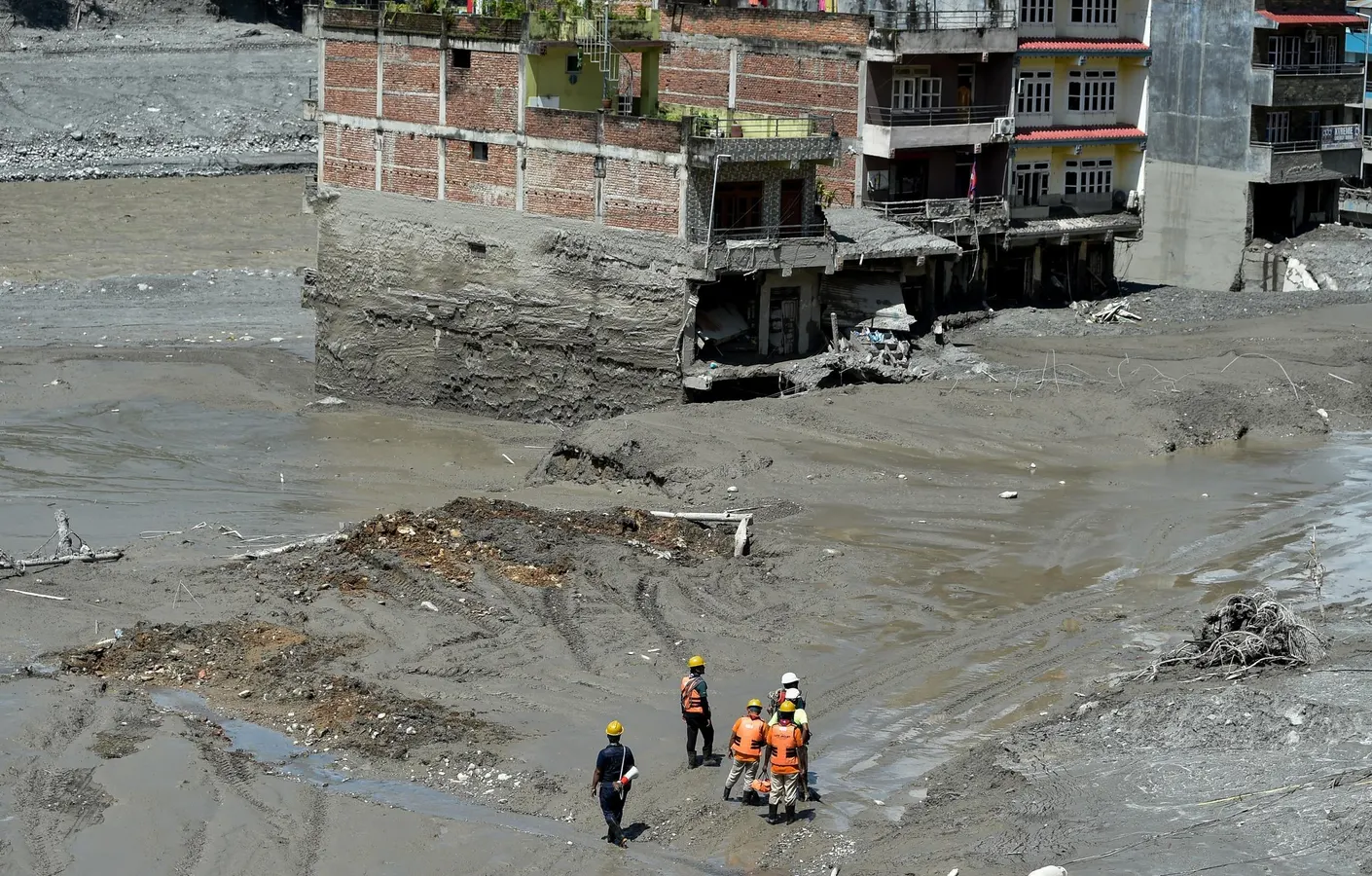

TRISHULI, NEPAL – AUGUST 27: Rescue workers and Nepal police search through mud and debris following devastating flash flood on August 27, 2026 in Trishuli Dam, Nepal. (Photo by Ritesh Shukla/Getty Images)
Getty Images
Rajendra Dawadi was in his classroom in Bidur, Nepal, on the morning of August 26 when a colleague rushed in with a warning: floodwater was tearing through the Trishuli Valley, ripping apart homes and bridges upstream. He didn’t wait to confirm it. He rang the school bell, sent roughly 900 students toward high ground, and turned back a busload of children just before the old bridge it would have used collapsed. The three-story school was swept away within the hour.
Many of Dawadi’s countrymen weren’t so lucky. Part of a glacier had sheared off Langtang Lirung peak near the China border, sending a wall of water, ice, rock and debris down the Trishuli and Bhotekoshi valleys. As of this week, more than 1,250 people are confirmed dead, and over 4,200 remain missing, according to Nepal’s disaster management authority. Twelve thousand homes are gone. Roughly 1.6 million people have been directly affected.
The money that was supposed to help countries like Nepal anticipate and absorb disasters like this one has not arrived, not in time and not in anywhere near sufficient amounts. Nepal’s flood is a preview of what happens to the rest of the developing world if that doesn’t change.
“Nepal is paying the price of global warming where our contribution is less than 0.1%,” Sujeeta Mathema, executive director of ActionAid Nepal, told me.
I’ve covered this argument since wealthy nations first made it official, at the 2009 Copenhagen summit, when then-Secretary of State Hillary Clinton pledged that rich countries would mobilize $100 billion a year in climate finance by 2020.
I’ve heard the same frustration from officials across the Global South ever since, at COP after COP: the number kept getting “met” on paper while the money on the ground stayed thin. The OECD says that the $100 billion goal was finally reached, two years late, in 2022. Oxfam and CARE, stripping out loans and inflated development aid, put the real grant-equivalent value closer to $20 billion to $35 billion a year.
The Money Is Drying Up
TOPSHOT – A woman cries after being rescued at an army camp following flash floods, in Battar Bazar town in Nepal’s Nuwakot district on August 28, 2026. (Photo by PRABIN RANABHAT / AFP via Getty Images)
AFP via Getty Images
Nepal’s flood isn’t teaching the world anything it didn’t already know. It just underscores the exasperation.
“The international community has failed Nepal,” Brandon Wu, director of policy and campaigns at ActionAid USA, told me. Wu spent 15 years working inside institutions like the Green Climate Fund (GCF) and now the newer UN Fund for Responding to Loss and Damage (FRLD)—the plumbing meant to move money from wealthy, high-emitting countries to poorer, climate-exposed ones. “We know that disasters are going to happen, and how to build resilience to them, but there’s not enough money, and that money is moving too slowly.”
The numbers back that up. Nepal has nearly 2,000 glacial lakes, 21 of which scientists have flagged as dangerous. The GCF has approved a $36.1 million grant—part of a $49.9 million package once co-financing is included—to reduce risk at four of the highest-risk lakes through early-warning systems, reforestation, and protective infrastructure.
As of this summer, just $9.2 million of the GCF’s $36.1 million grant—about 26%—had actually been disbursed, according to the fund’s own project records. A week before the flood, Nepal had separately asked a UN technical body for help with glacial lake risk. The request arrived too late to matter.
Then there is the FRLD, created specifically to help countries recover after climate disasters strike. As of this summer, that loss and damage fund had roughly $250 million actually available to disburse against $3 billion in requests already in the queue. Nepal’s flood just adds to the total. Total pledges to the fund remain under $1 billion. The U.S. contribution to date: $17.5 million. Washington’s initial disaster aid pledge to Nepal itself was $500,000.
What relief money has arrived, Mathema says, is largely structured as loans, not grants—debt Nepal will carry for a disaster it did nothing to cause.
Nepal itself is a small, climate-exposed economy. Its roughly $43 billion GDP leans on agriculture and forestry, services and tourism, and above all remittances from citizens working abroad, which the country’s central bank now estimates at around a third of GDP—one of the highest such shares in the world.
Textiles and other agricultural commodities are its main exports. National electricity access is around 94%, per World Bank data, though that average hides sharp regional gaps: some western provinces still sit near 50%. Nearly all of that power—upwards of 95% of installed capacity—comes from hydropower, several of whose facilities were damaged or buried in the flood; imported petroleum fills the rest of the energy gap.
Nepal Powers On
TOPSHOT – A resident walks along a street covered in mud following flash floods and a landslide disaster in Devighat, in Nepal’s Nuwakot district on August 26, 2026. (Photo by PRAKASH MATHEMA / AFP via Getty Images)
AFP via Getty Images
Nepal has done the paperwork the international system asks of it. It has filed an updated national climate plan, along with adaptation strategies, and recently petitioned wealthy nations to convert loss-and-damage pledges into actual disbursements.
That plan puts a $73.7 billion price tag on cutting emissions 26.8% by 2035, and it assumes 85% of that money comes from international donors. The real dependency is even starker than the dollar figure suggests: by Nepal’s own accounting, 97% of the actual emissions cuts it is pledging are contingent on that outside financing showing up. Strip away the foreign money, in other words, and almost none of the promised reduction happens.
This financial bottleneck places Nepal squarely in a geopolitical squeeze between China and India, whose heavy industrial growth fuels regional warming while Nepal generates less than 0.1% of global emissions. In response, Kathmandu has taken the unusual step of pressing both neighboring superpowers alongside Western donors for direct climate compensation. But with multilateral UN funds idling, climate disasters threaten to force buffer states like Nepal into taking on high-interest infrastructure debt from those very regional powers just to rebuild their shattered energy grids.
Skeptics will point out that wealthy nations have their own domestic pressures—voters who want spending kept at home, not sent abroad.
Wu, an American, doesn’t dispute the politics but rejects the premise. Foreign assistance actually polls reasonably well in the U.S., he notes, and Americans tend to underestimate how little of the federal budget it consumes; when they learn the real figure, support tends to rise, not fall.
“It’s not a question of whether the money is there,” he says. “It’s a question of political priorities.” And the case isn’t purely charitable, he argues: no country, including the U.S., benefits from its own emissions cuts if the rest of the world can’t afford to follow.
Indeed, money spent helping Nepal build early-warning systems, or helping Bangladesh raise its coastal defenses, is money spent keeping people at home rather than on the move. Wealthy nations already spend heavily managing migration at their own borders; funding resilience upstream, before a disaster would displace people, is the cheaper problem to solve.
From a geopolitical standpoint, climate finance is less about charity and more about risk mitigation for donor nations. A destabilized Nepal doesn’t just trigger regional displacement; it threatens South Asian trade corridors and cross-border energy supply chains. Investing in local climate defenses before disaster strikes prevents vulnerable nations from falling into systemic governance failures.
Mathema puts the moral case more simply: wealthy nations are free to protect their own citizens, she says, but not at the cost of injustice to countries that did almost nothing to cause the crisis now landing on them.
Nepal’s flood will vanish from international headlines faster than its damage will fade from the lives of the people who survived it. The pattern it exposes won’t: a fund with $250 million against $3 billion in requests. “This story is about climate justice,” Mathema says. “This story is about the people who have suffered because the global community is not fulfilling their commitment.”
Nepal is the warning. The question is whether the rest of the world is listening before the same issues hit home.














Leave a comment