


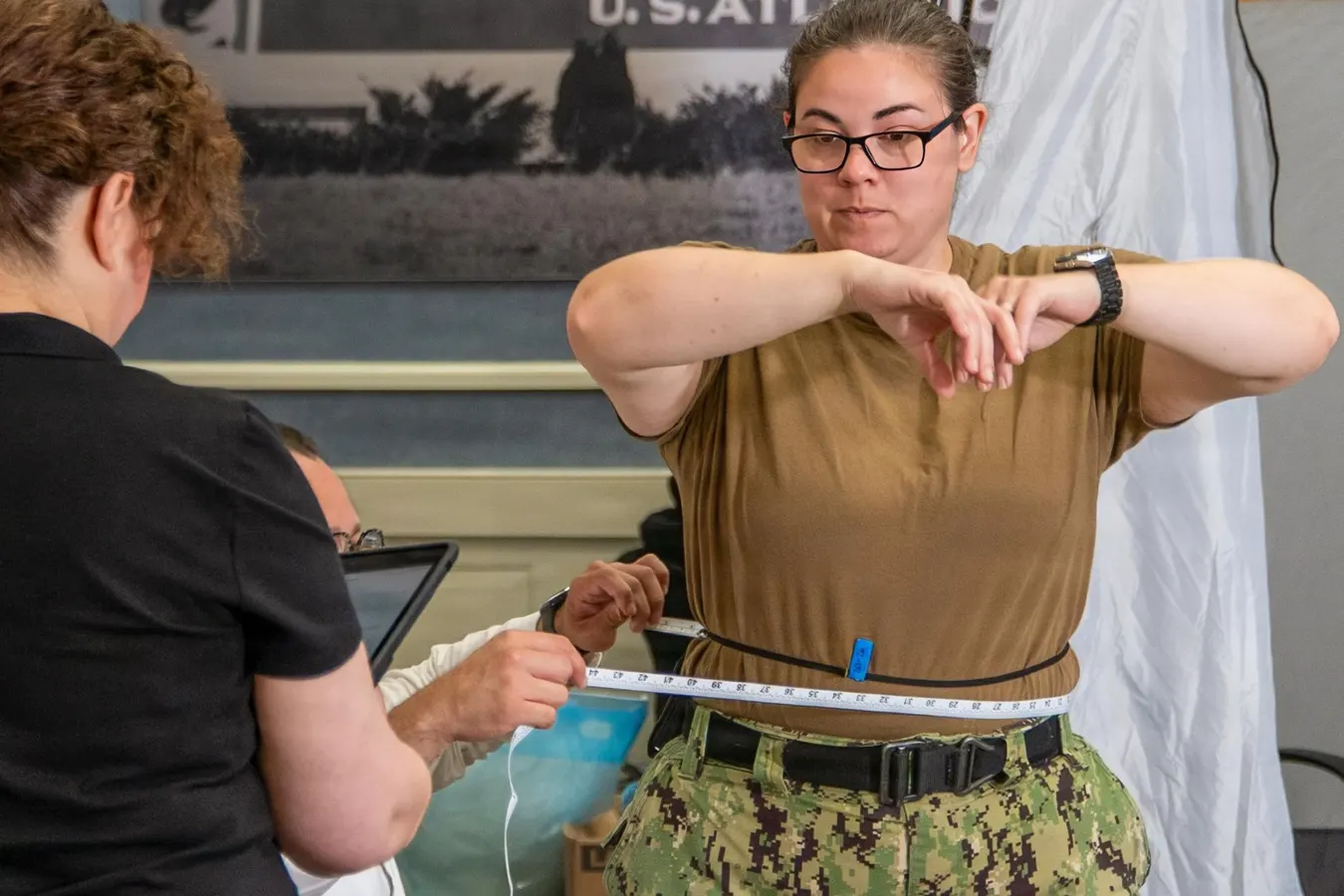

A researcher with the Navy Exchange Service Command’s Navy Clothing and Textile Research Facility take body measurements from a female Sailor during a Navy uniform fit evaluation at Joint Expeditionary Base Little Creek-Fort Story, Virginia, Aug. 20, 2026.
(U.S. Navy photo by Chris Abaya/Released)
The current Marine Corps Combat Utility Uniform (MCCUU), the battledress of the United States Marine Corps, has been in service since 2022, but the Marines are now evaluating a new “next-generation” combat uniform design. Last month, the Portfolio Acquisition Executive Marine Corps’ Program Manager for Combat Support Systems announced that it was modernizing individual equipment via the Next-Generation Marine Corps Combat Utility Uniform, dubbed the NexGen MCCUU, which was described as an “evolution” of the current battledress.
It promises to preserve many of the familiar characteristics of current battledress while providing increased combat and mobility in a variety of environmental conditions.
USMC Feedback Being Gathered
Throughout history, soldiers, sailors and Marines were seldom given the ability to comment on uniform design, and instead had to simply endure what they were issued. Historically, military uniforms were designed by high-ranking officials, procurement bureaus, or civilian tailors, with the frontline soldiers who wore them rarely (if ever) given a voice. Because of this traditional top-down approach, many uniforms prioritized visual conformity, rank identification, or cheap mass production over the comfort and mobility required by the people actually wearing them.
That is why, for centuries, uniforms were itchy, heavy, too hot in the summer, not warm enough in the winter, and universally never that comfortable.
Portfolio Acquisition Executive Marine Corps’ (PAE MC) Program Manager for Combat Support Systems (PM CSS) is modernizing individual equipment through the development of the Next-Generation Marine Corps Combat Utility Uniform (NexGen MCCUU)
(Portfolio Acquisition Executive Marine Corps photo by Todd Towles)
The MCCUU was already designed with Marine comfort in mind, and the NexGen MCCUU will take it even further, as it pairs lighter-weight material with an updated fit. According to the PAE MC, the new design includes a crotch gusset that is intended to improve comfort and durability. In addition, there will be updated sizing and two uniform cuts to better accommodate different Marine body types.
This might not seem like a huge change, but the updates are intended to improve mobility and better support Marines during training and operational missions.
“Equipment must evolve continuously to outpace near-peer technological advancements and deliver peak capabilities to the Fleet Marine Force,” said Todd Towles, Clothing and Equipment Team Lead.
“Just like a rifle or an armored vehicle, the combat uniform is a critical piece of tactical gear. Material advantages on the battlefield directly save lives and secure operational success,” Towles added.
The USMC is now in the initial production stage, which will provide the NexGen MCCUUs for wear testing and user evaluation. Feedback will be used to further refine the uniforms before they are adopted across the entire Fleet Marine Force.
“As part of an ongoing Limited User Evaluation (LUE), NexGen MCCUUs were issued on Aug. 4 and 5 to Command Staff, Drill Instructors, and recruits from three platoons in Alpha Company, 1st Battalion, at Marine Corps Recruit Depot Parris Island. Participants will continue wear testing and complete evaluations at the conclusion of the LUE,” the USMC explained.
Unlike in the past, when warfighters had little say in the uniforms they wore, the USMC is actively seeking input to develop the literal clothes on their back.
“A Marine who is protected, agile, and unburdened is a faster, more lethal, and more effective kinetic asset. Plain and simple,” explained Towles. “The next step for the team is a near-term fielding to Fleet units for Marine feedback in the different environments and missions our units deploy to. We are also testing articles at Natick Army Lab to ensure we incorporate objective analysis on durability and performance.”















Leave a comment