


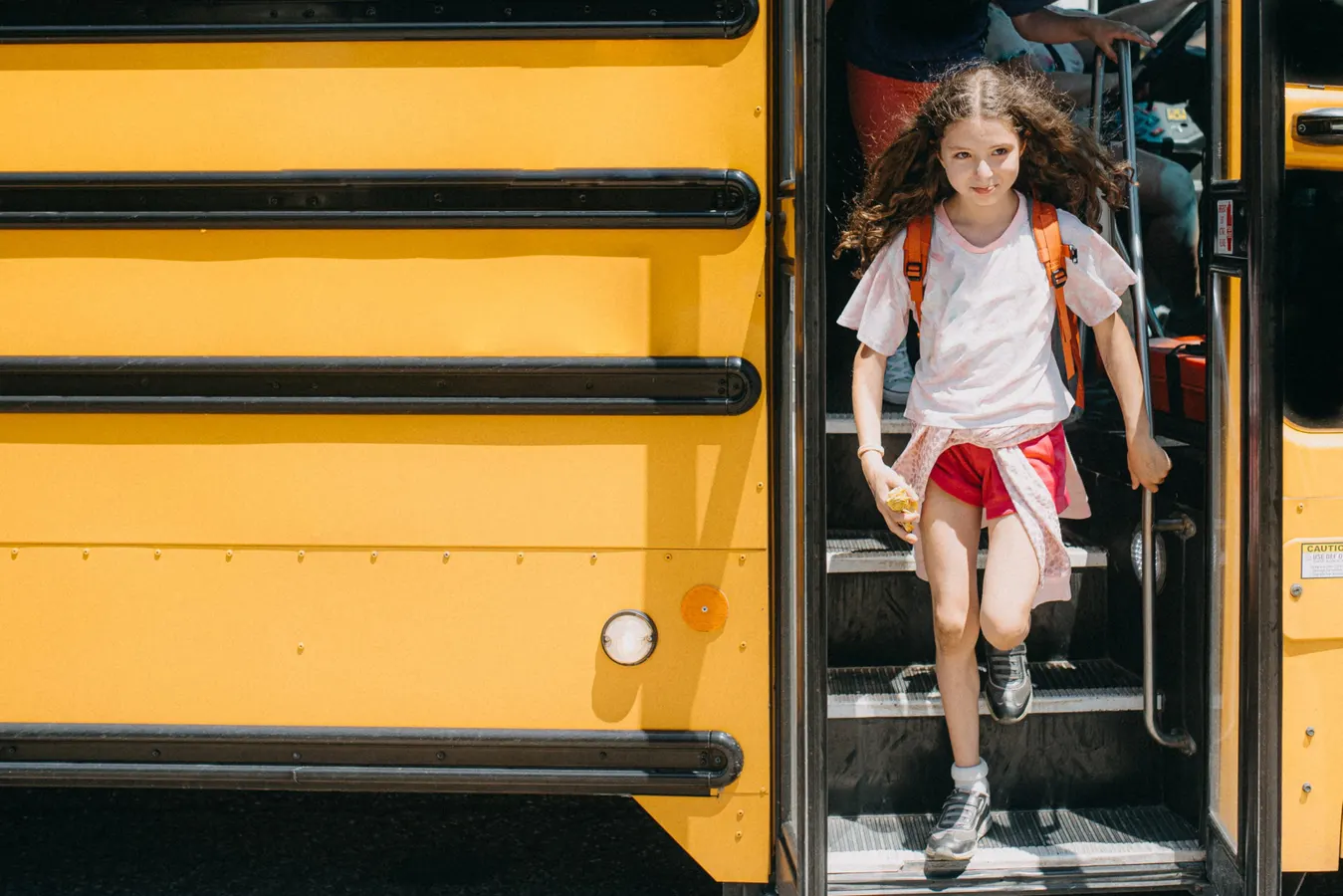

A young student stepping off a yellow school bus into bright sunlight.
getty
July was the hottest month in 132 years of U.S. record-keeping. This is more than just a climate statistic, though. It is a number that parents, teachers, and administrators are watching closely as another school year gets underway.
Hotter days mean hotter bus rides to and from school, cancelled recess and sports practices, and, in some cases, it can even mean a return to remote learning. Already this year in Tennessee, Polk County Schools dismissed students early two days in a row because of heat, while Ivy Academy’s Skillern Elementary School in Hamilton County moved to virtual learning. Wilson County Schools closed the first Friday in September when heat levels on school buses became a serious concern. But extreme heat is only part of the story. Flooding, hurricanes, severe storms, and other forms of extreme weather are increasingly determining whether students can get to school, stay in school, and learn once they arrive.
July was the hottest month on record in the contiguous U.S. in 132 years of record-keeping. And the extreme heat has continued into August, when many students start going back to school. Temperatures recorded as of the end of August indicate the summer of 2026 is highly likely to become the hottest in history.
NOAA Data and Chart, adapted by Tennessee SCORE
Over the past year, the Tennessee State Collaborative on Reforming Education (SCORE) has been exploring the intersection between nature and education, bringing together experts from education and the environmental space to understand forces that shape student success. Last week, we held the second webinar in our Connecting the Dots series, which examines issues sitting just outside conventional educational policy that nonetheless have a profound impact on what happens inside the classroom.
One thing is clear: high heat and extreme weather events are increasingly shaping the school day and students’ propensity to learn. During the 2024-2025 school year, at least nine million students had school days disrupted by extreme weather. That’s somewhere between one in five and one in six American children. This figure comes from UndauntedK12, which built its database from news reports and, as co-founder and CEO Jonathan Klein acknowledged, almost certainly undercounts the true number.
“This is not a future problem that we’re trying to solve,” Klein shared during our virtual Connecting the Dots panel discussion. “It’s happening right now.” And increasingly, it’s happening inside the school building.
Stop, Drop, and Roll for Fire – What’s Next?
We taught a generation to stop, drop, and roll. We haven’t done the same for heat.
Laura Schifter of the Aspen Institute’s This is Plant Ed made this point during the SCORE webinar, noting that nearly every adult knows what to do if their clothes catch fire. We built that reflex deliberately, over decades, until it became second nature. Yet today’s children are experiencing extreme heat days at dramatically higher rates than previous generations, and we never built up the same kind of shared response for heat.
The Tennessee State Collaborative on Reforming Education (SCORE) held a virtual discussion on “Extreme Weather & Student Success.” SCORE founder and chairman Sen. Bill Frist, MD moderated the conversation with Laura Schifter, Senior Fellow with This Is Planet Ed (Aspen Institute), Jonathan Klein, Co-Founder & CEO of UndauntedK12, John English, Director of Schools, Unicoi County Schools, and Dr. Jennifer Vanos, Associate Professor at Arizona State University.
SCORE
Schifter learned that firsthand coaching her daughter’s lacrosse game on a humid 80-degree day, when a player came off the field and became sick on the sideline. Schifter works on this issue professionally. Even she still wasn’t sure what to do.
This uncertainty is revealing. We have spent years building systems and habits around other environmental hazards. We know, for example, how to evacuate a building for a fire. We know where to go during a tornado. We know what to do when a hurricane is approaching. For heat, though, we are largely improvising. And as extreme heat becomes more common, that is no longer good enough.*
That’s why Laura has led efforts at The Aspen Institute to launch the new “Play It Cool” campaign, which works to keep kids safe in the sports and activities they love as extreme heat increasingly disrupts outdoor play. Organized around the simple message of “Speak Up. Sit Out. Cool Down.,” it unites partners across sports, health, media, and entertainment to make heat safety a social norm rather than an afterthought.
Young student using a portable electric fan in his classroom during a heat wave.
getty
Hidden Costs of Extreme Weather
Many parents and educators don’t realize that the outdoor environment has an impact on our indoor learning. Research has shown that a school year that is one degree hotter is associated with nearly a one-percentage-point reduction in expected academic gains, as higher temperatures make it harder to concentrate. School closures, which are often weather related, also have detrimental impacts. Each week of closure sets students back two to three weeks academically.
The disruption can extend far beyond just missed instructional time. Unicoi County Schools Superintendent John English joined our panel discussion to share his first-hand experience. He recounted how, two years ago in September 2024, he cancelled school the night before Hurricane Helene hit based on the forecast. His rule is that waiting for the weather to arrive is waiting too long.
“I had heard the term flash flood my entire life,” English recalled. “But the flash piece of that I had never really seen.” Within the span of 40 minutes, the southern end of the county was gone. Homes and bridges disappeared. The interstate was split in half. Power and cell service went down, eliminating remote learning as an option.
The high school became a shelter for hospital staff who had been airlifted off a roof. The middle school became a command post for first responders. The district ultimately missed three weeks. Its damaged elementary school emptied into the middle school, which spent the rest of the year as an improvised K-8. As English put it, there was no “thousand-year-flood manual” sitting on a shelf.
Hurricane Helene struck Unicoi County, Tennessee, on September 27, 2024, unleashing catastrophic flash flooding from the swollen Nolichucky River that severely damaged local infrastructure, homes, and businesses.
John English
This is the challenge schools increasingly face. Extreme weather doesn’t simply cancel the school day. It can reshape buildings, transportation, staffing, schedules, technology, and the basic infrastructure schools rely on to keep teaching.
In addition, the mental health impact on our children is an unseen but lasting consequence of these events. While Unicoi County marshalled a heroic response and innovatively found ways to get kids back to school, the ramifications of this catastrophic event touched all parts of their lives. Many had lost their homes and their families’ livelihoods, and some had even lost loved ones in the flood.
In 2005, I remember joining with first responders to provide medical care in the immediate aftermath of Hurricane Katrina. The devastation – primarily caused by flooding from failed levees – was akin to a war zone. Researchers have studied the impact of this natural disaster, and the mental toll became known as “Katrina Brain,” a syndrome with symptoms of short-term memory loss and cognitive impairment. Even twelve years after the storm, a study of survivors reported elevated levels of psychological distress and post-traumatic stress symptoms compared to the general population. There is no question this type of life experience jeopardizes a student’s readiness to learn.
A 50-Year Infrastructure Gap
While the psychological impact can be hard to quantify, the physical infrastructure is easier to evaluate. Almost half of America’s K-12 school buildings were built roughly 50 years ago. Many were designed without air conditioning because, at the time, planners reasonably assumed students would not be inside during the hottest parts of the year. That assumption no longer holds.
Jonathan Klein shared that one in three school buildings now needs HVAC upgrades. He added, though, that there are major infrastructure solutions. One of the most cost-effective upgrades are ground-source heat pumps, which use the relatively stable temperature of the earth to heat and cool buildings with fewer moving parts and lower operating costs. A federal tax credit running through 2034 covers 30 to 50 percent of conversion costs. These pumps, because they do not burn fossil fuels, also contribute to healthier air inside and out of the school building. Metro Nashville Public Schools is among the school systems that have started to incorporate these geothermal HVAC systems as a part of larger sustainability efforts.
This map, created by UndauntedK12, shows school closures (cancellations, early releases, or delays) from 2021 to 2026 caused by extreme heat, extreme cold, flooding, wildfire and wildfire smoke, hurricanes, or other severe weather events that are reported on by news agencies or district communication channels.
UndauntedK12
But not every solution requires a multi-million dollar investment. Dr. Jennifer Vanos, who leads Arizona State University’s Human Biometeorology Lab, has developed a HeatReady Schools framework with 30 recommendations for helping schools operate safely on hot days.
“A lot of research shows that younger kids are more vulnerable largely because of the (in)ability to understand what’s happening in their body and their access to resources they might need and the agency to get those resources,” Vanos said.
The HeatReady recommendations include more shade so playgrounds remain usable, basic staff training to recognize and respond to heat illness, and indoor alternatives for days when students cannot safely go outside. Older schools or urban space-constrained schools may lack a dedicated gymnasium for indoor play, particularly in milder or dry climate zones that historically relied on outdoor year-round play.
“So another recommendation we have is if you do absolutely have to keep kids indoors, what can they do to get play?” Vanos explained. “Because their readiness to learn is directly affected by their ability to get those wiggles out. And we have research that shows that.”
Heat imaging demonstrating how different materials and shaded areas change the temperature on a playground during periods of extreme heat.
Dr. Jennifer Vanos
Adapting to a New Normal
The challenge ahead of us is adapting before the next disruption arrives. That means updating school facilities, strengthening emergency plans, training staff, and creating policies that help districts prepare for extreme weather rather than simply react to it.
We can’t control the weather, but we can do much more to limit how far it interrupts a child’s education — through both adaptation and the work already underway to address its causes. Weather is undoubtedly changing the school day. Our schools need to be prepared to change with it.
*For information on how to prepare for and respond to extreme heat, visit Ready.gov/heat.
To view the full webinar “Connecting the Dots: Extreme Weather and Student Success,” as well as access additional resources, including reports, news coverage, and tools, click here.













Leave a comment