


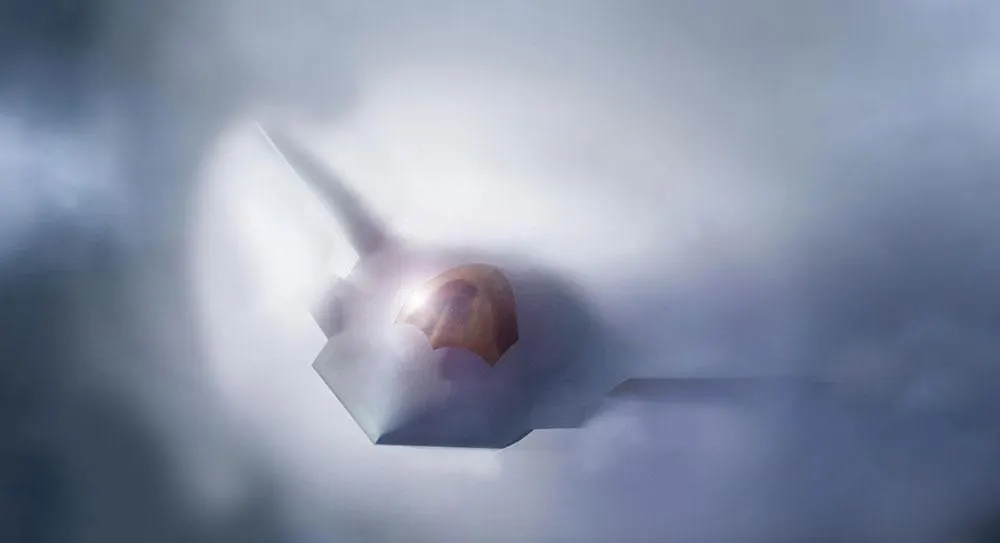

A a graphical artist rendering of the U.S. Air Force’s Next Generation Air Dominance (NGAD) fighter. The U.S. Navy has yet to reveal its F/A-XX.
(U.S. Air Force graphic)
It had been expected that the United States Navy was set to announce whether Boeing or Northrop Grumman would be producing the sea service’s carrier-based sixth-generation manned fighter, still dubbed the F/A-XX, which is set to replace the Boeing-made F/A-18E/F Super Hornet in the mid-to-late 2030s.
Chief of Naval Operations Admiral Daryl Caudle had previously indicated in April that a decision would be made by the end of August.
However, last month came and went, but on Tuesday, there was renewed speculation that Secretary of Defense Pete Hegseth, Acting Navy Secretary Hung Cao and Admiral Caudle could make a formal announcement in the coming weeks.
Repeated Delays
In March 2025, President Donald Trump and Secretary Hegseth announced that Boeing was awarded the United States Air Force contract to develop and produce the F-47, the manned sixth-generation fighter that was the centerpiece of the service’s Next Generation Air Dominance program, which called for a system of systems that also included Collaborative Combat Aircraft or “loyal wingmen” drones and an advanced, secure AI-enabled data network that could fuse information from a multitude of sources.
There was speculation at the time that the U.S. Navy’s F/A-XX contract would also be announced, but as both programs would cost billions of dollars, there had been calls within the Pentagon to push it back by as much as three years.
Lawmakers had other ideas, and subsequently earmarked $750 million for the F/A-XX in the massive tax-cut and spending bill signed into law in 2025, Reuters explained. An additional $1.4 billion was put forth to support the program in fiscal year 2026.
A significant fear is that China’s People’s Liberation Army Navy now has three aircraft carriers, with a fourth under construction, closing the gap with the United States Navy, which operates 11 nuclear-powered supercarriers. A greater concern is that Beijing is also developing a manned sixth-generation carrier-based fighter.
The Boeing-made Super Hornet, a modernized variant of the McDonnell Douglas F/A-18 Hornet, entered fleet service with the U.S. Navy in 1999. Although it remains a vital operational backbone for the service, the oldest aircraft are showing signs of physical wear.
A Congressional Budget Office report warned that the Super Hornet fleet is aging faster and experiencing steeper drops in availability over time compared to the legacy F/A-18C/D models. The Block III variants, which are equipped with advanced AESA radars and networked capabilities, will serve as a bridge to the sixth-generation F/A-XX, but the U.S. Navy can only extend the bridge so far.
Boeing Or Northrop Grumman
The program is now down to just Boeing and Northrop Grumman after Lockheed Martin was eliminated from the competition in early 2025 after its proposed design failed to meet the U.S. Navy’s strict technical and operational criteria.
As Boeing was awarded the F-47 contract and is producing the F-15EX Eagle II for the U.S. Air Force and foreign partners, the company could be stretched thin to develop the U.S. Navy’s carrier-based fighter. However, it is winding down production of the F/A-18 Super Hornet, which has been the mainstay of the carrier fleet for nearly three decades.
By contrast, Northrop doesn’t have a long history of naval aviation, although it did co-develop the F/A-18 Hornet with McDonnell Douglas. Moreover, Grumman has an extensive history of developing carrier-based fighters, going back to the Grumman FF, a two-seat biplane fighter that entered service in 1931.
It later produced the F4F Wildcat, which was the main U.S. Navy fighter in the early Pacific theater of World War II, and that was followed by the F6F Hellcat, a highly successful fighter credited with the most U.S. Navy aerial victories in the war. Other fighters included the F7F Tigercat, the F8F Bearcat, and the F9F Panther, which was Grumman’s first jet fighter. Most famously, Grumman developed the F-14 Tomcat, the iconic supersonic, twin-engine, two-seat interceptor/fighter that was as much the star of the film Top Gun as Tom Cruise!
Northrop Grumman is currently producing the B-21 Raider long-range strategic bomber for the U.S. Air Force, and it has been described as the first “sixth-generation” aircraft.
Concept Details Of The F/A-XX Have Been Teased
In the past year and a half, both companies have teased or shared concept art and video renders of the respective designs.
The Boeing design has hinted at design similarities with the U.S. Air Force’s F-47, featuring a tailless layout optimized for all-aspect stealth and a 25% greater range than the Lockheed Martin F-35C Lightning II. The cockpit and canopy were similar to the Air Force design, but the renders showed a narrower nose/radome that appeared optimized for carrier visibility during high angle-of-attack approaches.
Northrop Grumman’s renderings showed a sleek, tailless body, with top-mounted intakes to reduce radar and infrared detection from below. The design also featured folding wings and a strong landing gear for landing on a carrier.
Of course, the renderings could be misdirection. We’ll know more once a contract is awarded, but it remains anyone’s guess when that is coming. That might be the best stealth feature of the aircraft; we simply don’t know when the contract will be awarded.















Leave a comment