


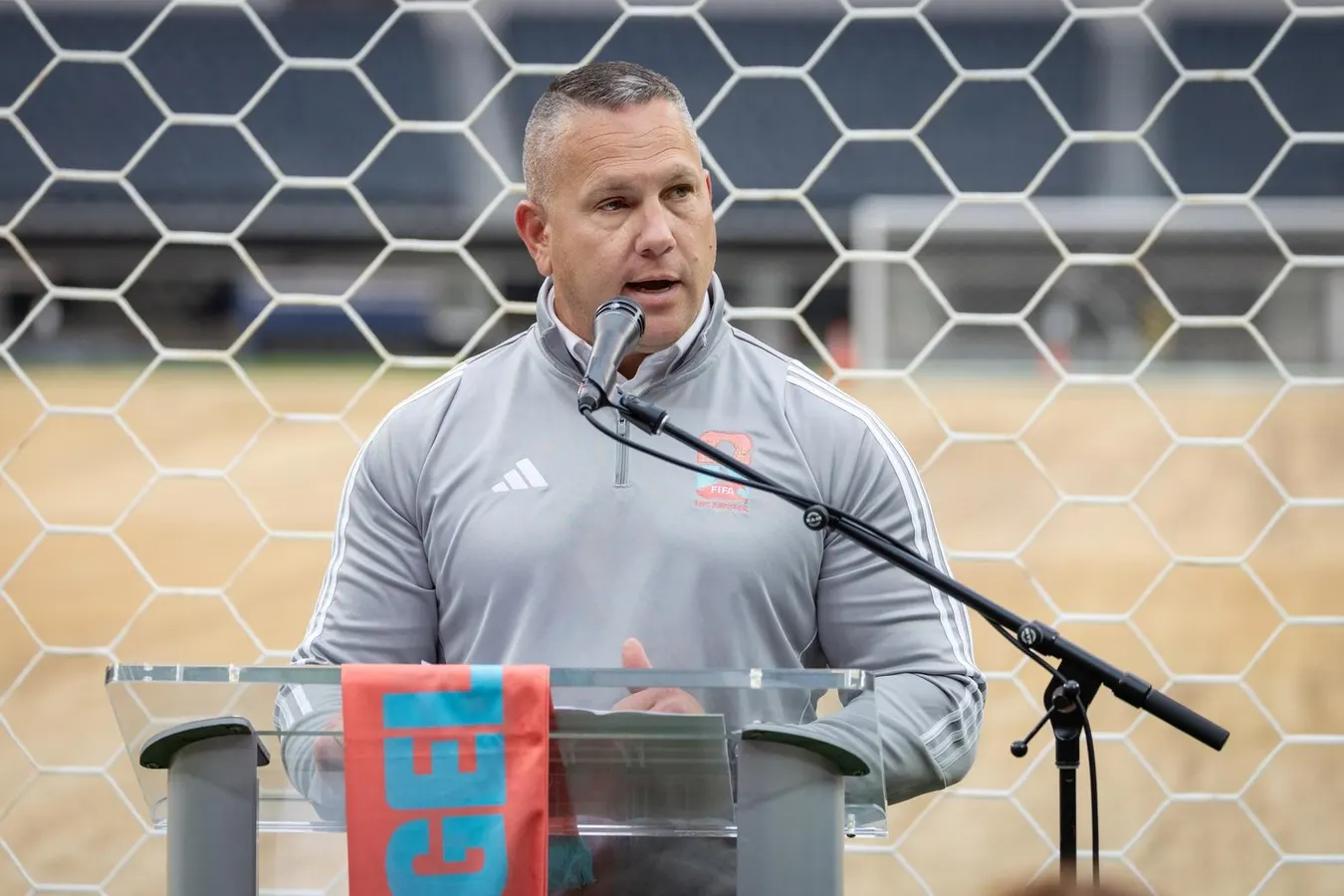
From FIFA World Cup soccer to two Olympic-size swimming pools and the LA28 Opening Ceremony, Otto Benedict and his team are preparing SoFi Stadium for the most ambitious transformation in its young history.
(This story is based on a Forbes exclusive interview with Otto Benedict, Senior Vice President of Facility and Campus Operations for SoFi Stadium, on September 10, 2026. All quotes are taken directly from a transcript of the interview.)
There is a moment in every great sporting event when the audience stops thinking about the building. The stadium disappears. The architecture, plumbing, engineering, technology, seating configurations and thousands of hours of preparation become invisible. What remains is the athlete, the competition and the emotion of the moment.
That may be the ultimate measure of success for Otto Benedict.
As Senior Vice President of Facility and Campus Operations for SoFi Stadium and the surrounding Hollywood Park campus in Inglewood, California, Benedict is helping prepare one of America’s newest major sports venues for one of its most extraordinary assignments. In 2028, SoFi Stadium will become the largest swimming venue in Olympic history. It will also co-host the Olympic Opening Ceremony with the Los Angeles Memorial Coliseum and host the Paralympic Opening Ceremony.
22 July 2026, United States, Los Angeles: A view of Sofi Stadium, the venue for the swimming competitions and the opening ceremony of the LA28 Summer Olympics. Photo: Michael Kappeler/dpa (Photo by Michael Kappeler/picture alliance via Getty Images)
dpa/picture alliance via Getty Images
And before that happens, Benedict and his team will have to transform an NFL stadium into an Olympic aquatic center, and somehow make it look effortless.
From NFL Stadium To Olympic Swimming Venue
The scale of the challenge is difficult to appreciate from the seats. SoFi Stadium was designed as a remarkably flexible building, and Benedict has already watched it change identities repeatedly. During its short existence, the stadium has gone from NFL football to concerts, Monster Jam, soccer and the FIFA World Cup.
“We’ve converted our stadium’s footprint from an NFL stadium to a concert to Monster Jam to a soccer match to a World Cup pitch,” Benedict told me during our interview.
The stadium has undergone those kinds of transformations more than 1,000 times and welcomed more than 10 million people.
But swimming is different.
For LA28, the stadium will contain two Olympic-size pools—one for competition and another for athlete warmups. And the pools won’t simply sit on the football field. They will have to be engineered into a building designed originally around a very different sport. The result could be one of the most visually striking swimming venues ever constructed for an Olympic Games.
Artists rendering of LA28 Olympic Swimming within Sofi Stadium
(Photo courtesy of LA28)
FIFA Was The Dress Rehearsal
FIFA 2026 provided Benedict and his team something almost as valuable as a dress rehearsal: experience. SoFi Stadium hosted eight FIFA World Cup matches, requiring the stadium to replace its normal NFL synthetic playing surface with a fully irrigated, FIFA-specified natural grass pitch. The stadium also modified its existing demountable seating to accommodate FIFA’s expanded operational footprint.
Those modifications generated lessons that will carry forward into LA28. Some of the irrigation and plumbing infrastructure installed for the World Cup may even serve another purpose. Benedict said some of those systems can potentially be used when LA28 installs and fills the Olympic pools.
“We had a lot of great learnings in what we did with that system,” he said.
But FIFA offered another important lesson: the best transformation is the one the public doesn’t even notice.
Making The Transformation Feel Permanent
LOS ANGELES, CALIFORNIA – JUNE 12: Katy Perry performs with Tius Luka during the Parade of Nations before the FIFA World Cup 2026 Group D match between USA and Paraguay at SoFi Stadium (Los Angeles Stadium) on June 12, 2026 in Los Angeles, California. (Photo by Chen Mengtong/China News Service/VCG via Getty Images)
China News Service via Getty Images
During the World Cup, SoFi had to hide or remove elements of its normal configuration, including field-level bungalows and cabana suites. The result was so seamless that even some people who worked at the stadium didn’t realize what had changed. Benedict wants to bring that same philosophy to the Olympics. The challenge is not merely to put swimming pools inside an NFL stadium.
The challenge is to make SoFi look like it was designed specifically for Olympic swimming.
“We want to take that type of application and go back and say, great, how do we make this look and feel like the largest swimming event venue in the history of the Olympics, but also feel like SoFi Stadium, and then also feel very seamless and intentional and all of that,” Benedict said.
The Hidden Engineering Beneath The Pools
For an Olympic swimmer, a lane is a lane. But for the engineers building the competition environment, every lane represents a remarkable amount of precision. Benedict explained that Olympic swimming requires consistency across the entire pool. There can’t be meaningful differences in water movement or other environmental conditions from one lane to another.
“Every one of these swim lanes has got to be the exact same,” he said.
That means much of the Olympic swimming venue will exist beneath the surface. Water-management systems, plumbing, infrastructure and connections to the permanent stadium structure all have to work together.
Then there is the weight.
Benedict said engineers must calculate how the enormous weight of the pools will be distributed across the stadium floor and how the temporary systems will connect to the permanent infrastructure. The project involves approximately a million gallons of water. “There is truly not a single stone that goes unturned,” Benedict said.
Thousands Of People Behind The Scenes
LA28’s operational, venue, infrastructure and event teams will lead many elements of the buildout, working alongside SoFi’s existing personnel, engineering teams, vendors and contractors. Benedict said the transformation will involve not hundreds but thousands of people.
And the work has to integrate with the stadium’s existing infrastructure. Engineers who helped construct SoFi Stadium remain involved because they understand the building’s fundamental systems and limitations. That institutional knowledge becomes particularly important when a football stadium suddenly has to support Olympic swimming. It is a remarkable example of how the most important Olympic infrastructure is often the infrastructure spectators never see.
The Fan Experience
The Olympic transformation is not only about engineering. It is about people. Benedict learned that during FIFA, when SoFi welcomed international fans who had never previously visited the stadium.
LOS ANGELES, CA – JUNE 12: Fans of Team USA prepare to enter the SoFi Stadium (Los Angeles Stadium) prior to 2026 FIFA World Cup First Stage Group D match between USA and Paraguay on June 12, 2026 in Los Angeles, California. (Photo by Chen Mengtong/China News Service/VCG via Getty Images)
China News Service via Getty Images
Wayfinding had to work.
Ticketing had to work.
Food and beverage had to work.
Mobile technology had to work.
And it all had to work for people whose phones and native languages might be completely different from those of the typical American NFL fan. Benedict said the experience was remarkably seamless. SoFi’s connectivity and mobile infrastructure allowed international visitors to navigate the building using their phones and the FIFA app. That experience will become even more important for LA28. Los Angeles will welcome athletes and fans from around the world, and many will be entering SoFi for the first time.
LOS ANGELES, UNITED STATES – JUNE 15: Players warm up prior of the 2026 FIFA World Cup First Stage Group G match between IR Iran and New Zealand at the Los Angeles Stadium (SoFi Stadium) in Inglewood, California, United States on June 15, 2026. (Photo by Tayfun Coskun/Anadolu via Getty Images)
Anadolu via Getty Images
The easier the journey is from ticket to entrance to seat to food and back out into the city, the more attention the fan can devote to the Olympic experience itself.
70,000 Spectators
There is another reason Benedict believes Olympic swimming at SoFi could be different. The building was designed around sightlines. All 70,240 seats were configured to provide views of the competition surface, whether that surface contained football, a concert stage or (eventually) two Olympic swimming pools.
Swimming could benefit enormously from the stadium’s verticality.
Fans will be positioned around and above the pools in a way that creates an unusually intense viewer experience with the athletes. Then there is the Infinity Screen. The stadium’s approximately 70,000-square-foot, 4K LED center-hung screen can give fans perspectives they otherwise couldn’t see. In an era when television broadcasts increasingly bring fans into the action with sophisticated cameras, replays and graphics, Benedict believes LA28 swimming could produce the unusual situation where being in the stadium is better than watching on television.
INGLEWOOD, CALIFORNIA – JULY 02: General view inside the stadium during the FIFA World Cup 2026 Round of 32 match between Spain and Austria at Los Angeles Stadium on July 02, 2026 in Inglewood, California. (Photo by Francois Nel/Getty Images)
Getty Images
“This is one of the games where being in person will be something that you cannot see and will not appreciate from the television side,” he said.
Just 120 days To Build The Olympic Venue
Benedict said the current plan calls for LA28 to take over the stadium beginning February 1, 2028. After the NFL season ends, the existing field will be removed, exposing the flat concrete surface underneath.
Then the Olympic transformation begins.
LA28 will have nearly four months to construct the pools, install the necessary infrastructure, prepare the ceremonies environment and complete the transition systems that will ultimately allow the stadium to move from Opening Ceremony to swimming competition. That is not a quick conversion. It is a major construction project taking place inside a working sports and entertainment venue. And there is virtually no room for error.
A Stadium That Has Learned To Reinvent Itself
The current LA28 plan places swimming at Sofi during the second week of the Olympic Games, with the stadium also participating in the Opening Ceremony on July 14. The Olympic swimming competition is scheduled to run through the Games, with the final Olympic champions of LA28 scheduled to be crowned in swimming just before the Closing Ceremony.
That means SoFi isn’t simply hosting another event.
The stadium was conceived from the beginning as a flexible building. Benedict has seen that flexibility tested repeatedly.
FIFA tested it.
The Super Bowl will test it again in 2027.
Inglewood, California, USA – July 23rd, 2024. Aerial shot of SoFi Stadium, a large sports stadium and concert venue in Inglewood, California, at night. It is scheduled to host several matches of the 2026 FIFA World Cup, Super Bowl LXI in 2027, and the opening and closing ceremonies, soccer, and swimming events of the 2028 Summer Olympics. Authorization was obtained from the FAA for this operation in restricted airspace.
getty
LA28 will take it to another level.
The Olympic Event Fans Will Never See
This then is the paradox at the heart of Olympic venue operations: The better the job is done, the less the audience notices. If Benedict and his team succeed, fans won’t think about the million gallons of water. They won’t think about the structural load. They won’t think about the plumbing. They won’t think about how the competition pool was constructed over a concrete floor designed for NFL football. They won’t think about how an Opening Ceremony set was built, concealed, removed and replaced. They won’t think about the thousands of workers who made it happen.
They will see swimmers.
They will see Olympic records.
They will see athletes racing for medals.
And they will see a swimming stadium. Not an NFL stadium with a swimming pool in it. That distinction matters. Because Benedict’s objective is not simply to transform SoFi Stadium.
It is to make the transformation disappear.














Leave a comment