


![A1 at Crystal Arrow 4 [May'26]](https://imageio.forbes.com/specials-images/imageserve/6aad159949fbf2c465587e87/A1-at-Crystal-Arrow-4--May-26-/0x0.jpg?width=960&dpr=2)
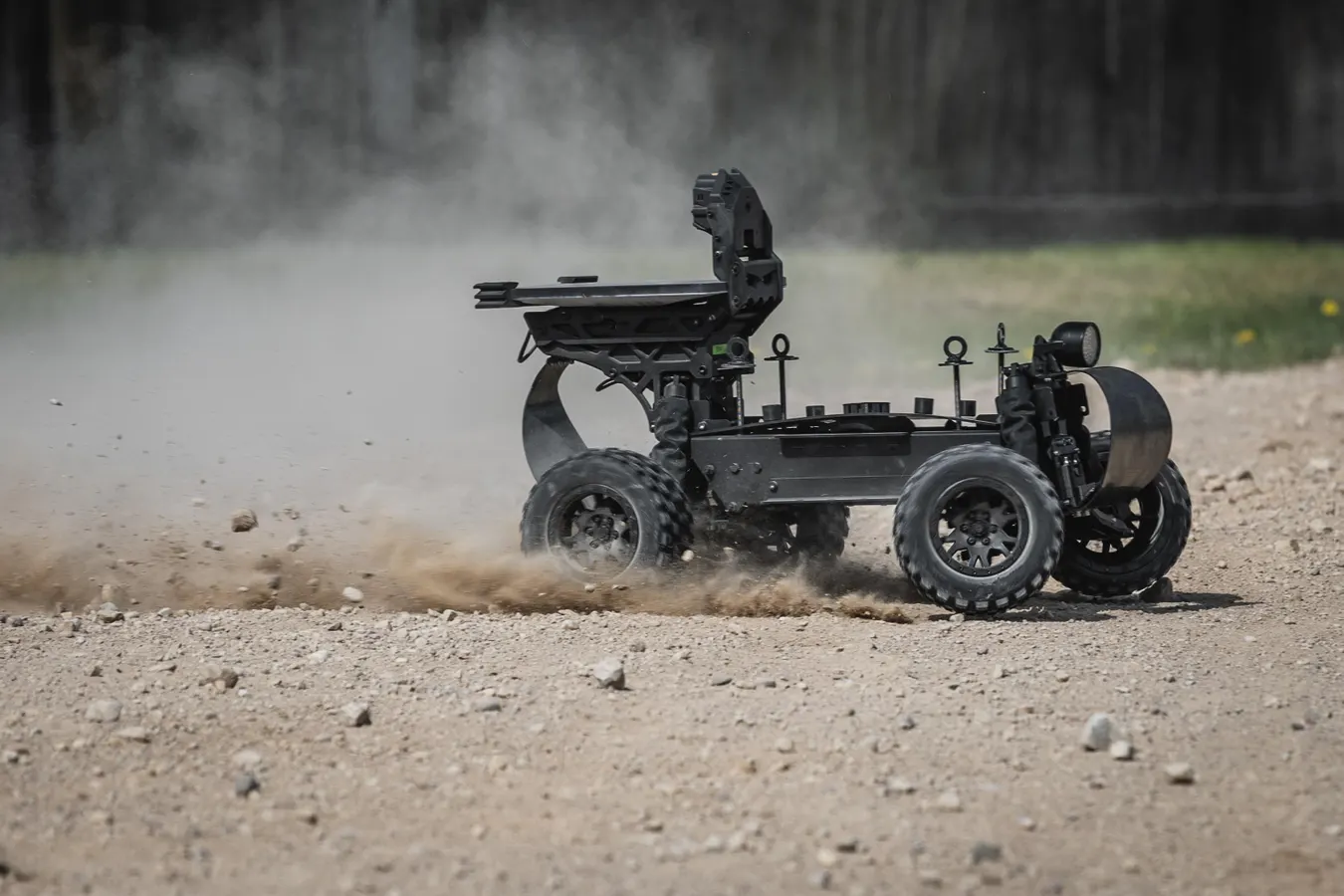
Ark M4 UGV, one of the company’s small, smart, low-cost robotic vehicles.
Ark Robotics
“We are entering the technology tunnel now,” says Achi Takagama, the CEO of Ark Robotics. “On the other side there will be thousands of robots and uncrewed systems for every human soldier inside any defence force.”
Ark is a Ukrainian-Estonian company best known for its ground robots, known as Uncrewed Ground Vehicles or UGVs, used in Ukraine. At present these are mainly used for logistics, but as Takagama explains, these robots are the cornerstone for a new and comprehensive model of robotic warfare.
This might have seemed like a fantasy just a few years ago. But Takagama believes all the elements are now in place for mass uncrewed warfare. 80% of casualties are currently caused by drones, but that is just the start.
“Transition is inevitable,” says Takagama. “It may look like total drone war now, when it is, it will step up an order of magnitude from where we are today.”
Interconnected Robot Brains
Ark’s flagship product is not a robot but the Frontier System which allows an operator to control a collection of robots from anywhere. These can be UGVs, drones, robot boats, or a combination of different types working together. Ark demonstrated the system as the MSPO Expo in Poland last week, with visitors driving a UGV in Ukraine from the expo site.
Frontier is based on a proprietary processing unit which can be fitted to any sort of mobile robot, air, land or sea.
“We are building a universal robot brain that is form-factor agnostic,” says Takagama. “It solves perception and localization and gives the robot agency. It can act on strategy and co-ordinate with other robots in line with human intentions.”
While Ukrainian companies like TFL have focused on adding AI to aerial drones, Ark started with UGVs , which Takagama sees as foundational to the robotic force. They can carry weapons, occupy territory, and perform other functions impossible for drones.
“They form a kind of unifying layer,” says Takagama. “Logistics is the start and you can extrapolate from there. UGVs mean you can move your defence around dynamically. You can carry rockets, high-power jammers, and all sorts of other things you cannot put on a drone due to their weight.”
Existing UGVs used as FPV carriers are awkward to control, future operations will be co-ordinated and seamless
Russian MoD
He also sees UGVs becoming the primary launch platform for FPVs.
“In the early days of the war, soldiers would prepare and launch drones in the field, that is already nearly impossible,” says Takagama. In the time taken to fit warheads and batteries and carry out pre-flight checks, drone operators can be targeted. “They have to do preparation in the safe zone now and only move into kill zone to launch.”
In future, UGV drone carriers may become the norm , transporting FPVs to the front and acting as a launch platforms and communication relays. Several types have already been fielded, but Takagama says better technology will provide reliable, seamless operation.
“It’s much easier when everything is connected to one system,” says Takagama.
Keep Off The Grass
Autonomy is key to massed robots. As DARPA’s Grand Challenge for driverless cars found, getting UGVs to recognize and respond to obstacles is a major issue. None of the contenders finished the course in the first event in 2004. Two decades on, Waymos and other robot cars can negotiate well-marked and mapped roads, but going-off-road is harder, especially when a track that was passable yesterday may be cratered or strewn with mines today.
Autonomous vehicles from DARPA’s Grand Challenge
DARPA
“We can see some obstacles, avoid them and tell other robots to avoid them,” says Takagama. “But there are many types of obstacle. For example, tall grass is a huge problem for localization and autonomous navigation, and many UGVs default to avoiding it. We are working on building models capable of understanding when something like tall grass is an obstacle, and when you can go through it.”
Ark’s UGVs can currently carry out many missions on their own but are not yet at the stage of being fully autonomous and doing any logistics run without human oversight. Takagama says that sort of capability is six months to a year away.
Data fusion is needed to make this work. Machines connected to the Frontier System communicate with each other and build up a dynamic map. That means, for example, that a drone can fly over an area, and a UGV can later use the images to plot a route.
“We do data fusion not just for providing data to humans but also so that multiple types of system can be connected in an automated chain to work together,” says Takagama.
This inter-connected automation is the next big step. It makes it possible for one operator to orchestrate a large, diverse group of drones and robots working together, enabling operations like amphibious assaults with robot boats transporting armed UGVs or heliborne assault with drones dropping UGVs.
IKEA-ization: Quantity, Quality And Armor
A highly robotized battlefield demands low-cost robots. Takagama says that when he entered this field a few years ago the established players were geared to a high-price, high-profit approach. What the new reality demanded was volume, and Ukraine has seen what one analyst terms “the IKEA-ization of military robotics,” with UGVs becoming consumables.
“Ukraine has completely disrupted that industry because we need to have completely the opposite approach, one of mass force,” says Takagama. “’Quantity has a quality of its own.’”
In Ukraine, UGVs cost tens of thousands of dollars at most, while NATO armies pay hundreds of thousands. This drive for affordability is also one reasons why Ukraine’s UGVs, unlike other military vehicles, generally lack protective armor.
“The frame of thinking is that it is going to be killed regardless,” says Takagama. “The best compromise was the cheapest and easiest to build. We don’t believe in super-heavy armor — we have destroyed plenty of super-heavy armored vehicles.”
The most likely threat for UGVs, as with other vehicles, is an FPV drone armed with a repurposed RPG warhead. These can penetrate eight inches or more of steel plate, so weighing down a UGV with thick armor makes no difference. Instead, protection will come from working as a group.
“Going forward we see them being used in groups, so that part of the group is air defence, some carry jammers, and so on, and you have a complete defensive system.”
This approach provides the best protection while sticking to the core principle of keeping individual units simple and affordable. What matters is the whole orchestra, the individual members are expendable.
Towards Total Drone War
Autonomy is coming to the battlefield and Takagama believes that in the near future most human tasks will be taken over by robots and drones. But in Ukraine progress is uneven, with some units showing a high commitment to automation while others focus on traditional warfighting.
“Some brigades are years ahead of others,” says Takagama. “People are the drivers of change. The ones that are ahead have put in the resources to train engineers, operators, and support personnel.”
Some brigades will be first out of the tunnel and with increasingly robotized forces. The 3rd Assault Brigade, for example, plans to replace 30% of front-line troops with UGVs by the end of this year and moving towards 80% in the next few years. Soldiers will shift to being commanders and coordinators for automated battlegroups, staying well back from the fighting.
Ukraine held the first robot-only military parade in Kyiv for Independence Day in August.
Ukraine MoD
Ukraine has dramatically ramped up UGV production, from under 10,000 units in 2025 to over 25,000 this year, set to double again in 2027. Western nations, despite vastly better funding , have not shown the same shift and are not prepared for automated wars.
“People in the West have made a lot of progress in trying to learn from Ukraine. But, with some exceptions, NATO does not have the readiness the survive what Russia and Ukraine possess at present,” says Takagama.
This lack of readiness means that a future war could see unprepared NATO countries sending people to fight against machines.
“The last thing you want to do is fight a drone war with humans,” says Takagama. “It will be the stupidest, bloodiest thing ever seen.”














Leave a comment