


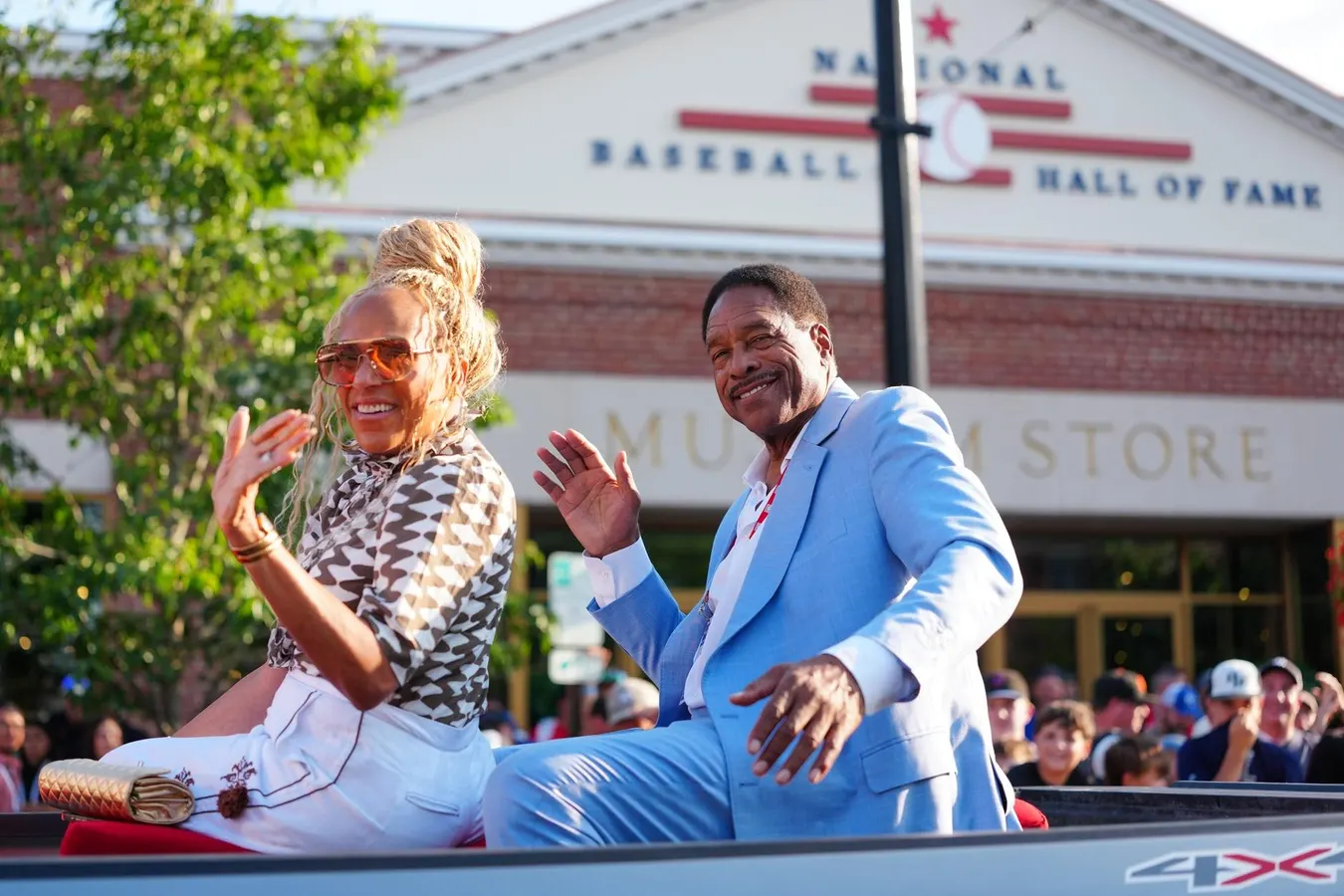

Dave Winfield is candid about his life and the late Yankees owner George Steinbrenner in his recently published autobiography (Photo by Daniel Shirey/MLB Photos via Getty Images)
MLB Photos via Getty Images
I’ve known Dave Winfield as long as I’ve been in the business. He was already developing into a star right fielder with the Padres when I broke in as a sportswriter covering baseball in 1976. He never treated me like some kid wet behind the ears, but with the respect due a veteran writer of which there were many in those days.
That relationship never wavered as we continued on our journeys. Here we are 51 years later. Thus, I was honored when his San Diego-based agent, Randy Grossman – another longtime friend – asked me to review his new book, Touching All The Bases: A Story of Power, Purpose and Surviving the Bronx.
The book, written with Alan Maimon, was released by Matt Holt Books, an imprint of Ben Bella Books, earlier this week.
It’s a no-holds-barred description of Winfield’s life and first-ballot National Baseball Hall of Fame career. He spares no details about his departure as a free agent from the Padres for the Yankees after the 1980 season; his subsequent decade-long battle with “The Boss,” George Steinbrenner; his decision to join the Hall as a Padre; and the personal chaos that engulfed his life at the same time.
It might have crushed a lesser man without his character and resolve. But the band played on as he rose above it all to bat .283 with 465 homers, 1,833 runs batted in, 3,110 hits, an .827 OPS and a 130 OPS+ in his 22 seasons for five teams, culminating with his 11th inning double that won the 1992 World Series for the Blue Jays over the Braves. Winfield was 41 at the time.
“So how does one deal with adversity?” Winfield said Thursday in a phone interview about the book. “How does one continue to display leadership under duress and pressure all the time? There are a lot of lessons here. My teammates didn’t know anything about it at the time. I had to go out there and play well every day with very few slip-ups and periods of adjustment at the plate.”
Winfield did it all with “no support during that period,” he added, specifically regarding his nine years playing for the Yankees while dealing with incessant court battles and tabloid headlines generated by Steinbrenner.
Winfield Does Not Hold Back When It Comes to Steinbrenner
It began when he signed a 10-year contract worth $23 million that included an annual cost-of-living clause. Steinbrenner didn’t understand the ramifications of the clause, and it had to be reworked.
“It began before I even started playing with the Yankees,” he said. “It never got any better, only worse.”
I wasn’t there to see it all, from 19981 to May 11, 1990, when he was traded to the Angels. I remained in San Diego covering the Padres, which had its own complications.
I didn’t realize Winfield was not only playing through his problems – having Steinbrenner pay funds contractually owed to his foundation – but at the same time he was in a Texas court with a woman who had his child out of wedlock and was demanding all kinds of money through an erroneous claim of common-law marriage.
The two cases eventually entwined like a spider web, ultimately leading to Winfield’s exoneration. Steinbrenner eventually settled and paid the foundation. Read the book if you’re interested in all the sordid details.
“I had to think, ‘OK, What am I going to do about it?’” Winfield said. “I wasn’t going to let him or anybody else get away with that. So, battle ensued.”
For Steinbrenner, the whole thing made little sense, in retrospect. Why would the most impactful baseball owner at the time battle Winfield over seemingly insignificant amounts of monetary contributions he agreed to give his foundation? Why would Steinbrenner pay a low-level gambler named Howard Spira to dig up dirt on Winfield, leading to Steinbrenner’s lifetime suspension from baseball – a sentence reduced to two years?
The whole affair hardly seemed worth it to Steinbrenner, but it made Winfield’s life miserable. Was that the point, just because Winfield, the highest-paid player in MLB history at the time, was 1-for-22 with a single RBI as the Yanks lost the 1981 World Series in six games to the Dodgers?
World Series Loss Damaged Winfield’s Relationship With Yanks
How much different would his life have been if he had performed well in that World Series and the Yankees won, Winfield speculates in the book?
By the time Winfield finally reconciled with Steinbrenner, The Boss was in a cycle of dementia that led to his death in 2010 at 80. During their last conversation, the subject was not broached.
“He never admitted why he did these things,” Winfield said. “He was very happy for my success, but for him to say, ‘This is why I did it,’ that was never put out there. It was much deeper than I was the highest-paid player in all of sports.”
Suffice to say, Winfield has returned at times to Yankee Stadium and is not estranged from the Yankees, but his No. 31 won’t be retired and there won’t be a plaque for him in Monument Park any time soon.
“I have no idea, and I’m not going to speculate about that,” he said, adding that there were no conversations with Steinbrenner at all about him being inducted in Cooperstown in 2001 as a Yankee. That might not have made a difference anyway. When he went into the Hall and retired as a Padre that put an end to that, the Yankees said on Friday.
Winfield had his number retired by the Padres and it’s on display at Petco Park along with four others in the courtyard leading to the main concourse. He’s planning on being there before the game against the D-backs on Sept. 26 to throw out the ceremonial first pitch.
Winfield said he’s looking forward to meeting the new owners, Jose E. Feliciano and Kwanza Jones, who the club said is expected to be there.
Winfield worked as an executive in the Padres’ front office from 2002 to 2013, but hasn’t been to Petco much since he left for a job in the Major League Baseball Players’ Association from which he retired in 2025. He was brought in to the Padres by former owner John Moores after going into the Hall with an SD on his plaque, the first of three Padres officially in the Hall followed by Tony Gwynn and Trevor Hoffman.
“Not only did I start my career there, but I worked there for 12 years,” Winfield said. “I brought a lot of nice things to that organization.”
At 74, setting the record straight is the primary reason he wanted to write this book now.
“It’s actually been 30 years in the making,” Winfield said. “I’ve been doing a lot of things, and now was the time, a good time.”














Leave a comment