


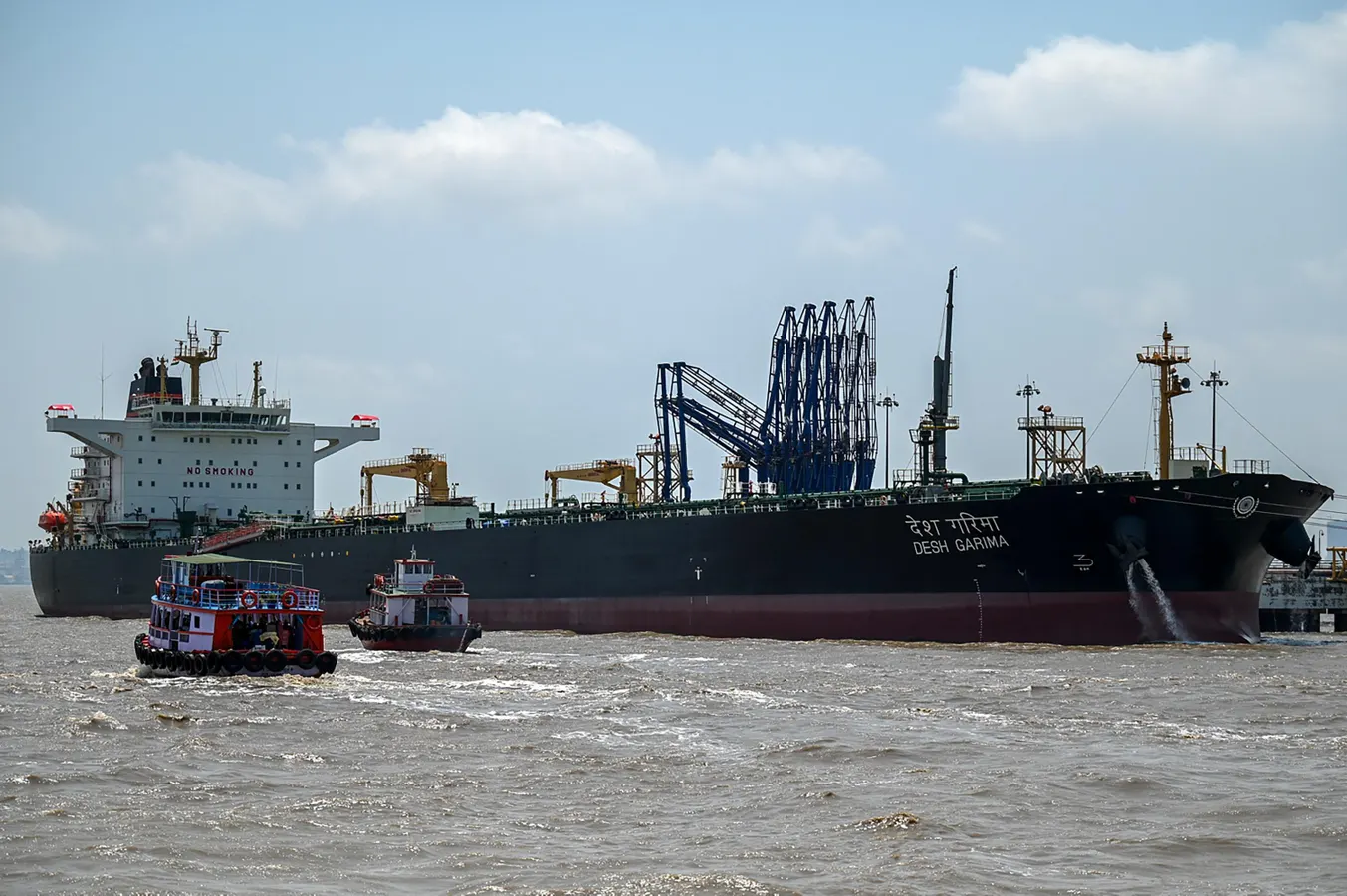

An Indian-flagged tanker carrying crude oil that transited through the Strait of Hormuz, is seen docked at an offloading terminal in Mumbai on April 30, 2026.
AFP via Getty Images
India And Its Oil Politics.
Globally, the U.S. is No. 1 oil producer, Russia is No. 3, India is No. 21 (see Table 1). India, with such a big population, needs oil in huge volumes. How did this situation arise?
After independence in 1959, state-owned Oil and Natural Gas Commission (ONGC) was given power to develop and sell oil resources. They brought in foreign experts, including Russian, who set up five-year plans that were governed by Indian bureaucracy.
After 1991, and the fall of the Soviet Union, India liberalized and formed drilling rights with Iran and Kazakhstan, which led to concerns with the U.S.
After 2000, US – India bilateral trade surged, growing from roughly $20 billion to an estimated total of $240 billion in goods and services by 2025. The U.S. had a trade deficit of $63 billion in 2025, although leaders from both countries have set a goal to expand bilateral trade to $500 billion by 2030.
Table 1. Oil reserves and production in several top countries. Reserves data from https://www.worldometers.info/oil/oil-reserves-by-country/ Production data from https://www.statista.com/chart/16274/oil-producing-countries/
Statista, Worldometers
In 2022 when Russia invaded Ukraine, the U.S. and Europe applied sanctions against Russia. These were aimed at reducing Russia’s exports of oil and refined oil products (gasoline, diesel, other fuels) that provided 40% of total export revenues. Part of this was used to fund the war in Ukraine. Russia started selling oil at a discount, and China and India jumped on it. China bought 50%, and India 37% of Russia’s exports in recent years (Figure 1).
Figure 1. China and India are top importers of Russian oil.
Statista
Figure 1. China and India are top importers of Russian oil.
https://www.statista.com/chart/31920/average-volume-of-russian-oil-exports-by-country-and-region/
India Imports And Exports Oil.
Russia had been a big exporter of oil products. But just this month, according to Reuters, about 40% of Russia’s oil exports have been stopped by Ukraine’s drone attacks on oil and fuel export infrastructure. Russia has now been forced to import oil products. Imports to Russia jumped to 172,000 tonnes in August, an increase by seven times. India supplied 120,000 tonnes, or 70%, of this, worth about $90 million US (this would be a bit over a billion dollars in a year).
So India has business acumen. They buy crude oil from Russia, turn it into oil products in their refineries, then sell these oil products back to Russia.
Lindsey Graham’s Bill On Sanctions And Tariffs.
Now, the U.S. Congress has dealt themselves into the triangle of nations. Last week, the House passed a bill to give president Trump power to impose more sanctions on Russia and to increase tariffs up to 100% on countries like India, unless India stops buying all that crude oil (37%) from Russia. The principal motive was to assist Ukraine by reducing Russia’s export revenue from the sale of their crude oil. Named after the late senator Lindsey Graham, the bill was signed by President Trump, after he insisted that Iran’s energy and weapons be included.
To be clear, this is not a tax on Russian crude entering India. It is a tax on India’s goods exported to the U.S. The U.S. imported $104 billion from India last year, so India would be seriously affected. But the U.S. consumer will be affected too, the BBC said. “India’s exports to the US include electronics, pharmaceuticals, machinery, jewelry, chemicals, textiles and petroleum products.” Imports of electronics and electrical equipment amounted to $26 billion, pharmaceuticals $10 billion, and machinery $7 billion.
This is not the first tariff threat aimed at India. In 2025, President Trump lobbed a 50% tariff rate on India, but later relented. The new threat comes after an earlier round of Trump tariffs on Indian goods in 2025, which peaked at 50% before being reduced.
India Is Vulnerable.
In regards to energy security, and oil and gas in particular, India is vulnerable, especially as its population approaches 1.5 billion. First, India imports 88% of its country’s oil needs, so they are far away from energy independence in oil. Second, six countries provide more than 85% of India’s crude oil need, and some of these countries are economically dicey. Third is LPG (liquefied petroleum gas), which is the main cooking oil for more than 330 million homes— India has to import more than 60% of its LPG. Last, in India the strategic reserves of petroleum hold only enough for 9-10 days, which is a trifle by comparison with about 200 days in Japan and South Korea.
All of this is why India has turned to buying cheaper Russian crude oil. They have saved over $12 billion dollars since 2022 when they made the shift toward buying Russian oil. The big question for India is, are the savings and energy security from buying Russian oil worth the costs of tariffs and trade losses with the U.S. that would follow a threatened jump in tariffs by the U.S.















Leave a comment