


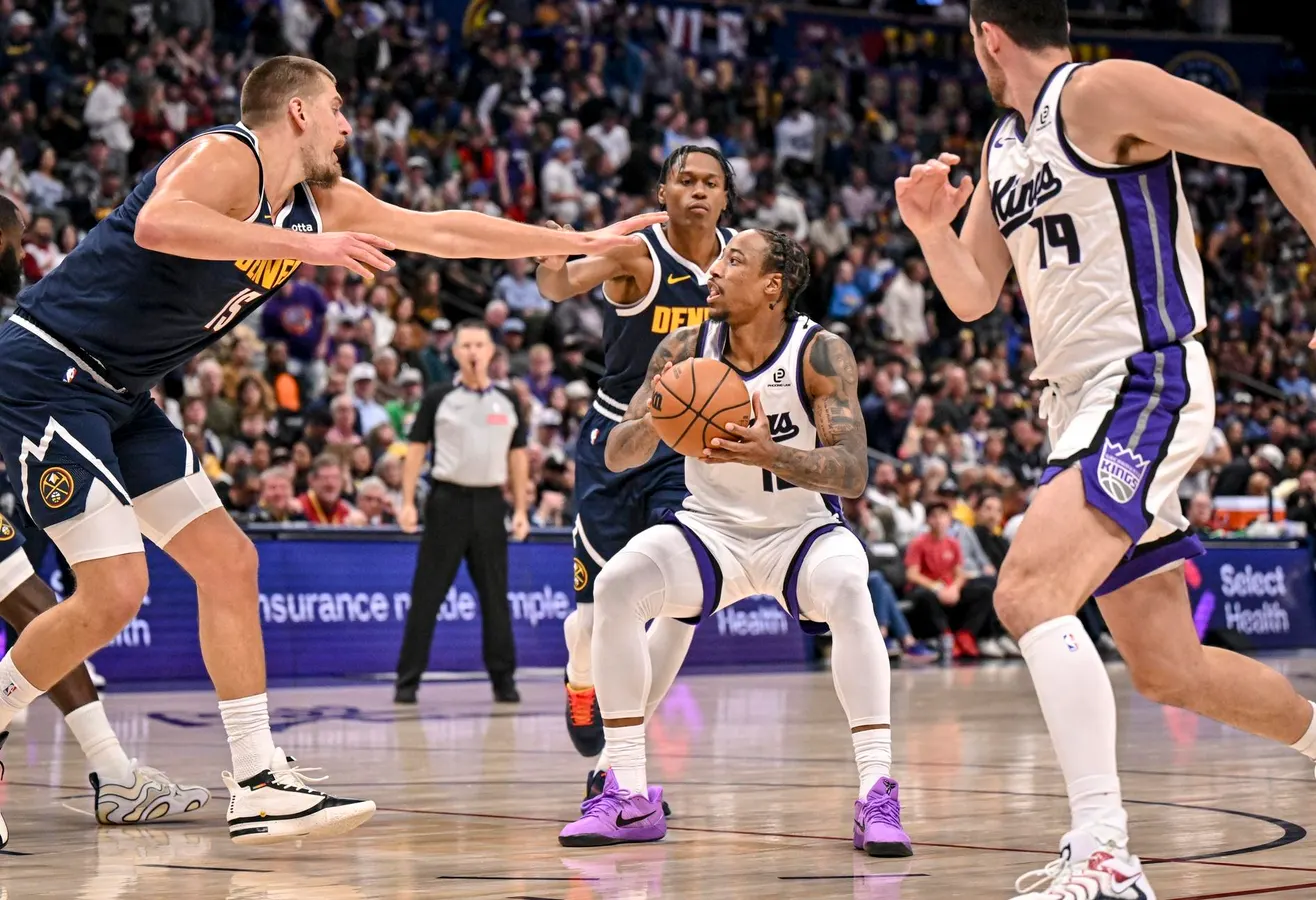

Bench help or hindrance for Nikola Jokic and Denver’s championship core? The Nuggets lost Peyton Watson but added DeMar DeRozan, among other 2026 offseason moves.
Denver Post via Getty Images
The Denver Nuggets’ offseason is officially over. The team held their 2026 media day yesterday, and enters training camp today with a host of new players after a fairly tumultuous offseason.
The Nuggets, outside of their starting five spearheaded by three-time MVP Nikola Jokic and first time All-NBA guard Jamal Murray, are entering the 2026-27 season with a dramatically overhauled roster, one that will feature a new-look bench filled in large part by newly-acquired players.
Many Nuggets fans found Denver’s tension-fraught offseason to be frustrating, disappointing and dispiriting, as it was most notably defined by strained negotiations with restricted free agent Peyton Watson which ultimately led to him being signed-and-traded to the Cleveland Cavaliers for a 2031 first-round draft pick, a 2032 second-round pick, and the salary relief that came by not taking back any guaranteed contracts.
Although trading Watson, one of Denver’s younger players with the most upside, defensive acumen and athleticism, may have helped restock draft assets and inch toward greater flexibility, it did little to directly improve the team on the court this season (and likely did the opposite) at a time when, after last season’s disappointing first-round playoff exit, they clearly could have benefitted from all the help they could get.
The widely held view among many fans and NBA analysts alike that the Nuggets organization should be going all-in to build the strongest possible title contender around Jokic, who remains solidly in the conversation for best player in the world while he’s still in his peak-era window, ran up against the (arguably self-imposed) financial constraints of a team trying to get under the punitive second apron of the NBA’s Collective Bargaining Agreement (CBA).
Getting under the second apron by the end of the season appears to be the mandate of owner Stan Kroenke, whose net worth is estimated at $27.6 billion according to Forbes., and who recently bought the Los Angeles Angels for $4 billion. And in fairness, a legitimate case could plausibly be made that it’s reasonable for ownership, and by extension the front office management of executive vice president of basketball operations Ben Tenzer and executive vice president of player personnel Jon Wallace, to accordingly constrain Denver’s spending under that threshold given the strict, restrictive penalties of the second apron.
But even so, it’s a very tough sell to Nuggets fans to convince them that the largest landowner in America, who’s just shown he can afford to buy yet another multibillion-dollar major sports franchise, couldn’t spend a few extra million to retain a player as valuable as Watson after his breakout season.
Irrespective of competing opinions on how well or poorly Denver handled the Watson situation and its offseason in general, however, the ink is now drying and the dust settling on the moves the Nuggets made which will transform their roster, and specifically the bench, going forward.
Recapping the Nuggets’ Offseason Transactions
Denver’s offseason roster makeover saw them prioritize the acquisition and retention of affordable bench players, largely placing a premium on athleticism, while at the same time retaining their entire starting lineup from last season – albeit as noted above, while also trading away a key rotation piece in Watson to both shed salary and move towards getting under the second apron, as well as to replenish their draft asset chest.
The following chart summarizes the Nuggets’ 2026 offseason player additions and subtractions:
Denver Nuggets 2026 Offseason Transactions
Salary data via Spotrac, chart by Joel Rush
In addition to dealing away Peyton Watson (who, per Basketball Reference, played 54 games, and 1,598 total minutes) and waiving and stretching backup center Jonas Valanciunas (65 games, 871 minutes), the Nuggets lost two key rotation players in Tim Hardaway Jr. (80, 2,127) and Bruce Brown (82, 1998) in free agency, as well as deep-benchers Jalen Pickett and David Roddy. Altogether, that represents 37.5% of Denver’s total player minutes played last season, and 33.8% of their points scored, going out the door, and leaving the team with a dire need to rebuild its depth.
The only two of their own free agents the Nuggets retained were forward Spencer Jones, who as a restricted free agent signed a two-year, $12 million offer sheet from the Oklahoma City Thunder which Denver subsequently matched to keep him, and Tyus Jones, who re-signed on a veteran minimum contract. Through free agency and the draft, they added six new players (or potentially seven if Lonnie Walker IV, signed on a training camp Exhibit 9 deal, earns a standard guaranteed contract).
The most high-profile of Denver’s new additions was 17-year veteran DeMar DeRozan, who signed to a veteran minimum contract, and will undoubtedly be leaned heavily upon to replace a hefty chunk of that lost bench production. Additionally, Denver landed Marvin Bagley III, also on a vet minimum, to replace Valanciunas at backup center, signed forward Alpha Diallo to his first NBA contract after he won the 2025-26 EuroLeague Best Defender award with AS Monaco, and most recently signed the recently-waived Cam Whitmore to a two-way contract in ostensive hopes he might have potential as a “second draft” prospect.
Of note, the 2026-27 salaries of this entire set of players (plus the cost of waiving Valanciunas) adds up to just over $16.7 million this season (an average of about $2.1 million per player), which is slightly above 10% of this season’s salary cap. When viewed in the context of Denver’s starting player salaries, this is a critical component of the team’s maneuvering to eventually get under the second apron.
With Jokic at $59 million (35.8% of the cap), Murray at $50.1 million (30.4%), Aaron Gordon at $32 million (19.4%), Cam Johnson at $23.1 million (14%) and Christian Braun at $21.5 million (13%), the salaries of the Nuggets’ starting five combine to $185.8 million, well over the $165 million salary cap (salary figures via Spotrac). In fact, these five salaries represent 112.6% of the cap, 88.9% of the first apron, and 83.8% of the second apron. The consequence of this is that, presuming Denver’s goal is ultimately to get under that second apron by the end of the season, the margins they’re constraining themselves to are razor thin.
One way to put the salaries of the incoming and retained players in context is to consider that, per the Denver Post’s Bennett Durando, the Nuggets’ “line in the sand” extension offer to Peyton Watson maxed out at an average annual value of $18 million, and he actually signed with Cleveland at an AAV of $22 million. Had Watson accepted Denver’s offer, his salary alone (less than $18 million this year since it would escalate) would have been roughly equivalent to the entirety of what Denver paid their six newly acquired or retained players, and if the Nuggets had compromised it would’ve been significantly more.
But then in either scenario they still would have had a plethora of open roster spots to fill to both meet the requirement of 14 standard contracts, and the necessity of replacing bench depth on the court. There will be endless debate about whether signing-and-trading Watson was the “right” move, but it’s a hard fact that had he extended, it would have plunged the Nuggets incredibly deep into the second apron.
All such “what ifs” are now in the rear-view mirror, however, and now the Nuggets will move forward into the 2026-27 season trying to figure out how all these completed offseason moves have reshaped their team, and how best to both find workable combinations with their new players, and to replace the lost production of those no longer with Denver.
The Replacements: How Will The Nuggets Change With Their New-Look Bench?
In considering the Nuggets’ offseason changes with specific respect to the bench (since the set of players lost and added are all non-starters), one useful way to evaluate their dramatically different second unit is not to simply just ask whether Denver replaced their departing players with equivalent statistical production, as in several cases, they clearly did not. A more important question then becomes: What types of production were lost, what was added, and how those changes could alter the way the team plays when its starters are off the court.
Some of these player substitutions are relatively straightforward. Marvin Bagley III should essentially step directly into Jonas Valanciunas’ old role as backup center, while Tyus Jones ostensibly provides the Nuggets with something they didn’t consistently have in 2025-26: a true backup point guard (contingent, of course, on Jones bouncing back to a career average level of production after underperforming last season).
The matter of who replaces the production of some other departed players gets more complicated. Spencer Jones is unlikely to be able to replicate some of Peyton Watson’s defensive playmaking or shot creation, and although DeMar DeRozan remains a very capable scorer at age 37, he is a fundamentally dissimilar player from Tim Hardaway Jr., whose three-point production and efficiency was critically important for last season’s Nuggets. Such differences make this bench overhaul all the more consequential.
Who Will Replace Peyton Watson’s Production?
Setting aside the promise of his future upside potential, in the immediate term Peyton Watson is probably the most difficult of Denver’s outgoing players to replace because of his multifaceted game, which he put on full display in his breakout last January before succumbing to a hamstring injury. He averaged 14.6 points, 4.9 rebounds, 1.1 blocks and 0.9 steals last season, combining size, length, athleticism, shot creation and defensive instincts in a way that made him one of the Nuggets’ more versatile players.
Although he was already with the team last season, Spencer Jones is the most obvious candidate to absorb Watson’s role by stepping into a larger one. Despite averaging just 5.5 points in 22.1 minutes last season, Jones was a formidable defender and shot nearly 40% from three (to Watson’s 41.1%). Beyond the bench, his ability to contribute without requiring the ball makes him a natural fit alongside the higher-usage starters, so in that sense he won’t need to match Watson’s scoring. If he proves to be a reliable three-and-D wing in a scaled-up role, he will provide some measure of what Watson produced when he played next to the starters (something likely to happen a good deal, given Denver’s recent injury history).
Watson’s ability to create his own shot, however, is a skill that’s not really in Jones’ wheelhouse, and for replacing this, as well as his scoring production, the Nuggets will need DeRozan to play a major bench role as their 6th man (this will apply to Hardaway Jr. as well).
And while Jones’ defense will be critical, he doesn’t have Watson’s explosiveness or weak-side rim protection. This is where Alpha Diallo, something of a mystery box as he enters the NBA for his first time, consequently becomes a potentially important complementary piece of the Nuggets’ bench puzzle. Diallo averaged 11.9 points and 1.4 steals in EuroLeague play last season, and won the aforementioned Best Defender award. He can provide some rim protection with his exceptional athleticism and six-foot-ten wingspan, and gives Denver another physically aggressive perimeter defender, which gives him a credible chance of cracking the rotation.
Who Will Replace Tim Hardaway Jr.’s Production?
Tim Hardaway Jr.’s three-point volume and efficiency might be the most difficult loss for the Nuggets to replace, especially considering it’s one skill set the did not find a clear and direct replacement for over the offseason.
Averaging 13.5 points in 2025-26, Hardaway poured in 224 of Denver’s 1,161 total made three-pointers, or 19.3% of them, averaging 2.8 per in his 80 games at a career-high clip of 40.7%. Additionally, a significant part of his value came from combining scoring with gravity-based spacing and off-ball movement without needing the ball or using up many possessions.
The Nuggets simply do not have anyone on their current bench who (at least as of yet) has proven capable of such offensive production from beyond the arc and the intangibles that come along with it.
On the face of it, DeRozan is the “obvious” primary replacement for Hardaway as their shoe-in leading volume scorer off the bench. But the tradeoff is significant, and a bit strange since they’re such different players.
DeRozan averaged 18.4 points and 4.1 assists last season, and even at his age remains a consummate self-creator. On the plus side, he should be able to manufacture offense when a opponents disrupt Denver’s go-to actions (namely the Jokic and Murray two-man game), skills which Hardaway was less equipped for.
But what he can’t replicate is Hardaway’s three-point gravity. Last season, DeRozan – an elite midrange specialist – attempted only 1.9 threes per game and made a very inefficient 32.0% of them.
To put a finer point on it, per Cleaning the Glass, only 13% of DeRozan’s total shot attempts were three-pointers, putting him in the first (i.e. bottom 1%) percentile, while 73% of his attempts were from midrange, landing him in the 100th percentile. Hardaway was a quasi-mirror image, with 67% of his attempts coming from three (86th percentile), but only 21% (46th percentile) coming from midrange.
Simply put, they both score in bunches, but they could hardly do it more differently.
Spencer Jones therefore has to potential to become important here as well. If he can maintain his perimeter efficiency while taking on a larger role – and importantly, keep defenses more honest in the process – he can help preserve the spacing that DeRozan’s arrival otherwise might shrink.
Denver’s newly-signed two-way player Cam Whitmore (and another possible two-way, Ryan Nembhard, although he has yet to clear as of this writing after being waived by the Charlotte Hornets) vaguely represent additional sources of three-point scoring off the bench (both have career averages of around 35% from the arc), but both their two-way status and the fact they were both waived relegates them to “taking a flyer on a second draft” status at this point, and not something the Nuggets can legitimately be counting on.
So as for the (albeit reductive) exchange of Hardaway for DeRozan, the dynamics are therefore clear: DeRozan gives Denver more self-created offense and potentially even a go-to scorer in closing lineups, while Hardaway gave it more beneficial spacing through at significantly higher efficiency through volume three-point shooting. Whether that ends up being a viable swap will depend on both how effectively the rest of the bench compensates for the difference, and how well DeRozan can operate alongside Jokic and Murray, both high-volume midrange shooters in their own right.
Who Will Replace Bruce Brown’s Production?
Unlike the difficulty of replacing Hardaway being his singular three-point prowess (which is to say, his proficiency at one particular skill), the difficulty of replacing Bruce Brown’s production is that he’s more of a Swiss Army knife, jack-of-all-trades who does a bit of everything, a “glue guy” who fills in many different gaps. (And again, as noted above, it bears repeating that one massively important contribution which both players shared last season was their reliability, with Hardaway playing 80, and Brown playing all 82 games through an injury-plagued Nuggets season.)
Some Nuggets fans considered Brown’s return to the team a bit disappointing, as he averaged 7.9 points on an inefficient 45.5% eFG% (effective field goal percentage, which accounts for the value of three-pointers), 3.9 rebounds, 2.1 assists and 1.0 steals last year, compared with 11.5 points on a much better 54.5% eFG%, 4.1 rebounds, 3.1 assists and 1.1 steals in Denver’s championship 2022-23 season. While Brown did shoot 38.5% from three versus 35.8% in the Nuggets’ title season, his efficiency still dipped due to a lower usage rate, a dropoff in his midrange percentages, and a lower frequency of shots from the arc.
Nevertheless, there’s a case to be made that his overall production was underrated last season due both to his played-every-game dependability, and that fact that his real value lied more in his ability to handle the ball, defend multiple positions and fit into almost any lineup, especially in the cases when other players all too often went down with injury. So although it may be unsurprising the Nuggets let him go in free agency, that certainly doesn’t mean his contributions weren’t valuable, or even easily replaceable.
Tyus Jones appears to be the primary “pure point guard” replacement of Brown, who essentially was backup PG to Jamal Murray – albeit Jones brings a very different skill set. In another case that underwhelmed expectations, Jones was effectively relegated to being a deep-bench garbage time player for Denver last season who was not able to capitalize on the few opportunities he got after the Nuggets signed him last March following his waiver by the Dallas Mavericks.
The ideal “on paper” version of Jones, who built his reputation in the league largely on having a historically elite assist-to-turnover ratio, is that he might bring the kind of traditional point-guard organization Denver has often lacked when Jokic and Murray are off the court (one big reason Murray has traditionally been the Nuggets’ main bench-stagger starter). If Jones can rehabilitate his excellent assist-to-turnover history even partially, along with his competent playmaking and distribution, it would help reduce some of the offensive mishaps and stagnation that have tended to plague Denver’s bench rotations. This also would make Jones particularly complementary to DeRozan. Jones could organize the offense while DeRozan handled more of the shot creation, giving Denver a clearer structure for its second unit.
One cost of this Tyus Jones for Bruce Brown substitution, however, is defensive versatility and capability. Jones cannot replicate Brown’s ability to switch onto larger players (or even defend the smaller ones as well as Brown), meaning there will likely be times when Diallo and Christian Braun will have to absorb more the difficult defensive assignments, and it could be tough to keep Jones on the court.
Hence Brown’s overall contribution probably can’t really be replaced by one player. If Jones indeed gets the nod as Murray’s backup point guard, the Nuggets are effectively exchanging Brown’s all-purpose versatility and competence for more specialized offensive organization.
Who Will Replace Jonas Valanciunas’ Production?
This is arguably the simplest comparison, as Marvin Bagley III is clearly the direct replacement for Valanciunas as backup center to Jokic.
The statistical on-paper case for this to work looks encouraging for there not being a production dropoff at this slot. Valanciunas averaged 8.7 points and 5.1 rebounds in 13.4 minutes for Denver last season, while Bagley averaged 10.5 points and 6.1 rebounds in 20.0 minutes, with Bagley actually scoring at a higher efficiency with a 65.5% eFG% to Valanciunas’ 59.2%.
The more important differences come down to body type and size, athleticism, and style of play. As a massive six-foot-eleven, 265-pound behemoth, Valanciunas provided bigtime bully ball against opposing backup centers with his size, post strength and interior physicality.
Bagley, on the other hand, delivers more mobility, transition athleticism and vertical finishing. This may result in him becoming a potentially better fit for a bench unit built around Jones’ pick-and-roll game, as he presents a rim-running, vertical lob threat that was not Valanciunas’ forte.
The downside is that Bagley will not provide the same bulk against larger centers, a factor which becomes more important if Jokic misses any time (in the six games Valanciunas started when Jokic was out, the Nuggets went 4-2). Still, this is the one substitution where Denver can most reasonably expect some more directly comparable production from the replacement, albeit in a different form.
A Different Nuggets Bench, But Is It A Better or Worse One?
“The Nuggets’ bench sucks now.”
Anyone heavily online in Nuggets social media circles know that the above sentiment, or variations of it, have been very heavily pervasive of late. The short version: “They lost Watson, they lost Hardaway, they lost Valanciunas, and they were all replaced with lessers” is often the prevailing sentiment.
When taken individually, the comparisons of the “replacement” players don’t point to one of the Nuggets’ outgoing players getting subbed in for an equivalent or superior version. Watson and Brown, in particular, leave behind defensive versatility that will be difficult to reproduce.
Taken collectively, however, a case can be made that the changes form a coherent picture – even if it’s still incomplete (the hope would be that the Nuggets use the 2031 Cavs pick they got back in the Watson trade in a package to upgrade their current roster for higher level playoff contention).
On the surface, Denver has assembled a bench with more clearly defined responsibilities: Jones can organize the offense, DeRozan can create his own shot, Bagley can provide athletic interior pressure, Spencer Jones can supply defense and shooting, and Diallo can add additional physical perimeter defense, with deeper bench players such as Julian Strawther, DaRon Holmes II, and Cam Whitmore remaining the wild cards who have a shot at getting into the rotation if they prove themselves in their more limited chances to get on the floor.
Overall, the Nuggets’ offseason moves point toward a significant change from last season in the team’s philosophical approach to roster building. They’ve essentially traded some two-way versatility for greater offensive specialization and organization. They traded Hardaway’s three-point volume for DeRozan’s shot creation, Brown’s positional flexibility for Jones’ point-guard skills, and Watson’s unique defensive upside for a group of players who will have to collectively cover different portions of his role.
The bottom line is that the new bench is probably more coherent, with more clearly defined roles for its players. But whether that translates to a better or worse bench for the Nuggets overall remains to be seen, and outside of the health of the starters, is probably the most important question facing Denver this season.
There are a ton of “If”s.
If Tyus Jones regains more of his career peak form, if Bagley finds his groove quickly and smoothly with his new teammates, and perhaps most importantly, if DeRozan demonstrates that he can be the primary load-bearing scorer (and at times, playmaker) for Denver’s second unit, then Denver stands a chance of their newly overhauled bench lineup working out. The Jones-DeRozan-Bagley combination, if those players find a way to execute as their best selves, gives Denver a more clear, functional mechanism for generating offense.
That said, the Nuggets have also sacrificed meaningful defensive versatility and prowess, especially at the wing in the loss of Watson, and the difficulty of replacing those qualities is evident in the fact Denver did not do so.
Overall, at first blush the changes in the new bench appear to be something of a lateral move – and potentially a slight step backward at the playoff level – than any sort of upgrade. The Nuggets will likely be better equipped to survive the 82-game regular season, but less naturally equipped to solve the specific problems that await it in a deep Western Conference playoff run, where stopping elite wings and surviving physical frontcourts becomes increasingly important.
For a team built around a player of Jokic’s caliber – perhaps one of the 10 to 15 greatest players in the entire history of the NBA – that distinction matters enormously. The Nuggets’ offseason was dictated as much by the second apron as by basketball considerations, and the resulting roster is therefore not simply a cheaper version of last year’s bench, but a fundamentally different one.
Whether that difference ultimately proves sufficient will depend heavily on whether Denver’s new bench can deliver a level of offensive production and efficiency which can compensate for what it lost on the defensive end. The answers to all these questions will soon be revealed, but for now, as the Nuggets enter training camp, mysteries as to how this season will unfold far outnumber clear understandings of what this team will be.














Leave a comment