


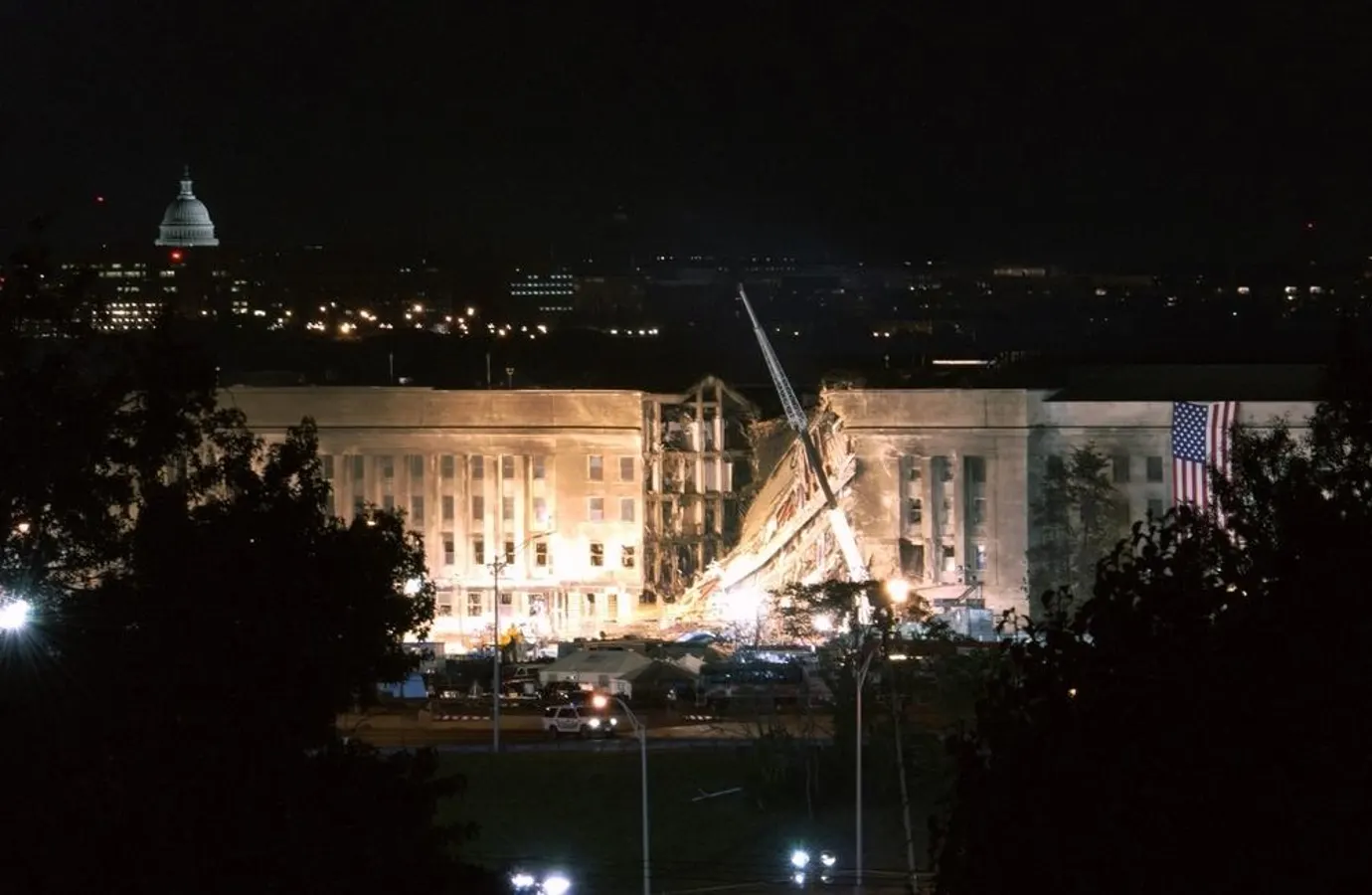

Damage to the Pentagon following the September 11, 2001 terrorist attacks. The presence of the American flag is particularly powerful.
Shutterstock – Everett Collection
As the 25th anniversary of September 11, 2001 now fades into history, the many lessons from that day and its aftermath will continue to be assessed and reassessed for another 25 years. No other event has more profoundly altered the trajectory of our country in living memory. Yet arguably one of its most important military lessons is rarely discussed.
Al Qaeda and the specific 9/11 hijackers did not discover an American vulnerability by accident, they studied us. They understood how our open society functioned, how commercial aviation operated, what our standard airline processes assumed, and how those assumptions created vulnerabilities.
They also understood something much older about warfare. Sun Tzu wrote that, “one cartload of the enemy’s provisions can be worth 20 of one’s own.”
Understanding this reveals the enormous asymmetric advantage of exploiting capabilities your adversary has already invested significant time and resources to develop. The hijackers did not have to develop and bring their own strategic transportation system to America, they used ours. They exploited the accessibility, reliability, speed, and precision of America’s commercial aviation infrastructure to attack the country that built it.
The terrorists did not need to match American technology, they needed to understand it well enough to turn our technological sophistication against us. Twenty five years later, we have yet to fully internalize that lesson as a new kind of American-built infrastructure becomes critical to both our economy, and national security: space.
The consequences of September 11 extended far beyond the terrible destruction of that morning, the attacks redirected enormous amounts of American blood, treasure, military capacity, political capital, and national attention for the two decades that followed. The tactical attack lasted hours, but its strategic consequences lasted for generations.
That must be at the forefront of our minds when we think about China and other adversaries today. They study us continuously: not only our doctrine and technology, but also our organizations, commercial companies, supply chains, dependencies, and responses to crises. We anxiously watch as China and others develop their own reusable spaceplanes and proliferated constellations in low Earth and geostationary orbits. While that is frightening enough, we should remember it is not just trying to match or destroy American capabilities but also studying how they can exploit our capabilities to use against us.
That matters because America has spent the past quarter century embedding space technology into almost everything it does. GPS supports transportation, communications, finance, agriculture, logistics, and critical infrastructure. Satellite communications connect people, machines, and military forces around the world. Commercial imagery and other space services have made capabilities once reserved for governments broadly accessible. These are extraordinary American strategic and economic strengths, which is why our adversaries are looking for ways to exploit them.
We still tend to imagine an attack in space as something physical: a missile destroying a satellite, a laser dazzling a sensor, or an adversary jamming a signal. But space capabilities require extensive ground stations, user terminals, communications links, software, data networks, cloud infrastructure, and the people and credentials that provide access to them. The easiest and most plentiful attack surface of America’s space architecture does not need to be in orbit at all. It is the cyber domain that connects everything together and it to the rest of the world, including even weapons that Secretary Meink recently acknowledged as both existing and a key part of our deterrence strategy to avoid a space war.
The greatest future space threat may therefore be an adversary gaining enough access to manipulate or exploit the infrastructure we depend on. Twenty five years ago, terrorists gained control of pieces of America’s commercial aviation infrastructure and turned its capabilities against us with devastating strategic consequences. Sun Tzu’s cartload has become a network, a signal, and a line of code.
The answer is not greater secrecy at the expense of the commercial innovation that gives America its advantage. It is to build an architecture our adversaries cannot study conclusively.
Any modern adversary of ours should never conclude that denying one signal prevents navigation, penetrating one network compromises a mission, or disabling one constellation eliminates communications. Commercial integration, proliferated architectures, alternative PNT, multiple communications pathways, and diverse suppliers create uncertainty about the effects of an attack. Resilience is not simply our ability to survive an attack. It is also the adversary’s inability to predict what its attack will accomplish.
We will be surprised again. We must assume today’s adversaries are studying our dependencies and planning how to exploit them. The next time an adversary turns American infrastructure against us, the weapon may be as seemingly innocuous as a repurposed electronic signal. Our task is to make sure they can never be certain what happens next.
The next time an adversary turns robust American infrastructure against us, it won’t be with cheap boxcutters; it may something even more seemingly innocuous: a repurposed electronic signal. Our task is to make sure they can never be certain what happens next.














Leave a comment