


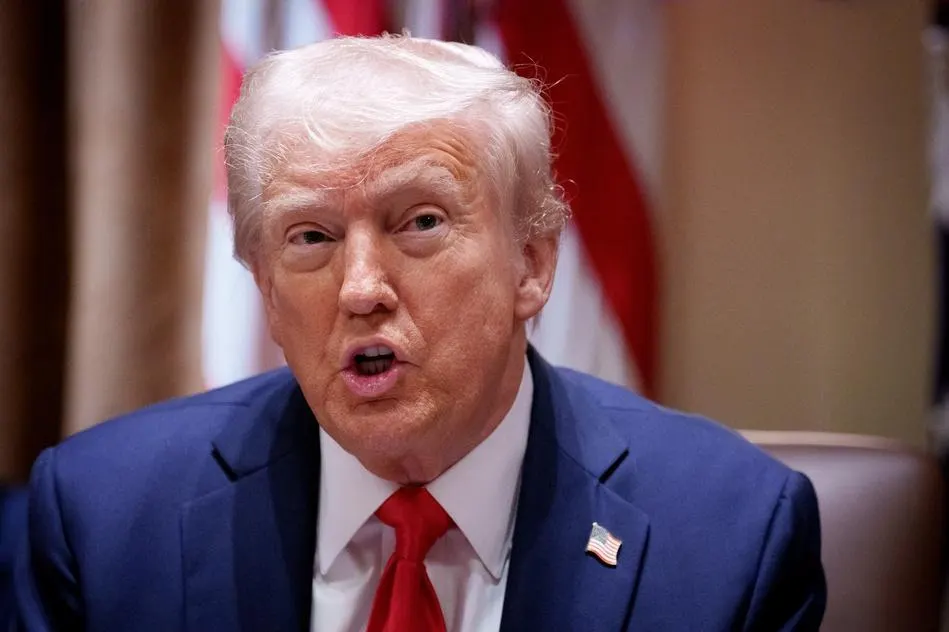

WASHINGTON, DC – FEBRUARY 26: U.S. President Donald Trump speaks during a Cabinet meeting at the White House on February 26, 2025 in Washington, DC. Trump is holding the first Cabinet meeting of his second term, joined by Tesla and SpaceX CEO Elon Musk, head of the Department of Government Efficiency (DOGE). (Photo by Andrew Harnik/Getty Images)
Getty Images
MS NOW is preparing to air paid advertisements from the Trump administration, an unusual development for a network whose hosts and journalists have spent the past week scrutinizing the ads as taxpayer-funded propaganda.
The news was first reported by Status, which learned that MS NOW executives disclosed the planned ad buy during a meeting with senior producers late Tuesday. According to people familiar with the discussion, at least one of the spots could begin airing nationally as soon as Thursday.
The disclosure reportedly caught staffers off guard. The network’s regular 4:30 p.m. meeting typically focuses on editorial priorities and the stories that will drive its prime-time programming. This time, executives also had to explain how MS NOW would handle an advertising campaign that its own programming has been examining critically.
The Trump administration’s ads have already aired repeatedly on Fox News, CNN, the major broadcast networks and during national NFL games. MS NOW has devoted more than a dozen segments to examining the campaign, including questions surrounding its funding and legality, according to Status.
The prospect of carrying the spots prompted pushback from some MS NOW employees.
One person familiar with the meeting told Status that some staffers were “pissed” about the decision, adding that “everyone is very aware that our audience is going to hate this.”
Greg Kordick, MS NOW’s senior vice president of programming, sought to address those concerns by emphasizing the firewall between the network’s editorial and business operations, according to people familiar with the meeting.
Kordick also told staffers that MS NOW planned to issue a statement after the Trump ad aired. According to Status, the proposed messaging would note the irony of the White House spending money to reach an audience whose network Trump frequently attacks.
Kordick reportedly said there had also been a suggestion that MS NOW disclose how much the network was being paid for the advertising and announce that the proceeds would be donated to charity. But, according to Status, network chief Rebecca Kutler did not want to take that approach, apparently out of concern that it could further inflame the controversy.
In a statement to Status on Wednesday, MS NOW spokesperson Richard Hudock defended the decision to accept the advertising while stressing that it does not affect the network’s journalism.
“We know the size, engagement, and influence of the MS NOW audience, and apparently the White House does, too,” Hudock said. “The decision to spend taxpayer dollars to reach our audience speaks for itself.”
“Like all paid advertising on MS NOW, this spot was subject to an established review process by the sales team,” he added. “Accepting an advertisement is not an endorsement of its message, and purchasing airtime will never purchase favorable coverage.”
The White House, when asked by Status why the administration would spend advertising dollars on a network that Trump routinely criticizes, did not directly address the question. Instead, a spokesperson described the spots as being about “reminding Americans to love their country” and characterized them as “educational” and “unapologetically patriotic.”
The advertising campaign creates an especially striking contrast with some of MS NOW’s on-air coverage. Several prominent personalities at the network have sharply criticized the spots.
On Wednesday, Nicolle Wallace characterized the ads as “Putin-esque propaganda” and compared them to North Korean state television. Morning Joe host Joe Scarborough has described them as “bad for America.”
The network’s decision to carry the advertising also underscores the distinction between MS NOW’s editorial operation and its commercial business. Executives reportedly assured staffers that the newsroom would remain free to continue covering and investigating the Trump administration’s advertising campaign even while the network sells it airtime.
That separation is reflected in the publicly available advertising standards of MS NOW parent company Versant, which state that the company accepts advertisements expressing “divergent points of view,” including political ideologies and religious beliefs.
The standards also give Versant discretion to reject advertising containing certain categories of offensive material, personal or organizational attacks, or violent or graphic content. According to people familiar with the situation, the Trump spots were not deemed to violate those restrictions.
The decision could nonetheless expose the network to criticism from viewers who see a contradiction between MS NOW’s editorial coverage and its acceptance of money from the government to broadcast the administration’s message.
It also reflects a broader question that Kutler has acknowledged publicly: how a news organization should navigate disagreements between its editorial staff and corporate decisions concerning controversial political figures.
At the Status Summit earlier this month, Kutler discussed the network’s decision to carry a substantial portion of Trump’s prime-time speech concerning election fraud. That decision had conflicted with positions expressed by some of MS NOW’s most prominent anchors.
Rachel Maddow, for example, has argued that Trump’s live appearances should not necessarily be aired because, in her view, false claims made by the president can have consequences. Wallace has also been outspoken about limiting live coverage of Trump and his press secretaries.
“I think a functioning, healthy newsroom is a newsroom where there’s disagreement. That is OK,” Kutler told Status at the summit. “I don’t ask everyone to agree with every decision that we make. I ask them to respect the decisions we make.”
The latest controversy comes as the relationship between Trump and MS NOW remains particularly combative.
Trump has criticized the network repeatedly on Truth Social over the past month, with Status reporting that he has complained about its coverage eight times. His attacks have included criticism of the network’s ratings, even as Nielsen data released Wednesday showed MS NOW’s audience had increased 20% year over year.
MS NOW was also among three news organizations that Trump recently attempted to bar from the White House grounds. A judge subsequently restored the organizations’ access through a temporary restraining order.
Against that backdrop, the administration’s decision to purchase advertising on MS NOW creates an unusual dynamic: Trump can continue attacking the network’s journalism while his administration simultaneously pays to place its message before the network’s viewers.
For MS NOW, the immediate challenge will be keeping that distinction clear — particularly for an audience that is accustomed to hearing the network’s personalities sharply criticize the very administration whose ads will soon be appearing between its programming.















Leave a comment