


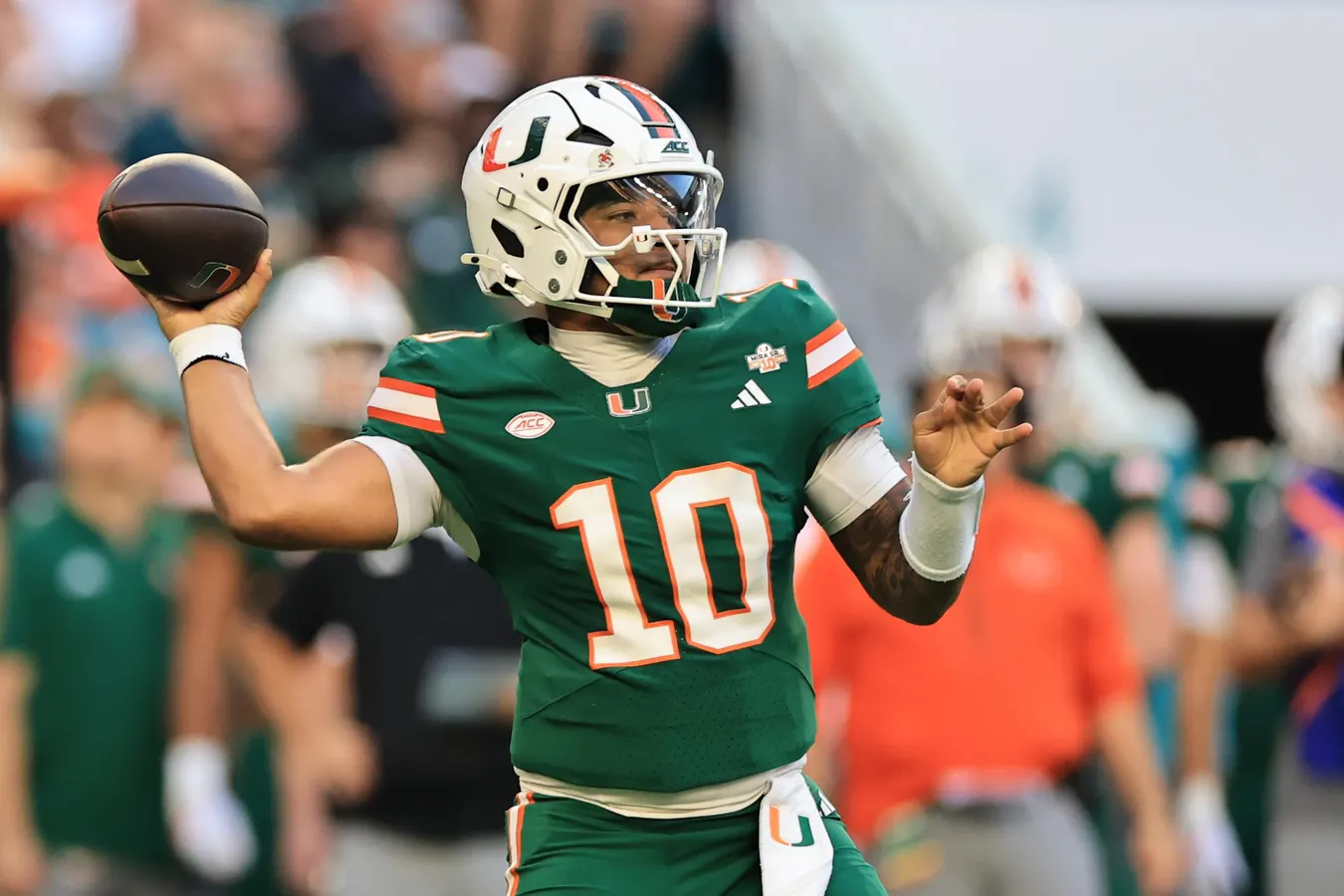

Miami QB Darian Mensah was sued by his former institution, Duke University, when he entered the transfer portal as the Blue Devils attempted to enforce the revenue sharing contract between the two parties. (Photo by Carmen Mandato/Getty Images)
Getty Images
Universities have submitted their information for the first year of revenue sharing, and the College Sports Commission says $1.8 billion was shared between institutions and athletes in 2025-26. A total of 34,915 student athletes at 307 schools across 33 conferences and 45 sports received revenue sharing funds from their schools in the first year.
Last school year, each participating institution could share up to $20.5 million with its athletes. Schools decided individually how much to share and which athletes to share with, at their own discretion. Anonymized data shared as part of the House settlement shows one school shared just $3,000
The CSC says $1,975,973,365 in payments was entered into its College Athlete Payment System, which included $1,770,453,776 in revenue-sharing payments, $42,034,090 in Alston Awards and $163,485,499 in new and incremental scholarship spending.
Of the 319 schools that opted into revenue sharing, 307 ended up compensating athletes directly. Here are some other interesting facts from the full anonymized report filed with the court in the House case:
- 63 schools reached the cap
- 5 schools came within 5% of the cap
- 10 schools spent $0 on revenue sharing, although they did engage in Alston payments or increased scholarships
- 14 schools spent less than $100,000 on revenue sharing, with the lowest at $15,000
- 72 schools reported no increased spending on scholarships
- 31 schools spent $2.5 million or more on new scholarships ($2.5M was the max that counted against a school’s revenue sharing cap)
- 122 schools reported they made no Alston payments
“The implementation of the House Settlement has resulted in $1.8 billion in direct payments from schools to student-athletes across college athletics, on top of billions in scholarship benefits. The College Sports Commission operated the system that facilitated these payments, allowing student-athletes to benefit from the new system while ensuring compliance with the rules,” said Bryan Seeley, CEO of the College Sports Commission.
The CSC was created in 2025 as a result of the House settlement as an independent body to enforce rules related to college athlete compensation, including both revenue sharing and name, image, and likeness deals. While the CAPS system manages reporting by institutions for revenue sharing, another platform called NIL Go exists to allow for reporting by athletes of NIL deals with third parties.
Division I college athletes are required to disclose any NIL deal over $600 (including multiple deals with the same party that are $600 in the aggregate) to NIL Go. Deals are also assessed to determine whether they are with an “associated entity,” and, if so, reviewed for compliance with being for a “valid business purpose” and within a “reasonable range of compensation.”
Data released in July 2026 revealed that 34,195 deals were approved for a total value of $355.24M in the first year of the platform. Meanwhile, 1,812 deals were not cleared for a total value of $89.85M. Updates data in September 2026 showed 46,478 deals worth $582.49 have cleared since June 2025, with July and August 2026 alone accounting for 12,283 deals worth $227.25 million. Those two months represent nearly 40% of all deal value approved to date.
Beginning in July 2026, the CSC announced deals valued between $600-$15,000 would not be subjected to range-of-compensation review until an athlete reaches a total of $50,000 in “associated” deals over the course of an academic year. Perhaps no surprise now that the CSC says it’s processing an average of more than 200 NIL deals per day.
Another CAPS report for revenue sharing won’t become available for a year, as institutions report annually. The cap for the 2026-27 year is $21.58 million, although that number could grow to $48.8 million annually in the future if the Protect College Sports Act becomes law.











Leave a comment