


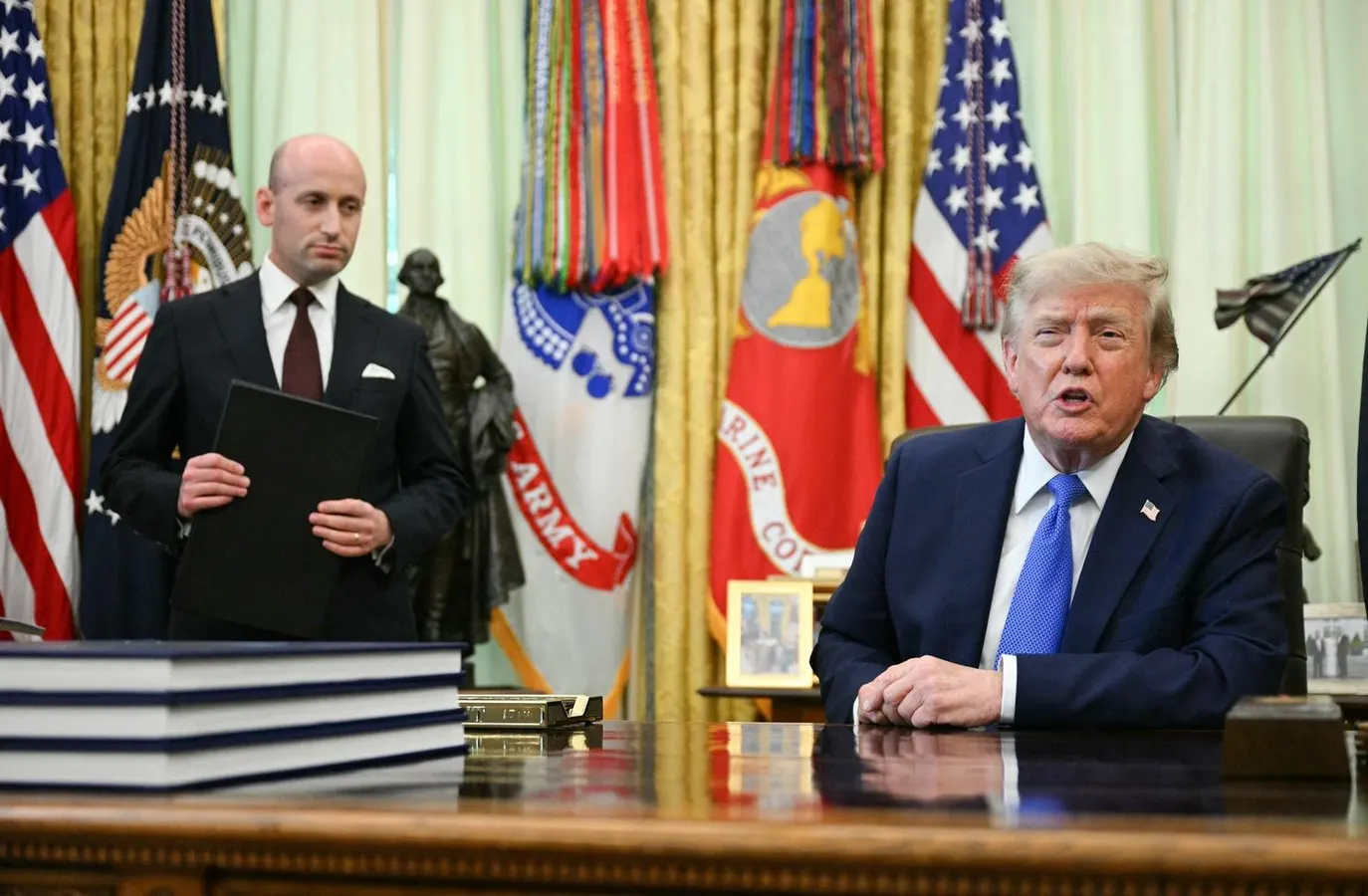

White House Deputy Chief of Staff Stephen Miller (L) holds an executive order on birthright citizenship as Donald Trump speaks before signing it on August 6, 2026. New Trump administration social media posts have boasted about reducing immigration and the number of new citizens in the United States. (Photo by Jim WATSON / AFP via Getty Images)
AFP via Getty Images
New Trump administration social media posts have boasted about reducing immigration and the number of new U.S. citizens. The posts raise questions about the veracity of previous administration statements by officials who told judges and the public the policies were needed for national security or other reasons. Economic data reveal the administration’s immigration policies have reduced the availability of workers, harmed consumers and businesses, and not benefited U.S. workers.
DHS Trumpets Declines In Immigration And Naturalization
In an October 2, 2026, post on X.com, the Department of Homeland Security posted a statement and a graphic that hailed declines in immigration and naturalization: “Net negative migration for the first time in HALF a CENTURY. Americans are amassing victories NEVER seen before thanks to President Trump. We will continue to grow our efforts to fulfill the mandate given to this administration.”
The DHS graphic featured the controversial heading “REMIGRATION REPORT.” Washington Post reporters David Nakamura and Adam Taylor detailed how the State Department’s Bureau of Population, Refugees, and Migration (and funding) turned into the Office of Remigration. After the new direction reached employees, a State Dept. staffer wrote, “It seems like the definition of remigration is ‘ethnic cleansing via the mass deportation or promoted voluntary return of non-white immigrants.’ Will this be the core of what PRM is promoting? This is, of course, beyond alarming.”
The refugee bureau’s website no longer lists its mission as admitting refugees, or even assisting them overseas, but “ending mass and illegal migration.” Two Christian groups criticized the administration for not admitting any persecuted Christian refugees in FY 2026. The policy will continue in FY 2027, according to the president’s annual refugee determination, which pledges to resettle only white people from South Africa.
The DHS social media post and a separate White House post raise questions about the Trump administration’s courtroom arguments and policy justifications in Federal Register notices, which did not list reducing immigration and naturalization as the purpose of agency memos, proposed rules and presidential proclamations.
The DHS “Remigration Report” social media post listed as “victories” the following:
- 3.3 million removals.
- 250,000 visas revoked.
- Asylum denials at 94%.
- 2,600+ 287(g) agreements.
- Travel banned from 39 countries.
- Naturalizations down 75%.
According to a National Foundation for American Policy analysis, naturalization approvals fell by 78% between January 2025 and July 2026, more than DHS boasted. The most significant factor: an August 15, 2025, U.S. Citizenship and Immigration Services memo that ordered adjudicators to “take a holistic approach in evaluating whether or not an alien seeking naturalization has affirmatively established that he or she has met their burden of establishing that they are worthy of assuming the rights and responsibilities of United States Citizenship.”
“The memo also said to go beyond someone not having any negative factors and to look for or require something more, in the form of ‘positive attributes,’” said Efren Hernandez, founder of EH3 Immigration Consulting, who was, until 2025, a supervisory policy analyst at USCIS, in an interview. “That alone would lead to more denials and probably slower processing. But beyond the actual words of the update, there is a clear undertone that would tend to shift how officers use their discretion in borderline cases.”
Hernandez said, “Officers are likely not to want to be seen as too permissive and having too high an approval rate. So, I do think that the stricter vetting combined with less use of discretion is a big reason for the increase in denials.”
Firing immigration judges who approved more cases facilitated the Trump administration’s efforts to increase removals and deny 94% of asylum claims, making it unlikely a persecution victim can find refuge in America, according to a September World Relief-Open Doors US report. Government employees would not miss the lesson that “too high an approval rate” will cost someone their job.
Critics note that at the same time USCIS, a component of DHS, issued a memo demanding a historically high standard for immigrants seeking citizenship, DHS was largely run by Corey Lewandowski as a “special government employee” reportedly in a relationship with DHS Secretary Kristi Noem. The Wall Street Journal reported Lewandowski approached foreign governments, including Qatar, for lobbying contracts on visa issues while working at DHS and is accused of seeking payments from contractors, like the GEO Group, a private prison company. According to former DOJ attorney Liz Oyer, in 2025, the president issued pardons or commuted sentences for over 100 people convicted of various crimes and “wiped out restitution, fines, and forfeitures totaling over $1.5 billion. This includes sums owed to fraud victims and taxpayers.”
The denial rate for naturalization during the Trump administration has more than doubled, increasing from 8.4% to 20.1% between January 2025 and July 2026. Under a proposed rule published in June 2026, the fee to apply online for naturalization will increase by 75%, from $710 to $1,280, and by 80%, from $760 to $1,330, for a paper filing.
In light of DHS boasting that naturalizations have plummeted by at least 75%, applicants and attorneys may decide to take with a grain of salt the Aug. 15 memo’s statement that “Evaluating aliens seeking to become naturalized is the most sacred and profound responsibility that USCIS is charged with performing.”
According to analysts, Trump officials may be motivated to reduce the number of new citizens because they believe immigrants are less likely to support Republican candidates, even though Donald Trump attracted significant support among Latino immigrants during the 2024 election. Preventing immigrants from naturalizing also restricts future immigration, since a U.S. citizen has the right to sponsor a spouse, child, parent or sibling. The new public charge rule and the prohibition on immigration from 39 countries restrict U.S. citizens’ ability to sponsor close relatives.
In 2025, USCIS Director Joseph B. Edlow made the civics exam harder to pass. An immigrant now must answer correctly 12 of (up to) 20 questions from a pool of 128 questions, compared to 6 of 10 questions from a pool of 100 questions under the prior test. DHS also plans to propose a rule likely aimed at making it more difficult for immigrants to pass the civics exam, describing it as “seeking to further enhance the integrity of the naturalization test.”
The DHS social media post came only a few days after the Official White House Rapid Response account on X.com retweeted a Cato Institute graph and wrote, “Legal Immigration from Majority-Muslim Nations Was Cut 96% Since 2024.” The Cato Institute’s David Bier replied, “Thanks for citing my work. You are violating the law and harming Americans while making the country less safe, less free, and less prosperous.”
When it replied to the White House on X.com, the Council on American-Islamic Relations raised a significant legal issue: “During the first and current Trump administration, government lawyers have denied the discriminatory purpose of the Muslim and African travel bans. The administration cannot continue to credibly claim religious neutrality while presenting exclusion associated with Muslim nations as a measure of success. . . . Courts reviewing the legality of the administration’s immigration policies should consider this official statement and reevaluate whether anti-Muslim animus has unconstitutionally motivated those policies.”
A Federal agent is photographed as ICE conduct raids on a local tire shop business in Colony Ridge on Monday, Feb. 24, 2025. (Raquel Natalicchio/Houston Chronicle via Getty Images)
Houston Chronicle via Getty Images
Immigration Reductions Have Not Yielded Economic And Political Benefits
Economic statistics show that reducing immigration has harmed the U.S. economy’s ability to grow and has not helped U.S. workers. A recent NFAP analysis found, “Donald Trump is on track to be the only president in the 20th and 21st centuries to preside over a reduction in the U.S. civilian labor force during the length of his time in office.” While the numbers fluctuate from month to month, as of September 2026, the U.S. civilian labor force has fallen by 434,000 workers since January 2025, when Donald Trump became president.
Demographics and the administration’s choice to reduce the labor supply by restricting legal immigration and deporting immigrant workers have caused the drop in America’s labor force. NFAP notes that the Congressional Budget Office and the Social Security Administration population estimates made near the start of the Trump administration for immigrants assumed about 2.2 million more foreign-born workers in 2025 and 2026. Instead, the BLS data for September 2026 show a decline of 1,028,000 foreign-born workers since January 2025.
An October 2025 National Foundation for American Policy analysis found the Trump administration’s immigration policies would lead to a potential labor loss to the U.S. economy of approximately 19 million worker-years by 2028 and 102 million worker-years by 2035. It could also lower the annual rate of economic growth by almost one-third, harming U.S. living standards. Slower economic growth will also reduce our ability to manage debt, potentially adding $1.7 trillion to Federal debt by 2035.
Trump administration officials, including White House Deputy Chief of Staff Stephen Miller and Vice President JD Vance, argued that reducing immigration, including by ending Temporary Protected Status for several hundred thousand workers, would benefit U.S. workers. Instead, the unemployment rate for U.S.-born workers has barely changed—to 4.2% in September 2026, compared with 4.3% in January 2025, when Donald Trump took office. The U.S.-born unemployment rate reached 4.6% during 2026.
U.S. workers also have not seen a wage benefit from fewer foreign-born workers in the labor force. “From August 2025 to August 2026, real average hourly earnings decreased 0.3 percent, seasonally adjusted,” the Bureau of Labor Statistics reported. Real earnings consider inflation and its impact on earnings.
Immigrant workers are also consumers, so removing people from the labor force reduces consumer spending and the jobs connected to it. Fewer workers also means fewer opportunities for businesses and entrepreneurs to invest profitably, which limits available employment opportunities.
Industry groups have complained about administration policies removing immigrant truck drivers from the workforce, which has increased prices for many transported goods, and immigration enforcement actions impeding the supply of meat for consumers. “These ICE operations are having a massive chilling effect on the legal, documented, skilled workers that put beef on the table and keep the cattle supply chain moving,” according to a statement from the Oklahoma Cattlemen’s Association, the Kansas Livestock Association and the Texas Cattle Feeders Association. Construction sites lack sufficient workers in Texas and elsewhere because the administration has focused on removing workers from the economy, according to the New York Times.
Politics influences many policy choices. “The Republican Party has lost its advantage on several key issues in the eyes of voters, including immigration: 41% say the Democratic Party would do better while 38% say Republicans,” according to an NPR/PBS News/Marist poll. Key voting blocs are also unhappy.
“In more than two dozen interviews across the region in recent weeks, Hispanic voters said they were furious over the president’s approach to immigration and the economy—the very problems they had counted on him to fix,” according to the New York Times. “Recent polls show Democrats leading Republicans among likely Hispanic voters by roughly 35 percentage points on the generic congressional ballot, which asks voters which party they will support for Congress.”















Leave a comment