


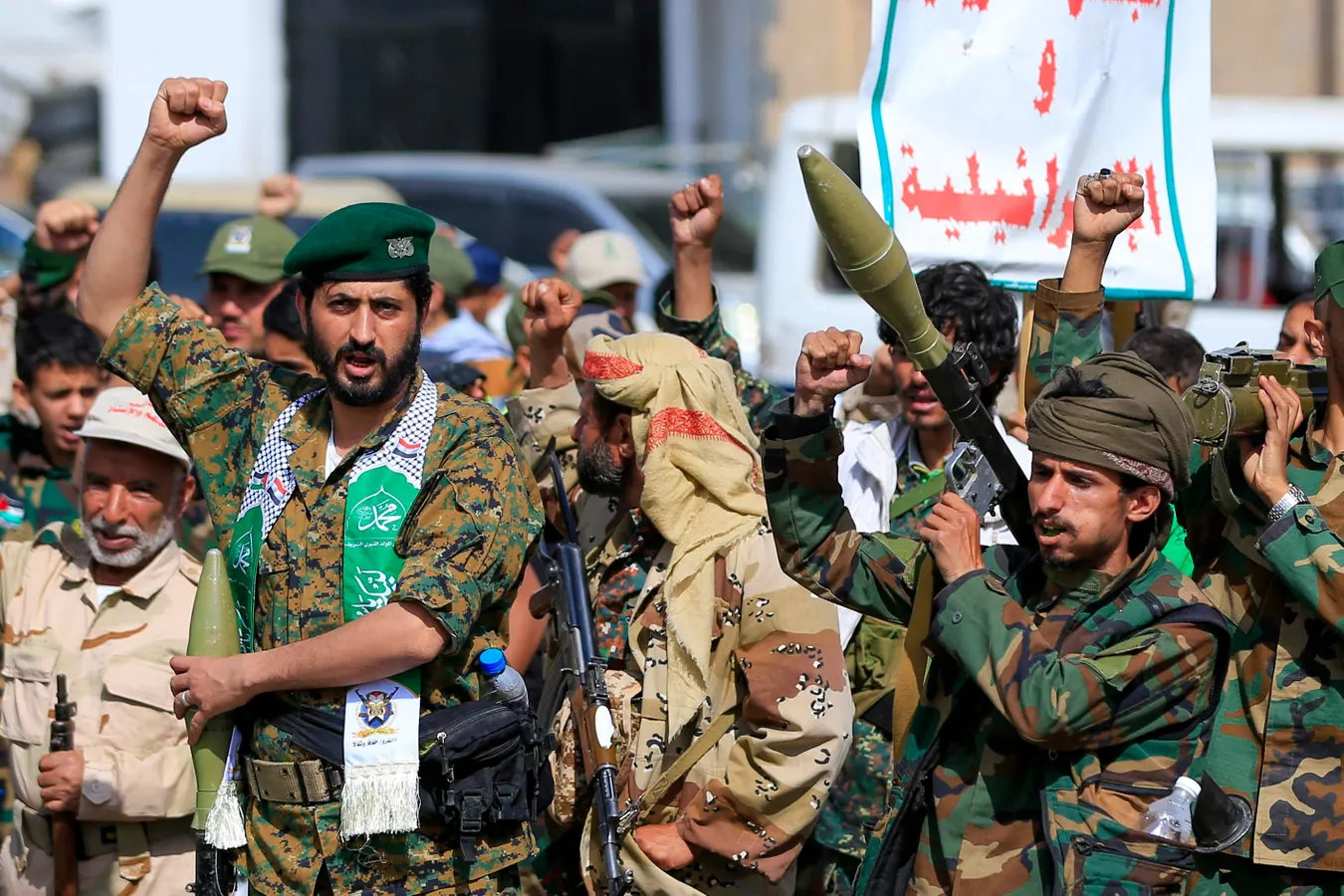

Fighters loyal to the Houthi authorities gathered in Sanaa, the capital of Yemen, last month. The country relapsed into war, drawn into the regional conflict triggered by the US-Israeli offensive against Iran.
AFP via Getty Images
The latest fighting in Yemen has been largely overshadowed in the West by the Iran war and the implications of that conflict on global energy prices. It would be a mistake, however, to not recognize the links between these wars.
The recent gains by the Houthis, a predominantly Shiite-led religious and political movement backed by Iran, are another clear sign of the risks that the Yemen conflict poses to regional and even global stability.
The Houthi Offensive
The Houthis launched a lightning offensive in September against the forces of the Saudi-backed Yemeni government, aimed largely at gaining leverage over international shipping routes and to bolster the Houthis’—and Iran’s—position in the broader Iran war. Within a few short weeks, the group captured key terrain including the historic port city of Mocha and Zuqar and Perim Islands, as well as most of Yemen’s west coast. This positioned the group to assert considerable control over shipping through the Bab al-Mandab strait, a key choke point near the southern tip of the Red Sea.
According to multiple news reports, the Houthis advanced by exploiting divisions within the Yemeni leadership and capitalizing on the government’s weak warfighting capabilities, with significant tactical support from Iran’s Islamic Revolutionary Guard Corps. Along the way, the Houthis captured considerable military hardware, including armored vehicles, rockets and various types of munitions—some of this hardware was likely provided to Yemen’s armed forces by the Saudis.
In the weeks following their offensive, the Houthis engaged in a series of missile and drone exchanges with the Saudis, with the Houthis particularly targeting Saudi energy infrastructure and targets near Riyadh. It’s also worth remembering that since 2023 the Houthis have periodically targeted merchant vessels in the Red Sea using their formidable arsenal of short and medium-range anti-ship missiles and drones, and that their newly acquired terrain along the coast greatly increases their ability to target commercial shipping.
In response to Houthi gains, the Saudis have launched their own counterattack this week using government troops backed by Saudi airpower.
Why The Fight In Yemen Matters
Although the Yemen conflict appears to be localized and a simple continuation of the country’s decade-old civil war, it has several potentially far-reaching consequences. These include:
The Global Energy Risk
With oil flows in the Hormuz Strait increasing in early October but subject to periodic Iranian harassment, the global energy market can little afford a disruption to Red Sea shipping. Oil flows through the Bab al-Mandab averaged around 8 million barrels a day in the second quarter of 2026, up sharply from last year due to the rerouting of oil caused by the Iran War. JP Morgan energy analysts note that future problems with passage of oil through the Bab al-Mandab could add $20 a barrel to global oil prices. With oil already hovering around $100 a barrel, any spike of this size in oil prices would obviously have a significant negative effect on global growth and inflation.
The Threat Of Regional Escalation
While the ground fighting has thus far been between the Houthis and Yemeni government forces, the Houthis’ battlefield gains have raised the specter that this conflict may expand in the coming weeks. Saudi air attacks against Houthi targets and Houthi targeting of Saudi cities and energy infrastructure have fueled growing concerns about a broader regional conflict involving not only the Saudis but potentially also their allies, including France, Turkey, Pakistan, and even the US. Allied support to the Saudis would likely involve the provision of air defense hardware, tactical intelligence, and air support, with no indication thus far that these allies would provide large numbers of ground troops. (There are press reports that US military advisers are already deployed to Saudi Arabia to help with the Yemen situation.) There is even a possibility that Israel, which has been targeted by Houthi missile strikes in the past few years owing to the Houthis’ strong support for Iran and the conflict in Gaza, could also get dragged into this conflict.
A Looming Humanitarian Crisis
The World Health Organization last week noted that the recent fighting in Yemen has already killed more than 800 people, wounded more than 3,000, and displaced tens of thousands of civilians. In addition, thousands of refugees have reportedly fled the fighting by crossing the Bab al-Mandab Strait by sea into Djibouti, placing acute pressure on that country’s already fragile health care and relief services. The conflict comes at a time when Yemen is already one of the world’s most desperate humanitarian situations, with more than 18 million people nationwide facing acute food insecurity and more than 2 million children under five acutely malnourished. As recent humanitarian crises have taught us, the fallout from these situations rarely stays within the affected country’s borders and has the potential to affect not only sub-regions but the entire international community.
Don’t Forget The Terrorism Threat
Finally, as is well documented, Yemen has long been home to al-Qaeda in the Arabian Peninsula (AQAP), a Sunni extremist militant group known for attempting high profile international attacks, including the attempted 2009 Christmas Day bombing of a Detroit-bound airliner. While the group has been largely diminished in recent years because of targeted US counterterrorism strikes, a loss of key terrain, and internal fragmentation, AQAP is capable of exploiting Yemen’s ongoing turmoil to carve out new recruitment space, acquire weapons, and train and plot operations. Ungoverned space has long been like oxygen to various terrorism organizations, and the current chaos in Yemen is tailor-made for these groups to exploit.
An Uncertain Outlook
I anticipate that the Saudi-led counteroffensive against the Houthis will intensify in the coming weeks. While it’s unlikely to force major concessions from the Houthis, it is possible that if coordinated closely with key allies that it could succeed in pushing the Houthis away from some of their recently acquired territory along the coast and force them further north toward their traditional stronghold along the Saudi border. This would significantly reduce, but not eliminate, the Houthis ability to target Red Sea shipping.
If the Saudi-backed offensive fails, however, the next-best option may be a diplomatic “freeze-for-freeze” deal in which Saudi Arabia would agree to halt airstrikes in Yemen, while the Houthis would agree to stop cross-border missile attacks and refrain from targeting Red Sea (including Saudi) shipping. This likely would also involve an agreement by the Saudis to funnel new money to the Houthis’ coffers.
As of now, I’d say that this doesn’t appear to be a war that either side is likely to win outright anytime soon. But given the serious stakes involved, it is one that the international community should focus on and try to resolve before its consequences expand well beyond Yemen’s isolated borders.
All opinions expressed in this commentary are solely those of the author.
















Leave a comment