


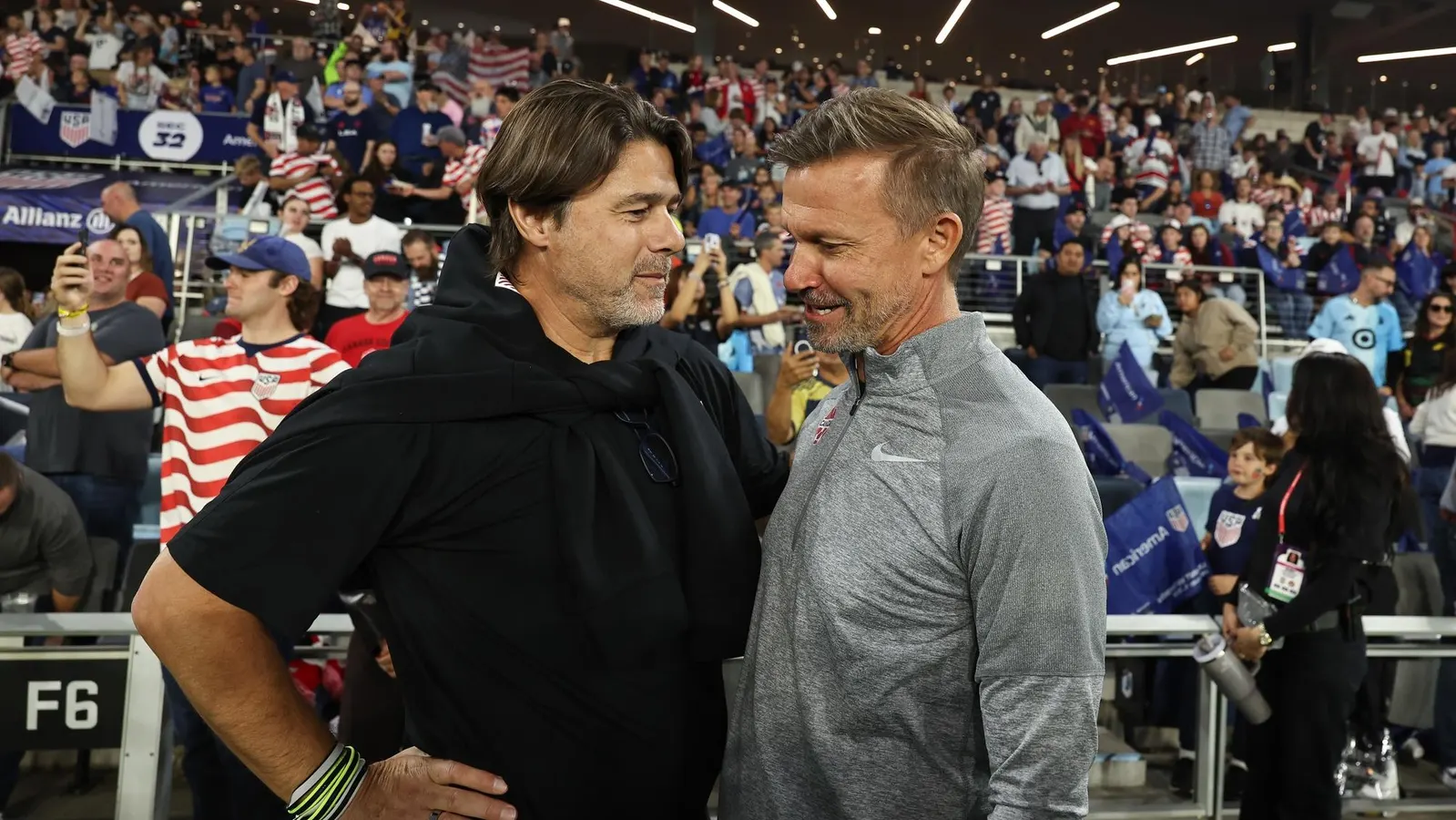

ST PAUL, MINNESOTA – OCTOBER 6: Head coach of the United States Mauricio Pochettino and head coach of Canada Jesse Marsch greet each other before the international friendly match between United States and Canada at Allianz Field on October 6, 2026 in St Paul, Minnesota. (Photo by Omar Vega/Getty Images)
Getty Images
After a convincing victory over Mexico on Saturday night, U.S. men’s national team fans could have looked toward Tuesday night’s 1-0 friendly victory against Canada as something of an afterthought.
Only Canada manager Jesse Marsch and his long-standing adversarial stance toward U.S. Soccer wouldn’t allow it.
The American manager, who has held the Canada job since May of 2024, has repeatedly needled his home country and its national team program, one he made two appearances for as a player but never managed. And he was at it again in the buildup to the final fixture for both the U.S. and Canada in this September/October international window.
This time around, Marsch asserted that FIFA’s decision to overturn Folarin Balogun’s red card was an example of “why everyone around the world hates America”. He also invoked the saga surrounding President Donald Trump’s move to rename Lake Ontario as Lake America in the eyes of the U.S. government. Never mind that the U.S. soccer fanbase, which skews young and urban, is probably less likely to support Trump than those of other U.S. sports.
If nothing else, it’s something new for those who have followed Concacaf since the United States first emerged as a credible rival for Mexico.
Having a third legitimate power in the region is good for everyone, giving more global exposure and relevance to a region too often defined by its lack of competition at the top.
Canada’s claim to that role is plenty credible after topping Concacaf World Cup qualifying in the 2022 cycle and finishing top among Concacaf teams in the 2024 Copa America (and fourth place overall). The Canucks currently sit No. 27 in the FIFA World Rankings, while Mexico is No. 16 and the United States No. 16.
And Marsch’s willingness to poke at a U.S. program he felt mistreated by during the 2023 process certainly adds sizzle to occasions like Tuesday.
Whether it is in the best interest of Canada’s national team development is another matter.
Healthy Motivation Or Destructive Obsession?
In the first half Tuesday, a clearly motivated Canadian side committed 13 fouls against the United States. According to TNT’s broadcast, that was the most suffered by a USMNT squad before halftime since a 1-1 World Cup qualifying draw at Guatemala on June 12 of 2012.
That’s the same Guatemala program that has never qualified for a World Cup, from a region that has seen minnows like Trinidad and Tobago, Curacao, El Salvador and Haiti all reach the world’s largest sporting stage. And while Canada clearly had more quality on offer than one of those sides, it was arguably reflective of a mentality beneath that quality.
Further, it didn’t work. The U.S. led at halftime on Justin Ellis’ 29th-minute tally (albeit one with a hint of offside). Canada’s better play by far came after halftime, when they at least partly abandoned their overly combative posture.
It’s arguably not the first time Canada has missed the forest for the trees under Marsch when playing the U.S.
In these sides’ previous meeting, Canada earned a deserved 2-1 victory over the U.S. in the 2025 Concacaf Nations League third-place match.
But in his second start in four days, star Canada fullback Alphonso Davies tore his ACL early in that encounter. That set off a spat with Davies’ club employer, Bayern Munich, who believed Marsch had overzealously started Davies after he played all 90 minutes in a loss to Mexico.
Davies eventually returned for Bayern last season, but his long recovery may have influenced a later hamstring strain that forced him to miss most of Canada’s 2026 World Cup.
Marsch has only faced the USMNT three times (winning twice), and only once in a competitive fixture. But that dynamic could change drastically in the remainder of the 2030 World Cup cycle.
While the two nations aren’t guaranteed any competitive meetings before the 2030 World Cup, three or four clashes is realistic between the Concacaf Nations League, Concacaf Gold Cup and World Cup Qualifying.
If it’s unclear now whether Marsch’s antagonism toward his home nation is a net positive for Canada as it continues battling for global relevance, we’ll likely soon find out.














Leave a comment