


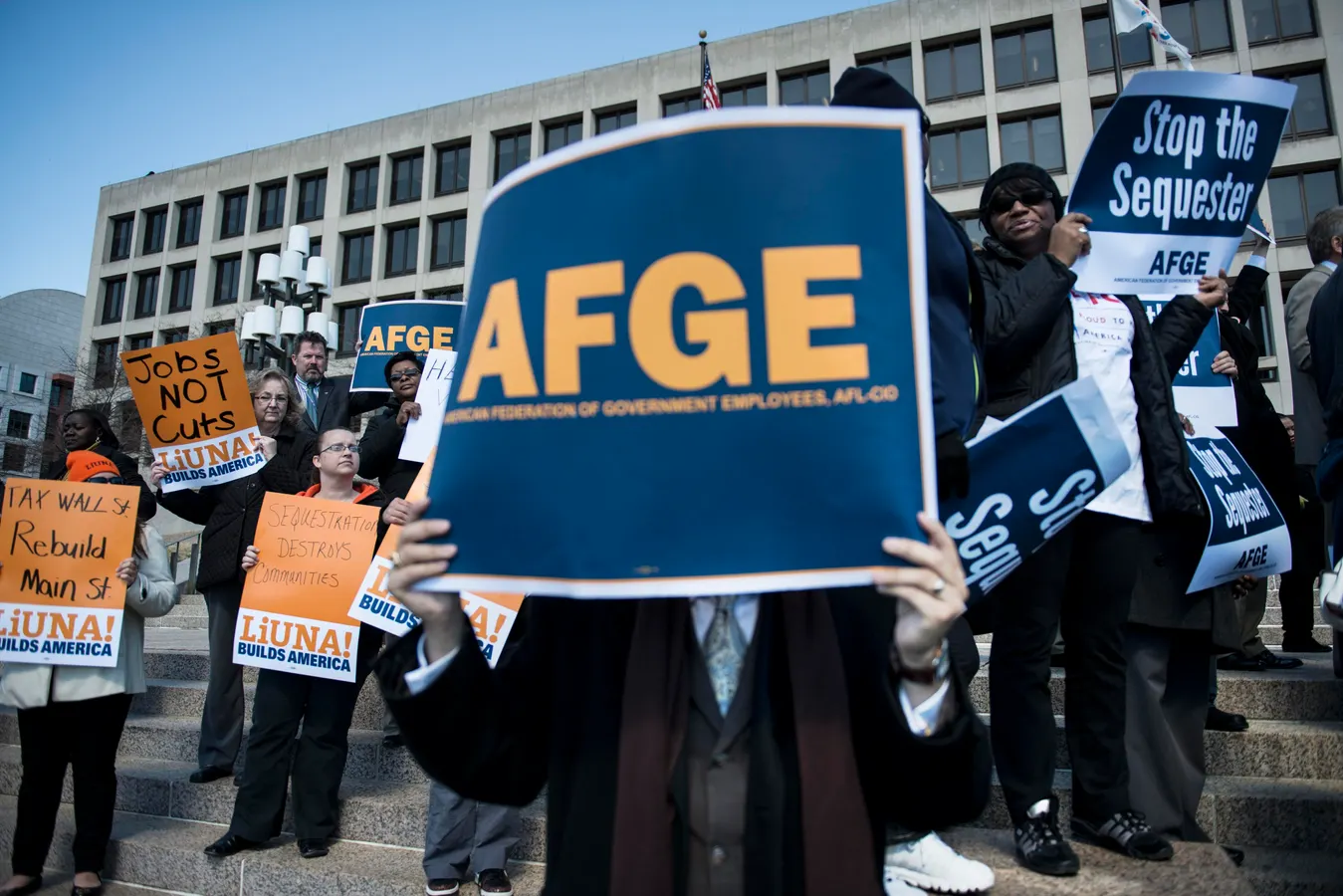

A federal judge in Connecticut will weigh in on a motion by the AFGE CPL-33 to reinstate the Collective Bargaining Agreement by telling a judge that the Bureau of Prisons is in contempt of his earlier order.
AFP via Getty Images
Just days after a federal judge ordered the Federal Bureau of Prisons to reinstate its collective bargaining agreement with the union representing thousands of its employees, the union is back in court. This time, it is asking the judge to enforce his own order.
On September 29, 2026, U.S. District Judge Vernon D. Oliver of the District of Connecticut granted a preliminary injunction requiring the Bureau of Prisons (BOP) to immediately reinstate its collective bargaining agreement with the National Council of Prison Locals, Council 33 (CPL-33), affiliated with the American Federation of Government Employees (AFGE). The ruling also reinstated amendments, local supplemental agreements and memoranda of understanding that operated under the national agreement. The union claims in its motion that the BOP has not done what the court ordered.
On October 6, CPL-33 filed a motion asking Oliver to hold the BOP and Director William K. Marshall III in civil contempt or, alternatively, to enforce the injunction. The filing turns what had already been an important federal labor dispute into something more immediate, which is whether a federal agency has complied with a direct order of a federal court.
The Judge Orders Union Contract Restored
The controversy dates to March 27, 2025, when President Donald Trump signed Executive Order 14251, excluding the Department of Justice, including the BOP, from federal collective bargaining requirements on national security grounds. The executive order relied on authority Congress gave presidents under 5 U.S.C. §7103(b)(1) to exclude certain agencies or subdivisions from federal labor-management laws when their primary functions involve intelligence, counterintelligence, investigative or national security work. The executive order, however, did not itself terminate the BOP’s existing collective bargaining agreement.
For months after Trump’s order, the BOP continued operating under its agreement with CPL-33. Then, on September 25, 2025, Marshall terminated the agreement effective immediately, approximately four years before it was scheduled to expire. The most recent agreement had been extended through May 28, 2029.
The judge was not deciding the broader question of whether Trump’s executive order was valid. In fact, litigation over the executive order has proceeded separately, and the Ninth Circuit has rejected a preliminary injunction against the order itself. Instead, Oliver focused on the BOP’s own decision to terminate an existing contract.
Office of Personnel Management guidance treated termination as something an agency could choose to do rather than something automatically commanded by the executive order. Oliver therefore concluded that BOP had discretion and that its decision was subject to review under the Administrative Procedure Act.
The President may have broad statutory authority to exclude agencies from federal collective bargaining requirements for national security reasons. But Oliver concluded, at this preliminary stage, that this did not necessarily give the BOP permission to terminate an existing agreement without satisfying the requirements governing federal agency decision-making. He then ordered the agreement restored.
A Relationship Dating Back Nearly 60 Years
The relationship between organized labor and the BOP is hardly new.
President John F. Kennedy issued Executive Order 10988 in 1962, providing federal employees a framework for collective bargaining. In January 1968, the BOP formally recognized the Council of Prison Lodges, the predecessor to today’s Council of Prison Locals, as the exclusive representative of prison employees. Congress later enacted the Federal Service Labor-Management Relations Statute as part of the Civil Service Reform Act of 1978.
It has not always been a peaceful relationship. A 2022 Justice Department Office of Inspector General report provides a remarkable history of the relationship between the BOP and its union. During the late 2000s, budget deficits and widespread understaffing coincided with deteriorating labor-management relations. By 2010, the BOP had a backlog of approximately 50 policies, and in 2013 there were still 40 policies awaiting union negotiations.
Even though there have been times that were contentious between labor and management, at times, cooperation produced results.
After approximately 13 years of negotiations, the BOP and CPL-33 reached a new Master Agreement in 2014. The BOP publicly celebrated the agreement, with then-Director Charles Samuels calling it something management and labor could be proud of. The BOP said improved cooperation contributed to the issuance of more than 100 policies during the following years.
The Political Pendulum Swung Again
President Trump ended a federal labor-management partnership initiative in 2017. President Joe Biden reversed Trump-era federal labor policies in 2021. That same year, the BOP and the union extended their Master Agreement another five years and resumed cooperative policy efforts.
Through its history, the BOP labor relations have rarely followed a straight line. Different administrations have had very different ideas about the role unions should play in federal agencies. It also shows why this dispute is about more than union dues or politics.
The collective bargaining agreement affects overtime, employee discipline, grievances, official union time, workplace policies and safety procedures. At the local level, supplemental agreements can address practical prison operations. In its September ruling, the court noted examples involving overtime procedures, medication transportation and safety practices.
Union Says BOP Has Not Complied
The union’s latest filing is only three pages, but its allegation is straightforward.
Oliver’s September 29 order directed the BOP to “immediately reinstate the CBA” along with subsidiary agreements. According to CPL-33, that has not happened.
The union says the BOP submitted a “Notice of Compliance” and a memorandum from Assistant Director Malia Wilber asserting compliance, but the union contends those documents did not identify concrete actions taken to implement the injunction.
The filing says union lawyers contacted government counsel on October 5 asking the BOP to identify the specific steps it had taken. According to the union, the response did not provide a list of implementation measures and instead stated that if union members believed BOP was violating provisions of the CBA, their recourse was to use the grievance procedures contained in the agreement.
The union’s position is essentially that it should not have to file individual grievances to force the BOP to recreate a labor-management system that the federal court already ordered the agency to restore.
CPL-33 is asking Oliver to find the BOP and Marshall in civil contempt. It also wants the court to require BOP leadership to file a sworn certification within 48 hours identifying the steps taken to implement the order and attaching instructions issued to BOP employees.
The union also asks the court to consider “coercive sanctions” if necessary to secure compliance.
Those are the union’s allegations. The court will still have to hear the government’s explanation of what it believes constitutes compliance with the injunction.
Federal Unions Have Been Here Before, But Not Quite Like This
Federal employee unions and presidential administrations have fought repeatedly over the boundaries of collective bargaining.
During Trump’s first administration, AFGE and other unions challenged three 2018 executive orders restricting various aspects of federal labor relations. A federal district judge initially blocked portions of those orders, but the D.C. Circuit reversed in 2019, concluding that the district court lacked jurisdiction because the unions were required to pursue their claims through the administrative framework established by federal labor law. The appellate court did not resolve the underlying merits of all the challenged provisions.
In this case, Oliver has already rejected the government’s effort to dismiss the Connecticut case, determined that the BOP’s discretionary decision was reviewable, and entered a preliminary injunction directing the agency to restore a particular contract.
That means the immediate issue is no longer simply the President’s power over federal labor relations. It is also the authority of a federal court to enforce an injunction against an executive branch agency.
What Happens Next?
The BOP can demonstrate that it has reinstated the agreement and provide evidence of the instructions and operational changes necessary to put the CBA back into effect. That could substantially narrow or eliminate the contempt dispute.
The government can also argue that it has complied with Oliver’s order and that individual disagreements about provisions of the agreement belong in the contractual grievance process rather than in contempt proceedings.
The union, meanwhile, will likely focus on whether the BOP has restored the institutional machinery that existed before the contract was terminated, which includes recognition of the union, representation rights, official time, grievance procedures, local agreements and other contractual protections.
There is also the larger appellate issue. The government can continue challenging Oliver’s underlying interpretation and may ultimately seek appellate relief. The Ninth Circuit’s 2026 ruling demonstrates that courts have been receptive to the President’s broad statutory national-security authority under §7103(b).
But the Connecticut case presents a narrower question that even if the President can exempt the BOP from the federal labor statute, did that automatically erase an existing contract, or did the BOP have to make, and justify, a separate agency decision to terminate it?
For now, Oliver has answered that question in favor of the union.











Leave a comment