


Topline
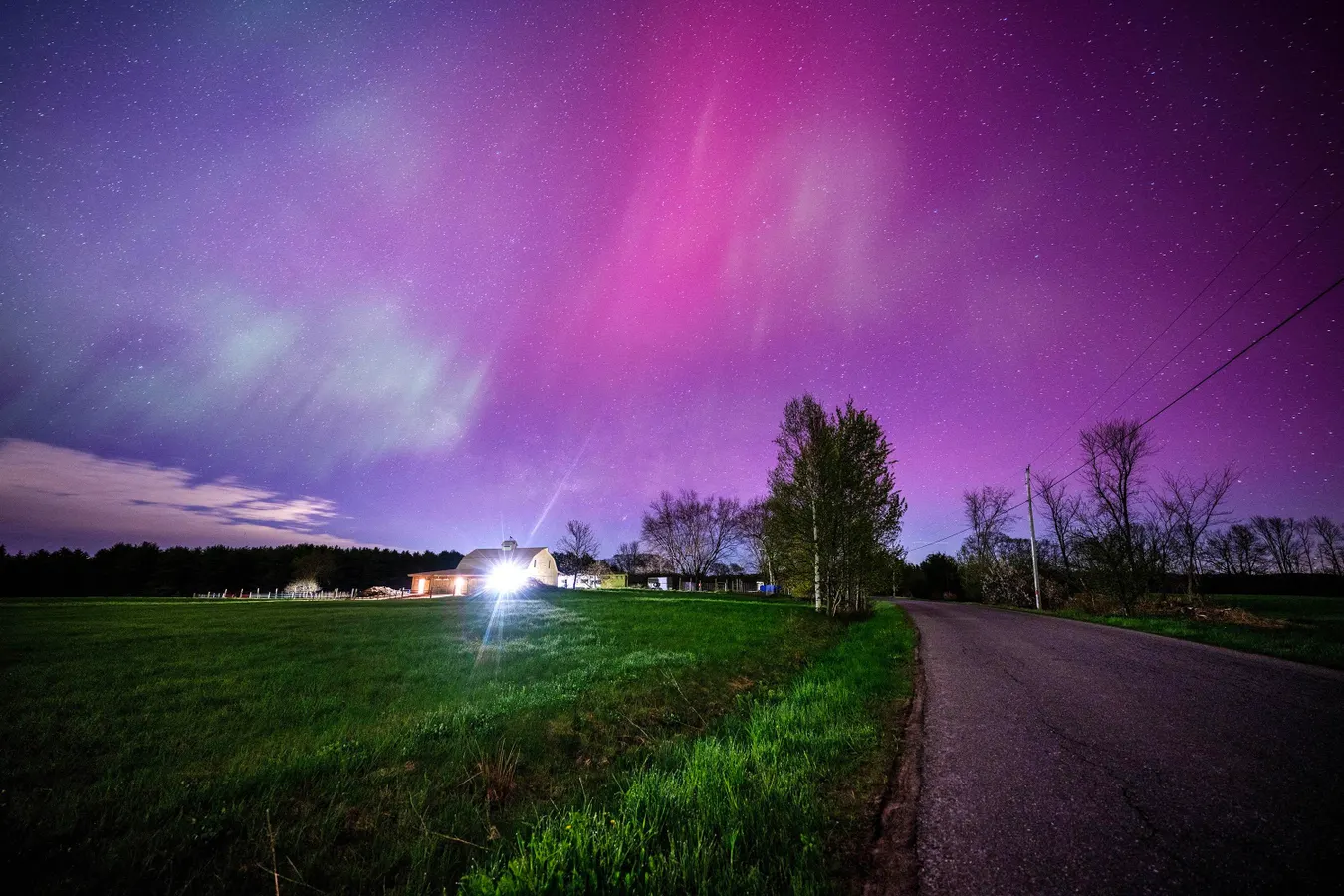
The northern lights could be visible from parts of the northern U.S. on Thursday night and early Friday morning, according to a forecast from the National Oceanic and Atmospheric Administration, which issued a geomagnetic storm watch for Friday following a solar flare and coronal mass ejection.
The aurora could be visible from 10 states in the U.S. on Thursday night and Friday morning.
Getty Images
Key Facts
NOAA is predicting a Kp index of five out of nine for Thursday, meaning the northern lights could be visible farther south and appear brighter with more “motion and formations” than usual.
Forecasters are expecting minor to moderate geomagnetic storms due to a coronal mass ejection first observed on Tuesday and expected to arrive at the earth by early Friday morning.
However, there likely won’t be much of an aurora on Wednesday night—NOAA is predicting a Kp index of only one out of nine, and the northern lights have only a “low” likelihood to appear in North America in parts of northern Canada and Alaska.
NOAA Issues Geomagnetic Storm Watch For Friday
Experts at NOAA are expecting minor to moderate geomagnetic storms on Friday due to a coronal mass ejection—a burst of plasma from the sun’s corona, or outer layer of atmosphere. This ejection was associated with an M-class solar flare. It is expected to cause geomagnetic storm conditions on Friday—up to a G2 on NOAA’s scale out of five, which can cause some damage to electrical infrastructure and high frequency radio disruptions, as well as make the aurora appear farther south than usual. However, in a storm watch issued on Tuesday, NOAA said these effects would be “mainly manageable” on Friday. In NOAA’s most recent three-day forecast, the agency predicted the most intense periods of storming coming between 11 p.m. EDT on Thursday through 2 a.m. EDT on Friday, then 5 a.m. EDT to 8 a.m. EDT on Friday morning.
Where Could the Northern Lights Be Visible?
The aurora could be visible from states along the U.S.-Canadian border, according to NOAA’s forecast map for Thursday. These include northern Washington, northern Idaho, most of Montana, far northern Wyoming, all of North Dakota, northern South Dakota, most of Minnesota, northern Wisconsin and northern Michigan. The lights could also be visible from Alaska, with a “high” likelihood forecast for most of the state. During periods of more intense geomagnetic storms, the lights could be visible even farther south, according to NOAA’s storm watch announcement—including “northern and upper Midwest states from New York to Idaho.”
NOAA’s forecast map for Thursday night.
NOAA
What’s the Best Way to View the Northern Lights?
Experts at NOAA recommend viewers travel as far north as possible, toward Earth’s magnetic north pole located in northern Canada. They should try to find a suitable vantage point to view the aurora, ideally a hill with a clear view of the northern sky. They should also try to avoid cities or other sources of light pollution. The aurora is typically most active in the hours before and after midnight, according to NOAA’s experts, so viewers should generally try to look for the lights between 10 p.m. and 2 a.m.
What’s the Best Way to Photograph the Northern Lights?
An expert who spoke to National Geographic said modern smartphones are capable of taking quality photos of the northern lights, given the correct equipment and settings. Users should remember to turn off flash, turn on night mode and shoot in RAW image format. Photographers should also bring along a tripod and a remote timer in order to hold the smartphone or other camera still long enough to capture photos in the dark.














Leave a comment