


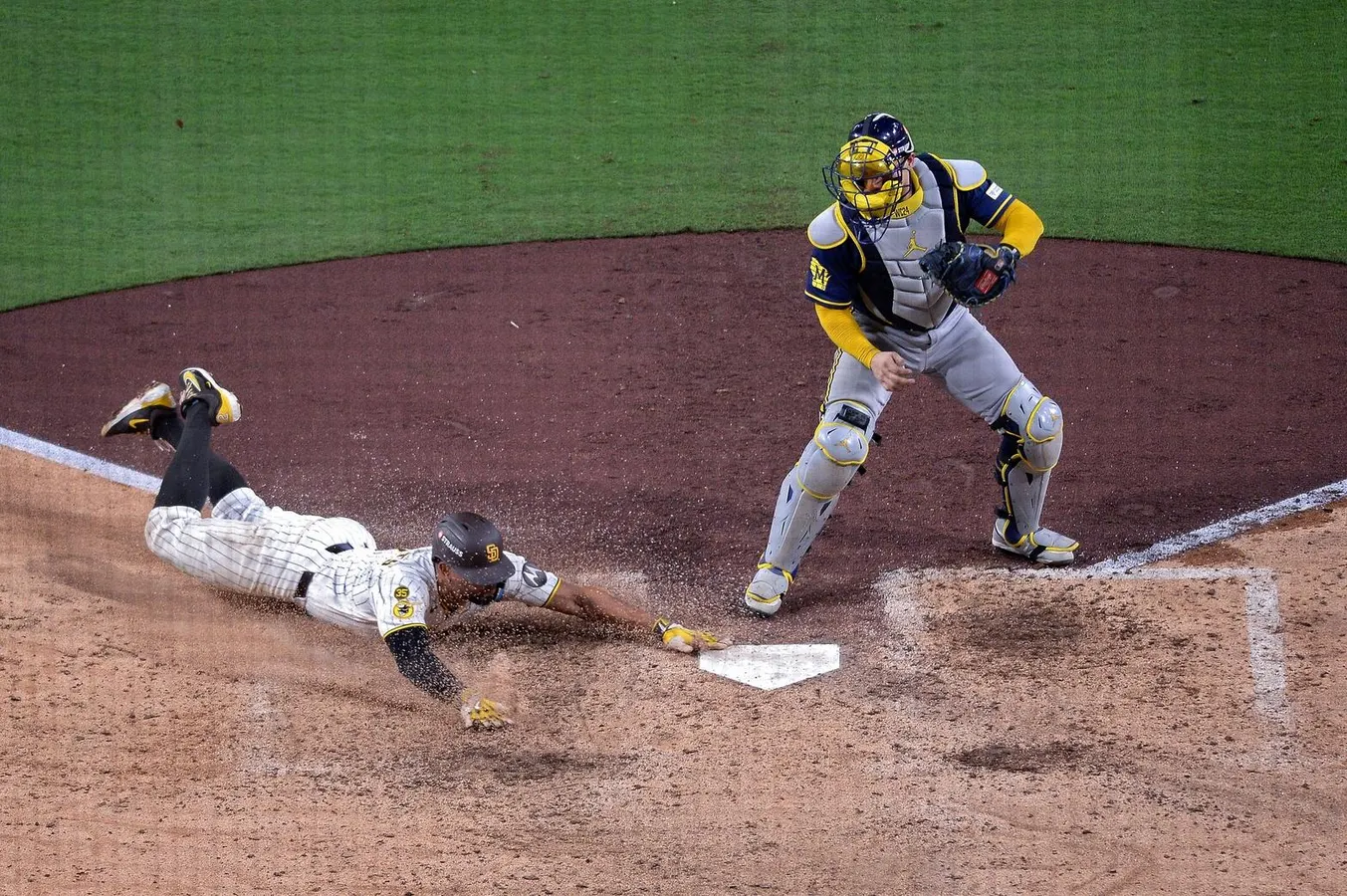

Xander Bogaerts dives across home plate to score the Padres fourth (and final) run in a 4-3 victory over the Milwaukee Brewers to stave off elimination for at least one more day. (Photo by Orlando Ramirez/Getty Images)
Getty Images
In 2022, the San Diego Padres agreed to pay shortstop Xander Bogaerts $280 million over eleven years. Was it an overpay? Well, his original team, the Boston Red Sox, offered him $90 million over four years, and then upped that to six years and $162 million. By all accounts, there were no other bidders. At the time, ESPN’s Jeff Passan wrote: “The amount the Padres were willing to spend to sign Bogaerts nevertheless stunned the baseball industry.”
Bogaerts made his major league debut for the Red Sox in August of 2013 and quickly found himself playing a new position – third base – in the playoffs. Over three post-season series that year, he played in 12 games, slashing .296/.412/.481, and showed the world that the moment wasn’t too big for him. The Red Sox won that year’s World Series and then another in 2018, this time with Bogaerts playing shortstop.
When San Diego acquired him before the 2023 season, his career slash line was .292/.356/.458, with 156 home runs and 683 RBI. And he also had played in 44 post-season games. But since arriving in Southern California, he has not lived up to the hype or the contract. Over his first four seasons, Bogaerts has an OPS+ of 105, meaning he is just 5% better than league average. That is not great for a player making more than $25 million per year and will continue to do so through 2033.
But then something like Tuesday night happens, and it might make the entire contract worth it (flags do fly forever). The Padres, after losing two heartbreaking games in Milwaukee to start the Division Series, came home with their backs against the wall. Win or go/stay home. San Diego scored two in the third to take an early lead, but then gave one back in the fourth to make it a one-run game.
It was in the fifth inning when Bogaerts made his presence felt. Milwaukee led off with two singles, and then a sacrifice bunt and a sacrifice fly tied the game at two. With two on and two out, William Contreras hit a 98-mph shot into the hole between shortstop and third. If the ball made its way to left field, the Brewers would have taken the lead. But Bogaerts dived to his right and smothered the ball before it got any farther, holding Sal Frelick at third. After a pitching change, Brice Turang grounded to – who else – Bogaerts, who stepped on second base to end the inning.
In the bottom of the sixth, Bogaerts singled with two outs. In the moment, it seemed innocuous. But when Brewers pitcher DL Hall threw a sinker in the dirt for a wild pitch, Bogaerts was able to move into scoring position. Pinch-hitter Miguel Andujar then got jammed on 96.6-mph fastball on the inner half, shattering his bat. The barrel and ball both flew towards shortstop. Bogaerts adeptly avoided the flying lumber and then patiently waited to hurdle over the approaching ball, blocking shortstop Cooper Pratt’s vision. Once Pratt fielded the ball, he rushed his throw to first, which was low and could not be scooped by first baseman Jake Bauers. When the ball trickled away from him, Bogaerts alertly sprinted to the plate to increase San Diego’s lead to 4-2 (that run would ultimately be the game-winner).
Fast forward to the top of the ninth. The Padres were clinging to a 4-3 lead with starter Michael King in his second inning of work out of the bullpen. With one out, Contreras worked a nine-pitch walk to put the tying run on base. Turang followed with a six-pitch walk to put the tying run in scoring position. At this point, King was up to 39 pitches, and the Brewers captain, Christian Yelich was coming to the plate.
Petco Park’s 47,708 fans stood, hollered, and waved their yellow towels. King took a deep breath and tried to retire one more batter. His first pitch was an 84-mph slider that Yelich crushed with an exit velocity of 107.1-mph and a launch angle of 7-degrees. According to Statcast, that exact ball has an expected batting average of .648. But this one was hit directly at Bogaerts, who was positioned perfectly. However, the ball was hit so hard and so low that the shortstop had to drop to his knees – like a catcher trying to block a pitch in the dirt – just to make sure he stopped it. Bogaerts gloved the ball, sprang to his feet, sprinted to second to record one out and then threw on the run to first to complete the game-ending double play.
Xander Bogaerts celebrates after making the game ending double play as the Padres beat the Milwaukee Brewers to force a Game 4. (Photo by Luke Johnson / The San Diego Union-Tribune via Getty Images)
The San Diego Union-Tribune via Getty Images
With his glove, with his arm, with his legs, and with his head, Bogaerts helped keep the Padres season alive for at least one more day. You cannot earn $280 million in one night, but if San Diego somehow comes back to win this series, and the next, and then the World Series, fans and commentators alike will be pointing to the “Xander Game” as one of the primary reasons the Padres won their first title.
















Leave a comment