


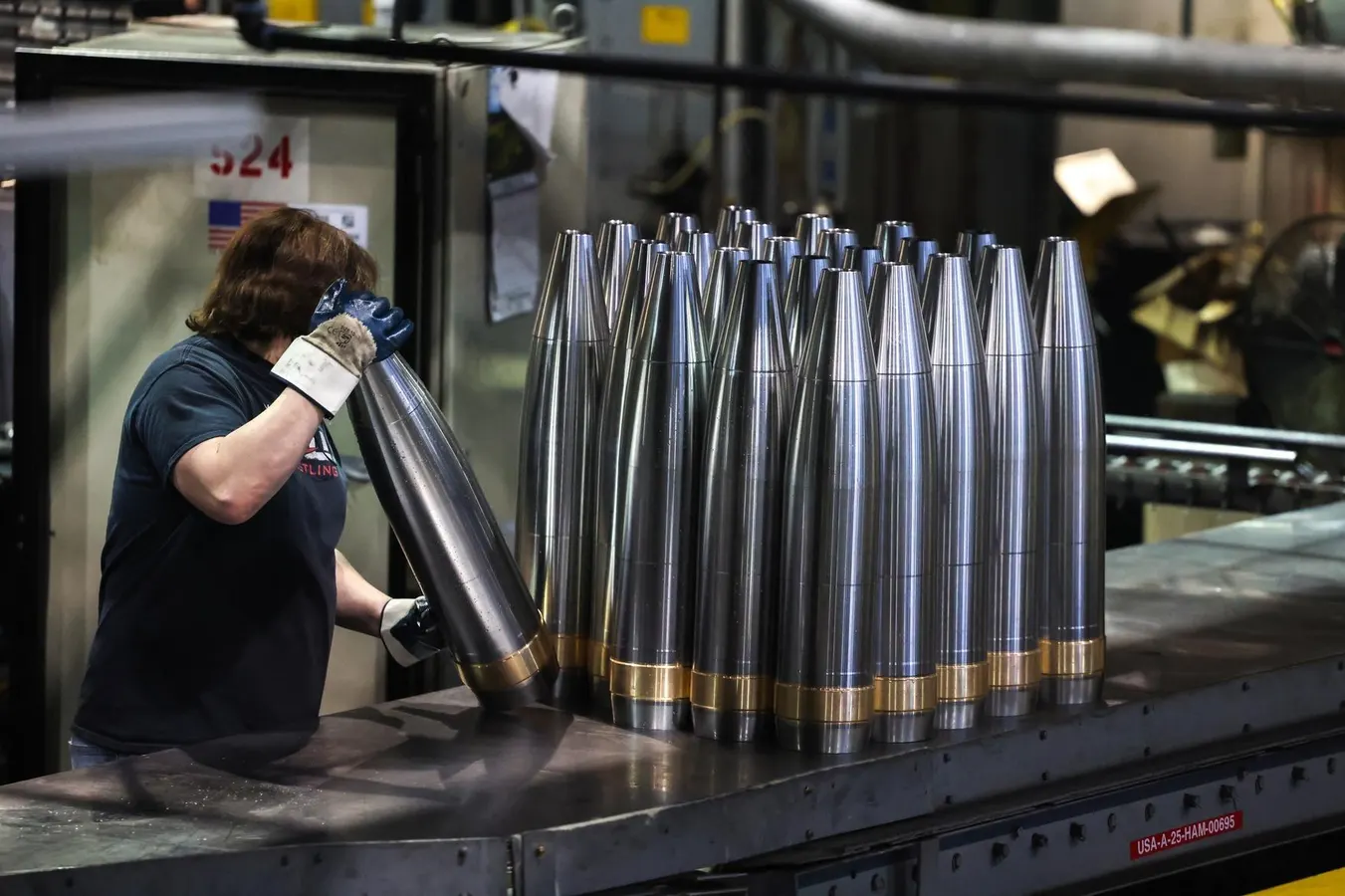

TOPSHOT – An employee handles 155 mm caliber shells after the manufacturing process at the Scranton Army Ammunition Plant (SCAAP) in Scranton, Pennsylvania on April 16, 2024. In brick buildings that are more than a century old, nearly in the heart of Joe Biden’s Rust Belt hometown of Scranton, Pennsylvania, dated machinery churns artillery for modern conflicts, especially the war in Ukraine. The Scranton Army Ammunition Plant (SCAAP) is making steel tubes for 155 mm caliber shells, which are crucial to Kyiv’s efforts to face down Moscow’s invasion. (Photo by Charly TRIBALLEAU / AFP) (Photo by CHARLY TRIBALLEAU/AFP via Getty Images)
AFP via Getty Images
Next month, millions of Americans will gather at the polls for the 2026 U.S. midterm elections. As U.S. citizens select their next elected representatives in Congress, top voter concerns can be summarized in two words: the economy. A strong military also remains a priority for voters, but amid the controversies of the war in the Middle East and foreign engagements in Ukraine, Taiwan, and elsewhere, U.S. elected officials have warned that the isolationist tide is rising in the U.S. even before the midterms render ultimate judgment.
The Trump Administration’s request for greater defense spending has encountered opposition. To date, the House of Representatives and the Senate have not approved the administration’s record $1.5 trillion defense request for fiscal year 2027. Congress cleared a continuing resolution (a short-term funding extension) on September 1 to extend current spending levels, but it will only last through December 11.
If approved, the proposed defense budget, in addition to “providing a raise to service members,” will buy “munitions, planes, tanks, and ships.” It will also “expand multiyear contracts up to seven years for critical munitions,” and “incentivize long-term investment across the supply chain.” However, in February, The Washington Post reported that some senior officials “resisted the decision to approve the major military spending increase.” Meanwhile, U.S. Secretary of Defense Pete Hegseth said on September 30 that the United States military would “cut 20% of its generals and admirals,” noting, “I call it accountability and long overdue.”
There have also been discussions of withdrawing U.S. troops abroad, as well as some actual withdrawals. U.S. Ambassador to Turkey Tom Barrack, who also serves as the special envoy to Iraq and Syria, celebrated the U.S. troop withdrawal from Iraq on September 30 following a 2024 agreement between the U.S. and Iraq. Elsewhere, with U.S. President Donald Trump’s reported frustration with the lack of European cooperation around the conflict with Iran, Hegseth canceled one U.S. military deployment to Europe and ordered a withdrawal, reducing U.S. presence there. The administration argued that the Europeans must “take over primary responsibility for Europe’s defense.”
Meanwhile, in Congress, Republican Senator Rand Paul is arguing that increasing military spending is “fiscally irresponsible.” Similarly, Politico reported in August that “several top Republicans are skeptical about the Trump Administration’s two-track approach to clinching $1.5 trillion” for the defense spending request.
Policy analysts have also questioned U.S. defense spending and America’s presence abroad. Dr. Jennifer Kavanagh, a Senior Fellow and Director of Military Analysis at Defense Priorities, argued in a report published September 10 that the U.S. should “narrow its defense commitments” in Asia. Defense Priorities has received substantial funding from the Charles Koch Institute and millions of dollars through National Philanthropic Trust, a donor-advised fund that, by its own description, does not necessarily disclose the identity of the underlying donors.
Steven Kosiak, a nonresident fellow at the Quincy Institute for Responsible Statecraft, which has received substantial funding from Koch-affiliated and Soros-affiliated organizations, published an April report titled “Trump’s $1.5 Trillion Defense Budget Request: Unhinged, Unaffordable, and Unnecessary.” Eldar Mamedov, also a nonresident fellow at the Quincy Institute, has argued that the U.S. should sharply reduce its presence in the Gulf if the U.S. reaches an agreement with Iran.
The arguments against U.S. defense spending and calls to reduce America’s presence abroad reflect a range of motivations. Mamedov, a former Latvian diplomat, was suspended from his role as foreign policy adviser to the Socialists and Democrats group in the European Parliament and referred to the Belgian authorities over the “Qatargate” cash-for-influence scandal. Additionally, the exiled Iranian opposition group National Council of Resistance of Iran, which Mamedov has publicly criticized, has called him an “Iran lobbyist.”
After being suspended from the European Parliament, Mamedov subsequently became a nonresident fellow at the Quincy Institute, where he has continued to advocate a substantially reduced U.S. military role abroad. For example, he has called the U.S. war with Iran an “illegal, unprovoked war of aggression.” He has also argued that “there is no point in engaging with the U.S. as it does not negotiate in good faith.” At times, isolationist voices are indistinguishable from those of America’s opponents around the world, while supporters of a larger defense budget argue that such positions would weaken U.S. and allied interests.
For many Americans, support for a reduced U.S. role in world affairs reflects a desire to focus on domestic issues, according to the Chicago Council on Global Affairs. What these discussions can overlook, however, is how robust U.S. international engagement supports the global system built after World War Two. It is also vital for the U.S. economy.
According to the U.S. Government Accountability Office, the U.S. Department of Defense is “one of the nation’s largest employers,” and FEDweek notes that DoD has almost 3 million military and civilian employees. This figure includes U.S. service members and federal employees worldwide. The Aerospace Industries Association, an industry trade group, adds that the aerospace and defense industry in the U.S. supports around 2.1 million jobs, with nearly half in defense.
Given this vast global workforce, part of the annual U.S. defense budget goes to paying American service members and federal employees. The U.S. defense budget also covers benefits and healthcare for DoD employees.
Foreign military sales have also helped boost the U.S. economy. According to the U.S. Department of State, for fiscal year 2025 the “number for total sales, both government to government Foreign Military Sales, and exports licensed via Direct Commercial Sales was $331.18 billion.”
Of the $104.38 billion implemented through the Foreign Military Sales program, $75.90 billion was funded by partner nations and international organizations in 2025. Additionally, the U.S. Army announced in May that it “plans to launch [a] marketplace to streamline U.S. weapons exports to allies.” This will further strengthen defense cooperation between the U.S. and its allies and partners by speeding up the weapons-sales process.
The U.S. is also engaged in the Prioritized Ukraine Requirements List. Under this program, NATO allies and partners purchase U.S.-made weapons, which are then sent to Ukraine. According to the inspector general overseeing Operation Atlantic Resolve, allies have contributed or pledged $6.3 billion through the program.
More broadly, U.S. aid to Ukraine has helped strengthen American national security and defense, according to a report published by the Center for Strategic and International Studies. The think tank found that between February 2022 and April 2024, Congress appropriated $113 billion in U.S. aid related to the war in Ukraine. Of that $113 billion, “as much as $68 billion is destined to be invested here at home.” CSIS further reported that as the U.S. sent Ukraine equipment, Congress appropriated funds allowing U.S. manufacturers and businesses to replenish stockpiles, adding that this impacted “prime vendors and critical suppliers in 37 states.” In other words, as the U.S. sent defense assistance to Ukraine, it also used funds to help the U.S. replenish its stockpiles with modern technology and new weapons.
In another example of how DoD and the broader defense industry contribute to the U.S. economy, the TD Economics September 2026 State Economic Forecast indicates that defense manufacturing helps bolster local economies. The federal government and companies within the defense industrial base require specialized and skilled workers, which leads to high-paying jobs. Defense firms, manufacturing plants, and military bases across the United States also employ thousands of Americans, and the U.S. is continuing to open new factories across the country.
Finally, at a time when U.S. job openings are low and hiring is weak, and as labor market fears persist, the workforce in the defense industrial base has continued to grow. According to ClearanceJobs, several new contracts issued to companies in the American heartland include hundreds of millions of dollars for facility upgrades, job creation, and strengthening the defense industrial base. For example, in February 2026, Avio USA announced that it will invest more than $500 million in a new solid-rocket-motor manufacturing facility in Pittsylvania County, Virginia, for defense, missile, and space applications, with more than 1,000 jobs expected. Also, in July 2026, Lockheed Martin announced an investment of more than $60 million, doubling the size of its Archbald, Pennsylvania operation and creating more than 700 new jobs while expanding production of munitions and components supporting programs including PrSM, THAAD, and PAC-3 in Jessup, Pennsylvania. Additionally, programs such as the Defense Civilian Training Corps and the Reserve Officers’ Training Corps prepare American men and women for careers with DoD and the U.S. military.
In other words, supporters of a larger defense budget argue that it enhances U.S. national security, bolsters the defense sector, and strengthens the American workforce by creating jobs. DoD and the defense industrial base play an important role in the U.S. workforce and economy. Rejecting or scaling back the defense budget would scale back spending on U.S. weapons and stockpiles, but it would also affect the U.S. workforce and the economy.
As elected officials finalize their campaigns for the 2026 midterm elections, American voters will watch how debates on U.S. defense spending progress. Once Congress returns from the midterm elections, the House and Senate will re-evaluate the proposed $1.5 trillion defense budget, aware that the December 11 deadline for the continuing resolution on defense spending is approaching. Defense experts will be anxious to see what unfolds, as the decision on increasing the defense budget will affect both national security and the defense industrial base.
Disclaimer: Mark Temnycky was a defense contractor who provided contract support to various divisions within the U.S. Department of Defense’s Office of the Under Secretary of Defense for Acquisition and Sustainment from June 2018 to March 2025. In this capacity, he wrote congressional reports, conducted legislative audits, and prepared briefings and action memos for senior government officials on topics pertaining to defense acquisition and defense innovation. As a defense contractor, his contract support work did not address or cover munitions stockpiles, defense production, defense manufacturing, or weapons contracting. As of March 2025, he is no longer a defense contractor.















Leave a comment