


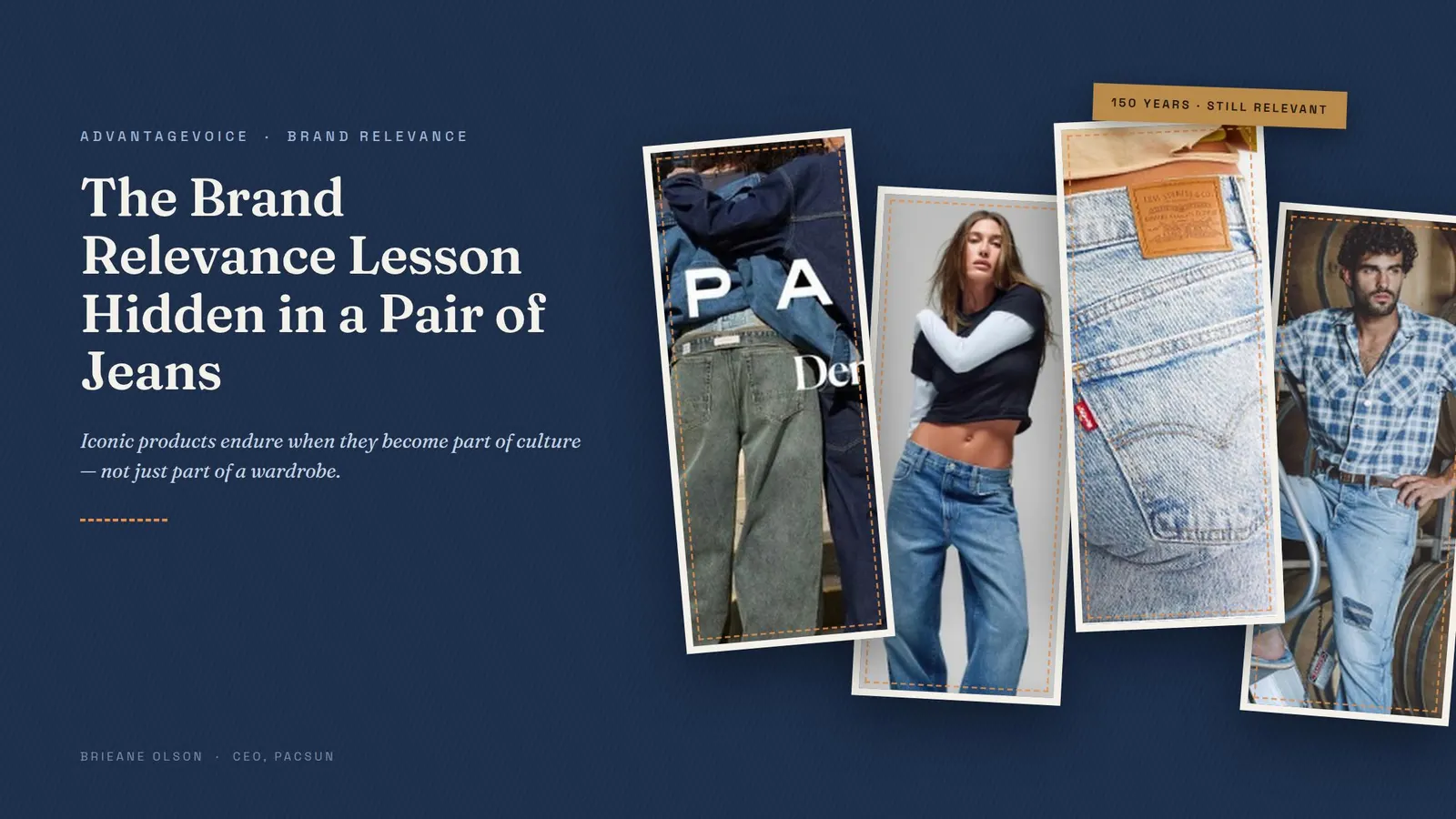

Levi’s transformed durable workwear into a universal symbol of individuality.
Brieane Olson
Few products have remained culturally relevant for more than 150 years. Denim has. It has outlasted countless fashion trends, economic cycles, and shifts in consumer behavior. It has been worn by miners and movie stars, artists and athletes, teenagers and CEOs. Having spent nearly two decades at the intersection of youth culture and retail, I’ve come to believe that denim’s endurance has less to do with the fabric itself and more to do with what the brands that built their legacies on it understood about reinvention. The lessons in brand relevance go far beyond fashion.
What the Iconic Denim Brands Got Right
Levi’s, Gap, and Ralph Lauren each approached denim differently. Yet they all succeeded because they understood that iconic products endure when they become part of culture rather than simply part of a wardrobe. Levi’s transformed durable workwear into a universal symbol of individuality. Gap democratized denim for millions, proving that simplicity and accessibility could define an era. Ralph Lauren elevated it into a lifestyle, pairing timeless American style with aspiration and craftsmanship.
That kind of lasting brand relevance is rooted in trust. As Levi’s European MD Lucia Marcuzzo noted recently, “In times of uncertainty, people revert to brands they trust.” That trust takes time to build and work to preserve—and it means evolving with consumers, not dictating to them. The brands that have navigated decades of shifting consumer preferences have done so not by protecting their legacy, but by reinterpreting it for each new generation. Young consumers don’t reject heritage; they reject stagnation. Heritage creates credibility. Reinvention creates relevance.
The Authenticity Shift
Trust remains an enduring principle—but how it gets built has changed. We’ve entered the trust economy, where influence alone is no longer enough and the most powerful brand building happens through creators and communities. The influence once held exclusively by magazines, runway shows, and celebrity campaigns has been redistributed across creators and social platforms. Today’s fitting room is often a creator’s video. Nowhere is that more visible than in denim.
Consider the case of Lyla Biggs. In November 2023, the creator, who at the time had just 5,000 followers, posted a video wearing a low-rise baggy jean. Within 48 hours, 11,000 pairs had sold, generating over $20 million in sales from social commerce alone. The video was not part of any larger campaign—simply the initiative of one person sharing how a pair of jeans fit, and a community responding in real time.
That appetite for authenticity doesn’t stop at the creator. It runs all the way through to the product itself. Salvage denim—raw, untreated indigo that fades and forms uniquely to the wearer—is making a meaningful comeback in 2026. Beyond creators they trust and read as authentic, young consumers are seeking products they see as authentic, too: crafted with intention, designed to last, and impossible to replicate.
What Denim Teaches Us About Brand Relevance
Every generation has redefined denim. One decade favors skinny jeans, another embraces oversized silhouettes, and tomorrow the silhouette will shift again. But denim’s role remains remarkably consistent: it gives people a way to express who they are.
Lasting brands like Levi’s understand the power of that essential appeal and don’t interfere with it. Instead of reinventing themselves every season, they reinterpret their purpose for a new generation while remaining true to themselves. Like denim, they offer consumers steadiness and authenticity. And by staying themselves, instead of always chasing what’s new, they establish the kind of trust that allows for enduring brand relevance.
















Leave a comment