


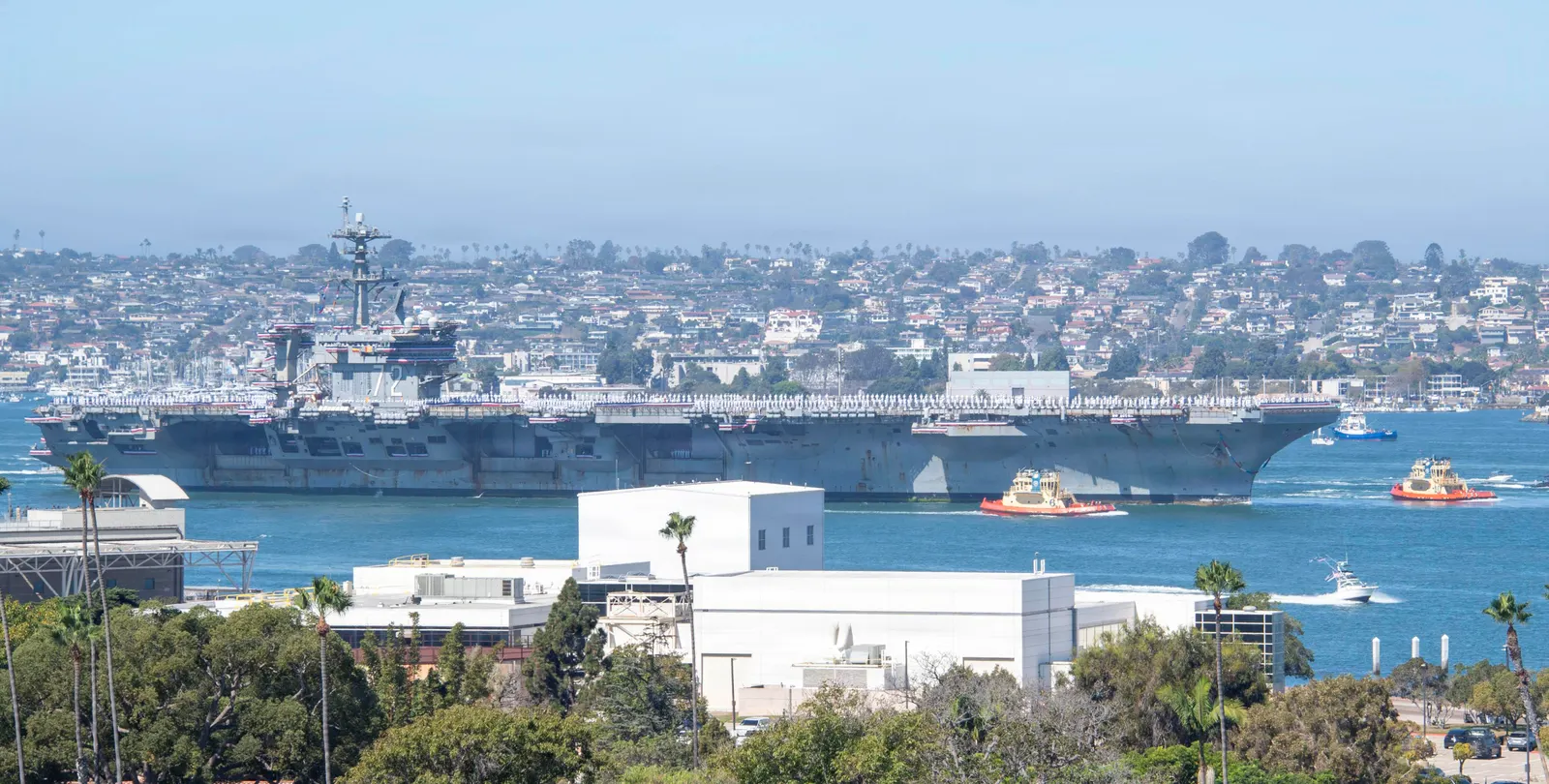

U.S. Navy Nimitz-class aircraft carrier USS Abraham Lincoln (CVN 72), returns to its home station at Naval Air Station North Island, Calif., Oct. 8, 2026, following 10 months of operations in the U.S. 5th and 7th Fleet areas of operations.
(U.S. Navy photo by Mass Communication Specialist 2nd Class Alexander Timewell)
The United States Navy’s supercarrier USS Abraham Lincoln (CVN-72) arrived at Naval Air Station North Island in San Diego, Calif., on Thursday afternoon, ending a grueling 322-day deployment, the second-longest time at sea for any aircraft carrier since the end of the Cold War.
“U.S. Navy Nimitz-class aircraft carrier USS Abraham Lincoln (CVN 72), returns to its home station at Naval Air Station North Island, Calif., Oct. 8, 2026, following 10 months of operations in the U.S. 5th and 7th Fleet areas of operations,” the U.S. Navy announced. “An integral part of the U.S. Pacific Fleet, U.S. 3rd Fleet leads naval forces in the region and provides the realistic, relevant training necessary to execute our Navy’s role across the full spectrum of military operations – from combat operations to humanitarian assistance and disaster response.”
The arrival at Naval Base San Diego came one day after Secretary of Defense Pete Hegseth paid a visit to the warship to thank the crew for their sacrifice and to present the Presidential Unit Citation – the highest unit award – to the USS Abraham Lincoln Carry Strike Group (CSG-3).
During this now-completed deployment, CSG-3 executed 3,693 combat sorties, delivered 1.37 million pounds of ordnance, launched 450 Tomahawk land-attack cruise missiles, shot down 77 Iranian one-way attack drones, sunk 64 Iranian warships, destroyed 21 anti-ship cruise missiles and defended against four fast-attack craft and dhows, Hegseth noted during the presentation.
Acting Secretary of the Navy Hung Cao also welcomed home the USS Abraham Lincoln and CSG-3.
A Long Haul For CVN-72
The fifth Nimitz-class nuclear-powered flattop departed from Naval Base San Diego on November 21, 2025, for a planned mission to the Western Pacific that was expected to have ended by summer. In January, CVN-72 was dispatched to the Middle East as part of the U.S. military build-up before the start of Operation Epic Fury on February 28, 2026.
Even as combat operations wound down this spring and into the summer, the USS Abraham Lincoln remained in the Arabian Sea to help enforce a U.S. naval blockade. Its time deployed this year was only surpassed by that of the Naval Station Norfolk, Va.-based USS Gerald R. Ford (CVN-78), which spent 326 days, or roughly 11 months, deployed, including to the Middle East. CVN-78 also operated in the North Sea, the Caribbean and the Mediterranean.
The USS Abraham Lincoln was commissioned on November 11, 1989, and past nearly four decades, the supercarrier has conducted multiple humanitarian missions in the Persian Gulf and Pacific region and took part in multiple combat operations. Following its 49-and-a-half-month overhaul in 2017, CVN-72 became the first carrier in the U.S. Navy’s fleet that will be able to operate Lockheed Martin F-35C Joint Strike Fighters from its decks.
Deteriorating Conditions On The Carrier
CVN-72’s mission was twice extended, but in addition to the prolonged time away from home, it has only made two brief port calls in more than eight and a half months, and that time away from port resulted in far from ideal conditions on the aircraft carrier.
In August, reports circulated that the crew was dealing with moldy showers, clogged toilets, and shortages of food and necessities such as toothpaste, deodorant, and soap. Secretary Hegseth dismissed the reports as fake news.
However, the situation aboard the warship continued to make headlines this week, and it was disclosed that multiple sailors had attempted to jump overboard. One sailor even went overboard but was quickly rescued.
The troubles aboard the USS Abraham Lincoln then caught the attention of U.S. lawmakers, who have called upon the Pentagon to address the issue.
In August, the United States Navy dispatched the only forward-deployed supercarrier, the Yokosuka, Japan-based USS George Washington (CVN-73), to the Middle East to relieve USS Abraham Lincoln. That was an unexpected move, as CVN-73 – much like CVN-72 in January – was operating in the South China Sea when the call went out directing the carrier to the Arabian Sea, leaving the U.S. Navy without a significant asset in the Western Pacific.
Another San Diego-based supercarrier, the USS Theodore Roosevelt (CVN-71), is now en route to the Middle East and is expected to arrive later this month. CVN-71 spent much of August preparing for its next patrol after leading the 2026 Rim of the Pacific international naval exercises off Hawaii in July.
Too Few Carriers Means Longer Deployments
The long deployments of CVN-78 and now CVN-72 aren’t likely to be exceptions to the rule, but could rather be the new normal. The fact remains that the United States Navy has just 11 operational carriers.
Under Title 10 U.S.C. § 8062, the U.S. Navy must maintain 11 active aircraft carriers on paper, yet only three to five are regularly deployed or immediately available around the world at any given moment. This standard availability is driven by the Navy’s Optimized Fleet Response Plan, which has structured carrier schedules around a “rule of thirds” over a 36-month readiness cycle.
It means that three or four carriers are actively stationed forward or patrolling strategic waters, such as the Indo-Pacific, the Mediterranean, or the Red Sea. Another three to four are engaged in readying for the next deployment, which includes conducting sea trials or intensive training, or holding in a “surge-ready” sustainment phase, ready to deploy rapidly if a crisis arises. The remaining three to four carriers are in dry docks for long-term overhauls, technical upgrades, or mid-life nuclear refueling, rendering them completely unavailable for immediate combat tasking.
In peacetime, this rule of thirds barely works given delays at the U.S. Navy’s few shipyards.
As the United States Navy has kept two carriers in the Middle East to deal with Iran, it lacks assets for other areas of responsibility. That has resulted in longer deployments, which mean longer maintenance periods, and the cycle repeats.
The East Coast-based USS George H.W. Bush (CVN-77), the tenth and final Nimitz-class supercarrier, also began its 2026 deployment on March 31, 2026, and is nearing 200 days at sea. Only last week did CVN-77 finally make a port call in Thailand to give the crew a respite from being on station in the Arabian Sea and the U.S. 5th Fleet area of operations to support the U.S. Navy’s ongoing blockade of Iran. It is unclear how long CVN-77 could remain in the region, but it likely could stretch beyond 300 days.














Leave a comment