


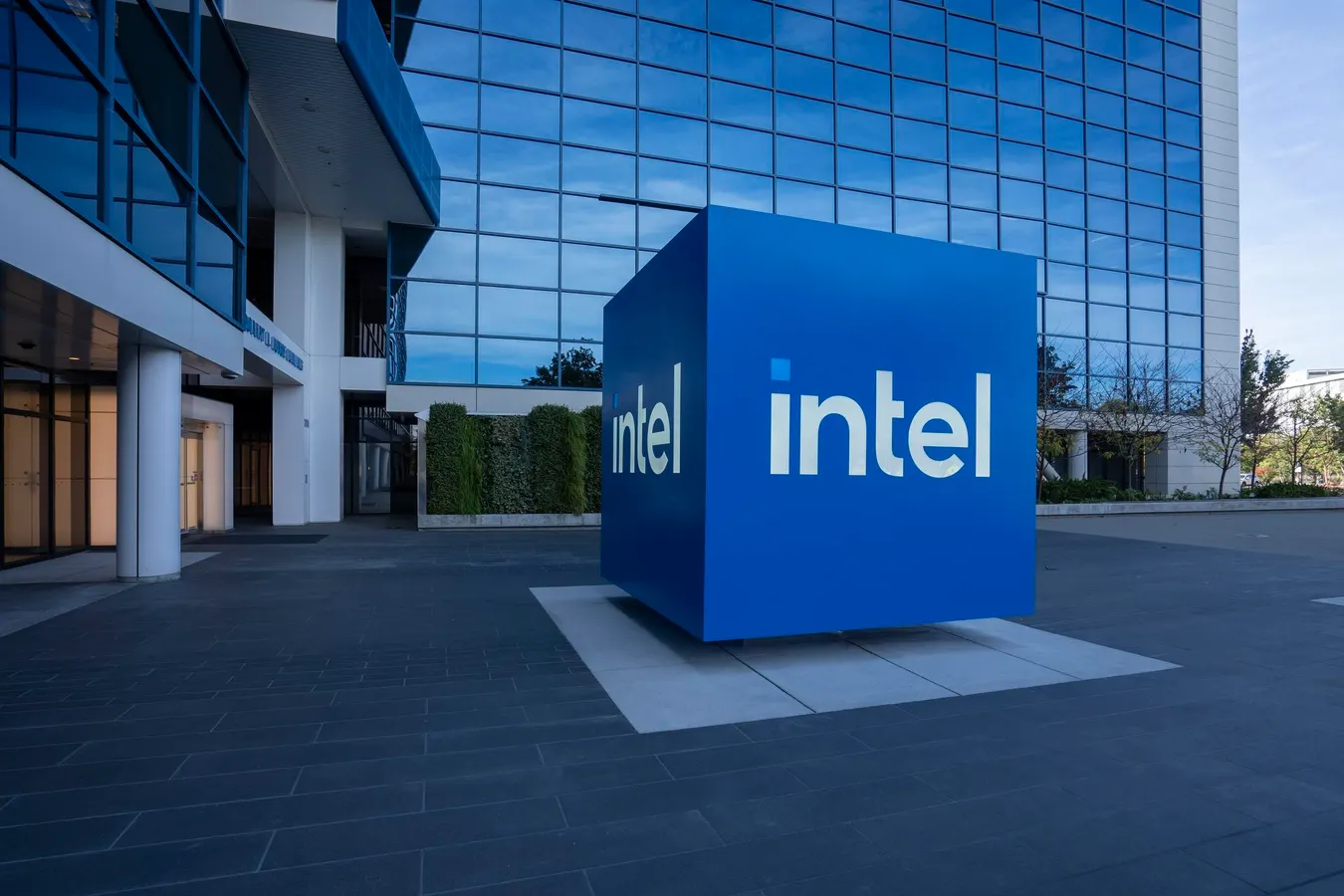

Intel Corporation’s headquarters in Santa Clara, California. Intel stock’s turnaround is gaining traction, but whether its worth buying will depend on investor risk profile.
getty
Intel has emerged as one of the biggest comeback narratives of the semiconductor industry in the past year. Intel stock has surged from a 52-week low of $32.89 to a high of $142.35 amid the artificial intelligence boom and is still up nearly 200% year-to-date despite pulling back from its late-June peak.
The renewed enthusiasm in Intel stock comes as the company, under CEO Lip-Bu Tan, is attempting to rebuild its manufacturing capabilities, capitalize on rising CPU demand as AI shifts to inference and turn its struggling foundry business into a viable long-term growth engine.
The turnaround is gaining traction. Intel reported $16.1 billion in second-quarter revenue, up 25% year over year, marking its strongest revenue growth in more than 15 years. Non-GAAP gross margin rose to 41.8% from 29.7% a year earlier. But after such a dramatic rerating, how much upside is left in Intel stock? Is it worth buying Intel shares at such elevated levels?
The Current State Of Intel (INTC)
Intel’s turnaround began to take shape in earnest after venture capital veteran Tan became CEO in March 2025. Tan inherited a company grappling with manufacturing delays, market-share losses and mounting concerns about its capital-intensive foundry strategy.
Under Tan, Intel continued workforce reductions, sold a major stake in Altera, closed its underperforming automotive chip division and secured billions in investments from SoftBank and Nvidia. Since the CEO’s takeover, Intel’s market cap has climbed from a low of $90 billion to over $500 billion currently.
Central to this massive surge in market value are the following tailwinds.
- Agentic AI and inference opportunities: As AI expands from model training to inference and agentic AI, data centers require substantial general-purpose computing alongside GPUs. While GPUs excel at performing billions of predictable mathematical operations in parallel, CPUs are better equipped to handle complex conditional logic, and unpredictable events that arise during computing workloads. Intel’s Data Center and AI business is already benefiting from this trend, growing 59% year-over-year in Q2 to $6.3 billion.
- CPU pricing power: The rapid growth of AI agents is driving a sharp increase in CPU demand, with Intel currently able to fulfill about 50% of leading-edge customer orders. This is in sharp contrast to the past decade, when excess capacity and intense competition limited Intel’s pricing power. Reports indicate that Intel has hiked prices for its consumer and commercial PC processors by roughly 10% recently, as demand for high-bandwidth memory and server infrastructure pushes up component costs.
- Progress on advanced manufacturing nodes: Intel hit a major milestone in its manufacturing comeback by putting its advanced 18A process node into high-volume production for its Core Ultra Series 3 “Panther Lake” processors. Intel is also gaining an early advantage in High-NA EUV, having successfully deployed ASML’s lithography systems on select layers of Panther Lake. High-NA EUV integration will give Intel a head start learning curve over rivals like TSMC, in their race to manufacture the world’s smallest, most powerful semiconductors. Intel plans to build on this progress with its next-generation 14A process, which is scheduled to begin risk production for internal products next year, followed by a high-volume ramp in 2028. However, the bigger test is whether Intel can convert these technological advances into meaningful business from external customers.
- Focus on energy-efficient inference: Intel is investing in startups such as SambaNova Systems, which is developing dataflow architectures to deliver high inference performance with lower power consumption. The investment matters because Intel is not simply trying to compete with GPUs on raw performance. It is also targeting performance per watt, an increasingly important metric for data centers facing rising electricity demand, power costs and grid constraints.
While Intel continues to develop its own AI accelerators, backing alternative dataflow architectures gives the company greater flexibility if the industry diversifies its approaches in processing AI inference workloads.
However, the investment has raised conflict-of-interest concerns because Tan remains the executive chairman of SambaNova. Intel has said Tan must recuse himself from investment decisions involving companies in which he has a financial interest.
That creates an interesting trade-off for Intel. Tan’s industry relationships and technology-investing background are among the reasons Intel brought him in. But those same relationships can create potential conflicts when companies in his network become investment targets.
Since the initial reports surfaced, Intel stock has surged more than 150%, suggesting that investors remain more focused on Tan’s ability to create value than on the conflict-of-interest concerns.
Why Has Intel Stock Pulled Back Recently?
Intel stock is down 25% from its 52-week intraday high and down 10% from the previous week’s close.
The latest pullback followed Elon Musk’s confirmation of early-stage discussions with TSMC about Terafab, his planned semiconductor factory for Tesla, SpaceX and xAI. Intel, which joined the initiative in April to supply its next-generation 14A manufacturing process, is counting on Terafab as a major external foundry customer. The possibility of TSMC’s involvement raised concerns about dual sourcing, but Musk confirmed that TSMC’s involvement would be limited to potentially subleasing part of the facility. Tan also told Bloomberg that Intel would continue working with Musk on Terafab.
Prior to the Terafab volatility, Intel stock fell 6% in late September on profit-taking. After rallying 42% from roughly $89 in early September to above $127 by Sept. 24, Intel stock had created an optimal window for locking in gains.
Earlier declines reflected broader concerns about AI spending sustainability following warnings from Anthropic CEO Dario Amodei about the potential risks of rapid AI development. Musk and OpenAI CEO Sam Altman, echoed Amodei’s concerns, triggering a broader sell-off in AI stocks.
Intel stock also declined modestly after Apple’s decision to phase out support for Intel-based Macs in certain applications. The move was largely expected given Apple’s long-standing transition to its own silicon, but it underscored the continuing erosion of Intel’s legacy x86 position.
The recent pullbacks highlight Intel stock’s sensitivity to external foundry customer wins and losses, as well as concerns about the sustainability of AI spending. Even after the recent pullbacks, Intel stock trades at a steep valuation of 9x forward sales, versus sector’s 3.5x and its own 5-year average of 3.2x.
Core Catalysts For Intel’s Near-Term And Long-Term Growth
Near-Term Catalysts
- Upcoming Q3 earnings call: Scheduled for Oct. 29 after market close, Intel’s Q3 earnings report could provide key updates on 14A, production capacity, and gross margin stabilization. Investors will be closely watching if Intel is translating its operational progress into sustainable financial gains.
- Altera IPO: The upcoming $2 billion IPO of Intel’s Altera unit may not be the core reason to own Intel, but it could make the chipmaker’s hidden value more visible. Altera is not a pure-play AI chipmaker, but its programmable chips are used in data centers, AI applications, telecommunications networks, industrial equipment and aerospace and defense systems. Intel bought Altera for about $16.7 billion in 2015, sold a 51% stake to Silver Lake in 2025, for $4.46 billion, retaining a 49% stake. When Altera goes public, its market valuation will provide a clearer reference point for the value of Intel’s remaining stake and make sum-of-the-parts valuations easier.
Long-Term Catalysts
- Intel foundry provides long-term optionality: Intel’s foundry business could become increasingly valuable as the AI boom and geopolitical tensions drive demand for more geographically diversified chip manufacturing. Microsoft is already set to produce a custom chip on Intel’s 18A process. Intel is also in discussions with SK Hynix over memory-chip manufacturing in Ohio and has secured advanced-packaging wins with customers, including AWS and Google. Intel’s advanced packaging technology could provide a relatively accessible entry point for customers facing long waits at TSMC. Those relationships could potentially expand into broader manufacturing agreements. Ultimately, however, what could materially change the economics of Intel Foundry would be winning high-volume, recurring wafer-fabrication business from major chip designers such as Apple, Nvidia or AMD.
- Strategic importance to Washington: Intel benefits from the U.S. government’s push to strengthen domestic semiconductor manufacturing. In 2025, the U.S. government agreed to take a 9.9% passive equity stake in Intel through an $8.9 billion agreement. Including the $2.2 billion in CHIPS Act grants Intel had received, this brings the government’s total investment in the chipmaker to $11.1 billion. Regardless of political cycles, reducing reliance on overseas semiconductor production remains a strategic priority. That creates a potentially durable policy tailwind for Intel’s domestic manufacturing investments, although the scale and form of future government support can change.
- Supply chain diversification: Geopolitical risk surrounding advanced chip production in Taiwan is also encouraging chip designers and hyperscalers to diversify manufacturing relationships. TSMC is capturing much of this demand by expanding its U.S. footprint, including a planned $265 billion investment across 12 facilities. Intel’s foundry business offers another U.S. based manufacturing option. However, how much of this opportunity Intel captures will depend on its ability to deliver competitive yields, meet production timelines and provide advanced packaging at scale.
Intel’s Long-Term Risks
- Foundry still bleeding money: Intel Foundry’s operational losses remained high at $2.1 billion in Q2, with $5.5 billion in revenue coming from internal customers versus roughly $293 million from external customers. To turn the business around, Intel needs high-volume, premium external customers generating meaningful, recurring foundry revenue
- The make-or-break advanced node roadmap: Intel has essentially staked much of its turnaround strategy on the roadmap for its advanced manufacturing nodes. Commercial viability depends on scaling the Intel 18A and 14A processes for external clients. Technical milestones offer some optimism, notably the Intel 18A node reportedly hitting roughly 80% yields as it transitions to high-volume manufacturing, according to analyst Jeff Pu at Korea’s GF Securities. This represents a significant improvement from 65% yields in Q2, though it still sits below TSMC’s 90% yields for its N2 (2 nm) process technology. The bigger test is 14A. Elon Musk’s Terafab represents a major win for Intel, but 14A is still years from mass production. Pu estimates 14A production of about 6,000 wafers per month by the end of 2027, rising to roughly 24,000 in 2028. The initial production estimate, which is modest for a leading-edge process, underscores how much execution and customer ramping remain before 14A can become a meaningful contributor to Intel Foundry. That said, Intel’s confidence in 14A is growing, as defect density declines, providing evidence that the process is progressing toward commercial viability.
- The TSMC reality check: TSMC commands a record 72.5% of the global pure-play wafer foundry market, and produces leading-edge chips for virtually every major customer Intel wants to win over, including Apple, Nvidia, AMD and Broadcom. The contrast between Intel Foundry’s small external revenue base against TSMC’s massive, fully-utilized capacity highlights the scale of the challenge for Intel.
- The secular threat to x86: Intel’s core chip business faces a long-term structural threat as data centers increasingly shift from traditional x86 architecture toward Arm-based alternatives to improve power efficiency and total cost of ownership. IDC data shows Arm-based accelerated server spending reached $53 billion in Q1 2026, eclipsing x86’s $34.6 billion. The pressure is compounded by Nvidia, which heavily favors pairing its high-margin GPUs with its own Arm-powered host CPUs, including Grace and the upcoming Vera. While legacy workloads sustain near-term x86 CPU demand, the future remains uncertain.
Intel Analyst Ratings And Price Target Outlook
Wall Street analysts remain focused on foundry execution and whether Intel’s turnaround can translate into better factory economics. Most remain cautious, with a “hold” rating and average price target of $116, representing roughly 8% upside from Intel stock’s last closing price.
TD Cowen reiterated a Hold rating on Intel stock with a $115 price target. While acknowledging the importance of the foundry progress, the research firm notes that Intel’s Products division remains the key value driver. TD Cowen believes investors need visibility to more than $100 billion in Products revenue and more than $20 billion of Foundry revenue.
Bank of America analyst Vivek Arya rates Intel a Buy with a $145 price target. BofA views Intel’s massive $20 billion capital raise in August as a sign of management’s confidence in its long-term foundry strategy rather than a bearish dilution event. The firm projects Intel could eventually capture 8% to 10% of a $380 billion global wafer foundry market by 2030, along with a quarter to a third of the advanced packaging market–giving Intel earnings power of more than $6 per share by the decade’s end.
The most optimistic price target for Intel comes from Melius Research analyst Ben Reitzes. The firm reiterates a Buy rating on Intel (INTC) with a price target of $165, while highlighting a potential path to $200 within two years. The sum-of-the-parts valuation values Intel’s foundry and product businesses at over $80 each. The bullish thesis anticipates high-volume commitments for Intel’s 14A process.
Is Intel Stock A Good Buy-The-Dip Candidate?
Intel is not a turnaround story waiting to happen. It already happened, and the stock price now reflects much of that recovery. Is Intel’s remaining upside from CPUs, 18A, 14A and its foundry business enough to justify the execution and valuation risks? Depends on your risk profile.
Intel stock trades at roughly 70x its 2026 earnings estimates. As a conservative investor, I refuse to chase Intel or any stock at such elevated valuations—especially when there is zero room for execution missteps.
For existing investors, Intel stock is a Hold.
There is, however, one key reason I wouldn’t be so quick to dismiss Intel. Sentiment surrounding its current leadership remains positive. Intel’s market value has increased multi-fold under Tan, despite prior conflict-of-interest concerns.
For new investors who like Intel’s long-term direction but are unwilling to buy the stock at its current price, selling an out-of-the-money (OTM) cash-secured put is one possible alternative.
Instead of chasing Intel at its current price, this strategy allows an investor to potentially buy the stock at a lower price while receiving a premium for waiting.
For example, a $95 strike put expiring in 30 to 60 days could work as follows:
- You sell one put contract with a $95 strike. Since one options contract controls 100 shares, you would generally need $9,500 in cash or equivalent collateral.
- The buyer pays you an upfront premium, which you keep whether or not the option is exercised.
- If Intel remains above $95 at expiration, the put generally expires worthless and you keep the premium.
- If Intel falls below $95, you could be assigned 100 shares at $95. If you received a $3 premium, your effective cost basis would be $92 per share, before fees and taxes.
The strategy does not eliminate downside risk. If Intel suffers a major setback and falls to $75, you could still be assigned shares at $95, leaving you with a significant unrealized loss.
Its appeal is simply that an investor who already wants to own Intel can set a lower entry price and get paid for waiting.
The trade-off is that if Intel surges well above the current price, the investor may keep only the premium while missing the stock’s upside.
Intel’s progress and long-term opportunities are real. So is its steep valuation — and so is its leadership.
Please note that I am not a registered investment advisor, and readers should conduct their own due diligence before investing in this or any other stock. I am not responsible for any investment decisions made based on this article. Readers are encouraged not to rely solely on the opinions and analysis expressed here and to perform their own research before making any investment decisions.













Leave a comment