


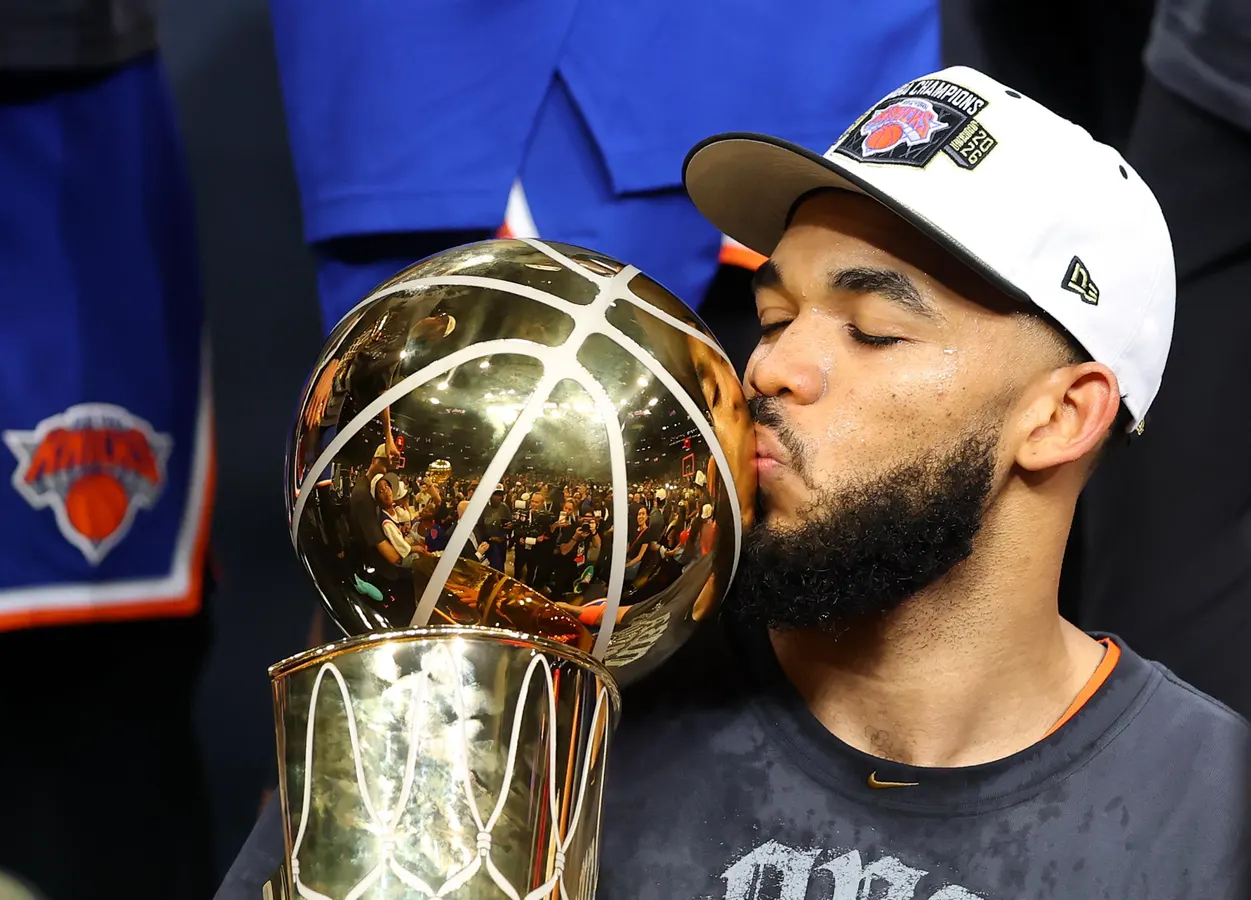

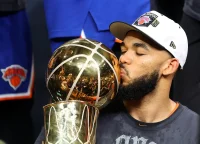
SAN ANTONIO, TEXAS – JUNE 13: Karl-Anthony Towns #32 celebrates with the Larry O’Brien Championship Trophy after the victory against the San Antonio Spurs in Game Five of the 2026 NBA Finals at Frost Bank Center on June 13, 2026 in San Antonio, Texas. NOTE TO USER: User expressly acknowledges and agrees that, by downloading and or using this photograph, User is consenting to the terms and conditions of the Getty Images License Agreement. (Photo by Gregory Shamus/Getty Images)
Getty Images
Just weeks after the New York Knicks won their first NBA championship in 53 years, the second apron of the salary cap started picking away at the title-winning roster.
Faced with either entering the second-apron of the cap ($221.7 million in salaries) or bringing back center Mitchell Robinson at a competitive number, Knicks’ owner James Dolan was firm: “We’re willing to stretch, but there’s certain things in the NBA that you’d have to be suicidal to do. One of them is the second apron.”
That effectively ended any chance of Robinson returning, and he’d soon wind up signing a three-year, $47.4 million deal with the rival Boston Celtics.
The Knicks weren’t outbid while trying to retain Robinson. They never had a chance with Dolan seeing the second apron penalties (draft penalties, loss of exceptions, cutoff from buyout market, no aggregating salaries) as a hard cap.
And that’s the point, in large part.
Since the implementation of the punitive first/second apron penalties starting in the 2024 offseason, a limited number of NBA teams have jumped above the second threshold. And over time, that number has dwindled even further, as executives use the first apron as the real limit, regardless of what it does to the well-being of their roster.
LOS ANGELES, CALIFORNIA – NOVEMBER 27: Peyton Watson #8 of the Denver Nuggets takes a shot against the LA Clippers in the second half at Crypto.com Arena on November 27, 2023 in Los Angeles, California. NOTE TO USER: User expressly acknowledges and agrees that, by downloading and/or using this photograph, user is consenting to the terms and conditions of the Getty Images License Agreement. (Photo by Ronald Martinez/Getty Images)
Getty Images
Cap Casualties
In recent years, the Denver Nuggets have been among the league’s biggest spenders in an attempt to surround superstar Nikola Jokic with the best roster possible. Yet, that has had its limits and the team has still been forced to shed salaries – including emerging talent Peyton Watson this offseason (in what was effectively a salary dump to the Cleveland Cavaliers).
Similarly, the Minnesota Timberwolves sent Julius Randle to the Brooklyn Nets as part of a larger deal to add LaMelo Ball. But one of the biggest benefits of that deal was avoiding the second apron.
And the Oklahoma City Thunder, small-market as they may be, had to spend this offseason moving role players like Isaiah Joe, Lu Dort and Aaron Wiggins out to avoid cap issues.
Similarly, as mentioned above, the Knicks losing Robinson, their longest-tenured player, is absolutely a second apron casualty. But as the team balances its books going forward and potentially rewards the various players that helped deliver a title to New York, more may be coming.
The Knicks, like many of the seven (different) championship winners before them, have found themselves in a juggling act born of success. And early returns suggest they may come out on the losing end.
ATLANTA, GEORGIA – APRIL 25: Karl-Anthony Towns #32 of the New York Knicks reacts after a dunk against the Atlanta Hawks during the first quarter of game four of the Eastern Conference first round playoffs at State Farm Arena on April 25, 2026 in Atlanta, Georgia. NOTE TO USER: User expressly acknowledges and agrees that, by downloading and or using this photograph, User is consenting to the terms and conditions of the Getty Images License Agreement. (Photo by Kevin C. Cox/Getty Images)
Getty Images
The Karl-Anthony Towns Kerfuffle
The Knicks’ salary issues are unique because their team construction arguably never should’ve happened to begin with.
Jalen Brunson’s now-famed discount deal that featured a $113 million haircut to facilitate the team’s spending around him, allowed the team to add key starters like Karl-Anthony Towns and Mikal Bridges to begin with. Naturally, those players now want to be compensated for their contributions to a championship, and those negotiations have spilled out in the open as the team has played hardball while walking a tightrope between salary and title nostalgia.
After numerous reports that the Knicks and Towns were “far apart” on extension talks, the team issued a sternly worded statement that they’d be tabling any extension conversations for the time being. Towns expressed disappointment about that fact this weekend, and felt blindsided.
The move from New York contained some level of posturing. Towns, rightfully, is doing some posturing of his own as he tries to avoid coming off as a villain amid the Knicks’ public desire to bring him back at a lower number to keep this roster together.
Simmering below all of this is also Josh Hart’s impending extension as well. While not nearly as public as the Towns disagreement, he’s also in line for a deal and would conceivably both want to come back and make more than his current $20.9 million salary.
But between the two, it should be clear to fans that the second apron is functioning not only as a hard salary cap that gives owners the ability to low-ball players – or at the very least, give them leverage to tamp down compensation in the name of being competitive. It almost serves as a penalty for drafting and/or trading well, and winning with those players.
That sort of system drives parity, of course. But it also makes for short-lived runs of success for teams that would otherwise have stayed together for extended periods of time.
SAN ANTONIO, TEXAS – JUNE 13: Jalen Brunson #11 of the New York Knicks lifts the Bill Russell NBA Finals Most Valuable Player Award trophy after defeating the San Antonio Spurs in Game Five of the 2026 NBA Finals at Frost Bank Center on June 13, 2026 in San Antonio, Texas. NOTE TO USER: User expressly acknowledges and agrees that, by downloading and or using this photograph, User is consenting to the terms and conditions of the Getty Images License Agreement. (Photo by Ronald Cortes/Getty Images)
Getty Images
What’s Next For Knicks
There’s still a chance that the outward back-and-forth between Towns (who wants to stay in New York) and the Knicks becomes a footnote in a long and prosperous relationship. Towns and the team could figure something out, they could do the same with Hart. And then still give Brunson the max deal he deserves as NBA Finals MVP and a franchise legend.
But given Dolan’s hard stance on the second apron, despite his historic willingness to spend money, the chances of all of that coming together are starting to dwindle.
These are professionals, yes. So they could very well take the court later in October and be unaffected by the salary conversation as they work to defend their championship.
As time goes on without Towns signing on the dotted line, though, the chances of this team being broken up before they really get going increases.
That’s a problem no matter who wins. Yet it’s especially one for the NBA when the Knicks – one of its biggest and most valuable brands – is the one in the spotlight.
If teams see winning as a penalty, then fewer teams will spend the money on talent to try and compete for a title. And with the Knicks, breaking up a team like this because of apron fears harms both the franchise and the league’s well-being.
The second apron issue won’t be adjusted any time soon. But now that it’s become a frequent talking point for the league and its players (Bruce Brown had thoughts on the matter last week that helped spur an NBA statement in response), it will – rightfully – be in the Players’ Association crosshairs come the next collective bargaining session.









Leave a comment