


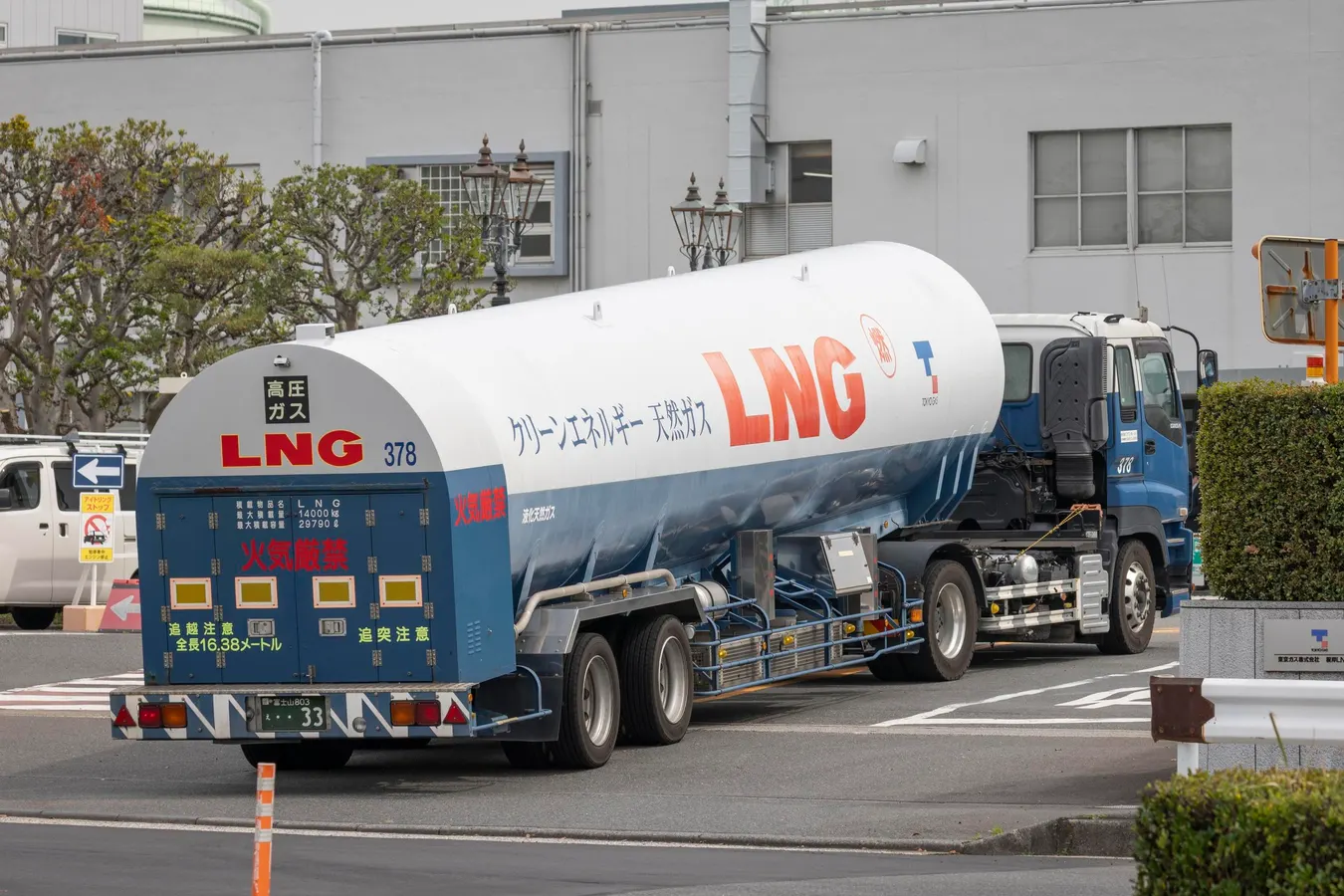

YOKOHAMA, JAPAN – 2026/04/06: A tanker truck of Liquefied Natural Gas (LNG) is seen at Tokyo Gas Negishi LNG Base. In the context of the ongoing US-Iran war (which began with US-Israeli strikes on Iran in late February 2026), (Photo by Stanislav Kogiku/SOPA Images/LightRocket via Getty Images)
SOPA Images/LightRocket via Getty Images
A $16 billion power plant is working its way through the permitting process in Anderson County, Texas—and this one project already tells you almost everything about the moment American energy is in.
Announced this spring as part of a U.S.-Japan trade agreement, the project sits in the Western Haynesville shale, roughly 100 miles from both Dallas and Houston, a site one Comstock Resources executive called “perfectly situated for both AI, data centers and LNG.” Comstock, whose largest shareholder is Dallas Cowboys owner Jerry Jones, is partnering with NextEra Energy, which is slated to build and operate up to 5.2 gigawatts of gas-fired capacity dedicated to feeding data centers and heavy manufacturing—once it clears the permitting and negotiation still ahead.
Here is the detail that makes the project worth a second look. Part of its financing traces back to Japan’s $550 billion U.S. investment commitment, negotiated as part of this year’s trade deal—meaning Japanese capital is now underwriting a Texas gas plant built to power American artificial intelligence. At the same time, the Japanese trading house Mitsui is racing to lock up LNG cargoes on the other side of the world. It’s buying equity stakes and offtake agreements in the Middle East, Australia and the U.S. to secure power for Japan’s own AI data center buildout.
It would be easy to read that as a collision in the making—American AI on one side, Japan’s on the other. That’s not quite right. A cubic foot headed to a Texas data center just needs a pipeline hookup. A cubic foot headed to Japan has to be chilled to minus-260 degrees and loaded onto a tanker, passing through a liquefaction terminal before it lands on site.
Gas that Mitsui or any overseas buyer has locked into a long-term 20-year contract is claimed. No producer or terminal operator can redirect it to a data center just because a better domestic offer appears; that would be a contract breach, not a business decision.
What’s actually contested sits upstream: how much new gas comes out of the ground in shale basins like the Haynesville, and how much new pipeline capacity gets built to move it. Producers and pipeline developers make that call project by project, committing new supply either to an LNG terminal’s next expansion or to a power plant built for a data center. LNG buyers hold contractual priority on everything already locked in; data centers are largely working with what’s newly developed, or what’s left.
The Math Behind The Molecule
TOPSHOT – This aerial view shows an Amazon Web Services (AWS) data center adjacent to single-family homes in Stone Ridge, Virginia on August 12, 2026. (Photo by Brendan Smialowski / AFP via Getty Images)
AFP via Getty Images
Rusty Braziel, executive chairman of RBN Energy, has run the numbers on exactly this question. By his analysis, data centers coming online through 2030 will add roughly 4 billion cubic feet per day (Bcf/d) of incremental gas demand—real, but modest next to new LNG capacity, on track to pull an additional 11 to 12 Bcf/d by the same year.
Dollar for dollar, $10 billion in LNG export infrastructure drives roughly 13 times more gas demand than the equivalent spend on data centers.
The Energy Information Administration projects net U.S. natural gas exports climbing from 18.7 Bcf/d in 2026, already an 18% jump, to 20.5 Bcf/d in 2027, driven mostly by five LNG projects ramping through next year, led by Corpus Christi’s Stage 3 expansion and Golden Pass.
The EIA links part of the surge to buyers hedging against disruptions to Middle Eastern supply routes through the Strait of Hormuz—a reminder that American gas has become a shield for nations nervous about their existing arrangements. Japanese and European buyers view long-term U.S. LNG as protection against Middle Eastern maritime chokepoints and Russian leverage.
Because Russia’s invasion of Ukraine cut off Europe’s pipeline supply, U.S. LNG has functioned more as a diplomatic offering than a traded commodity. Indeed, it’s a promise to allies from Warsaw to Tokyo that they will never again be as exposed as Europe was in 2022. What’s new is the AI demand at the same wellhead, with no existing contract and no patience for a queue.
Overseas allies like Japan aren’t just buying LNG to keep utility lights on or heat homes—they are scrambling for power to run semiconductor plants and sovereign AI data centers. Producers at home are racing to lock up Haynesville drilling rights; buyers abroad are battling to lock up LNG supply. “Without securing energy, it is impossible to implement solutions,” said Kenichi Hori, Mitsui’s CEO, in a Bloomberg interview reported by Rigzone.
Why The Calm Won’t Last
Taft, California, Natural gas pipeline in the oil and gas fields of southern San Joaquin Valley. (Photo by: Jim West/UCG/Universal Images Group via Getty Images)
UCG/Universal Images Group via Getty Images
It would be easy to read all this as an impending train wreck. But the numbers tell a less dramatic story. Haynesville output alone is growing by 1.3 Bcf/d—enough, for now, and national production is on pace for a record 122.5 Bcf/d this year, to cover both needs without a fight. That’s partly because much of the announced AI power demand exists only on paper—compounded by the fact that both the cost and time to bring a gas-fired plant online rose dramatically.
It’s worth remembering that gas producers and pipeline operators have warned of looming shortages before, in years when supply turned out to be ample, and prices fell anyway. That said, the comfortable math has a shelf life.
The real test is whether production growth and pipeline buildout keep pace with both claims. Purpose-built projects like the Comstock-NextEra hub, dedicated from day one to a single customer, are the kind of structural fix the industry will need more of. Multiply that model across the Gulf Coast, and today’s slack could hold. Fail to, and the U.S. arrives at 2028 to 2030 with most of its contracted LNG and most of its hyperscaler campuses coming online around the same time—and drawing on the same strained basins for growth.
Economists and domestic manufacturers have warned ever since the first LNG terminals opened that shipping gas abroad drives up the price Americans pay for it. AI’s arrival doesn’t change that argument. It adds a second, deep-pocketed domestic bidder. That will just make the pricing issue even worse.
If it ever came to a physical shortage rather than a paper one, the long-term contracts have the upper hand. But that is not an absolute: Texas’s curtailment rules, adopted after Winter Storm Uri, rank human needs and electric generation above “all other customers” during a supply emergency. Washington holds a parallel power to revisit LNG export licenses on public-interest grounds.
If production or pipeline expansion lags behind combined demand by 2030, Washington and Austin will face an imminent policy conflict. Indeed, every ally that has signed a long-term LNG contract will be watching whether domestic supply and infrastructure can keep pace with both claims at once—and that’s a taller order than “drill, baby, drill” suggests.
Meanwhile, Wall Street-enforced capital discipline ensures producers won’t over-drill just to keep prices low, while securing that energy hinges less on foreign capital than on domestic steel and permits.
As the decade-long fight over the Mountain Valley Pipeline showed, every bid for more capacity meets an equal and opposite reaction—and it’s that response, as much as the economic demand, that will decide who actually gets the gas.















Leave a comment