


Three-time Olympian Anita Alvarez shares the story behind her Paris 2024 silver medal, surviving a frightening incident in the pool, and mentoring students as she pursues LA28.

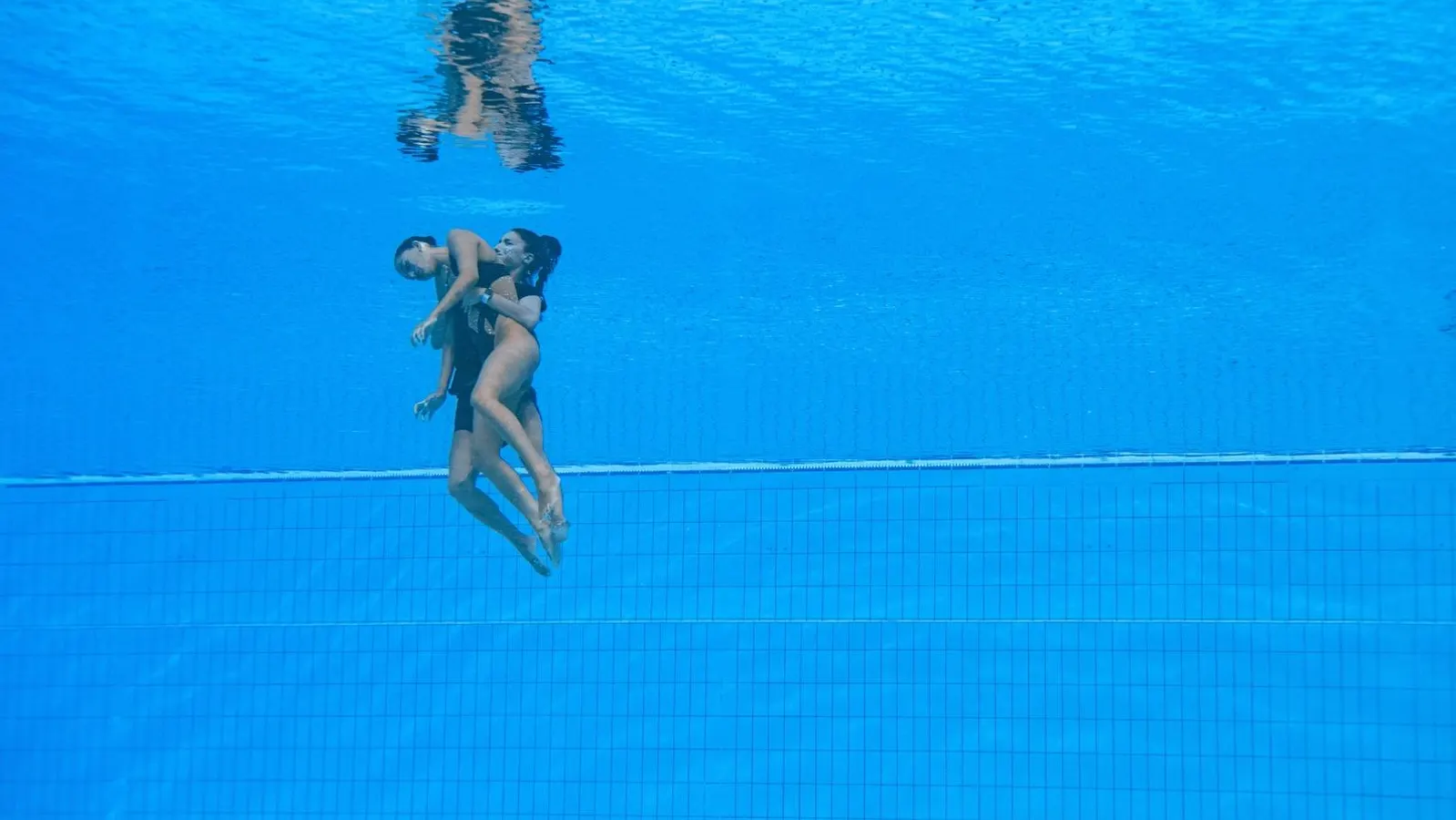
TOPSHOT – USA’s Anita Alvarez (L) is recovered from the bottom of the pool by USA’s coach Andrea Fuentes (R) after an incident, during the women’s solo free artistic swimming finals during the Budapest 2022 World Aquatics Championships at the Alfred Hajos Swimming Complex in Budapest on June 22, 2022. (Photo by Oli SCARFF / AFP via Getty Images)
AFP via Getty Images
(This story is based on a Forbes exclusive interview with Anita Alvarez, on September 25, 2026. All quotes are taken directly from a transcript of the interview.)
Beginnings
Her Olympic dream began when she was 11 years old. Alvarez was watching the 2008 Olympics and imagining what it might be like to be on that stage. At an age when most children are thinking about youth sports, Alvarez began turning her Olympic dream into a plan.
She began writing down goals. She kept journal entries. Six years later, at 16, Alvarez made the U.S. national team and made a fateful decision: She would leave her family in New York and move across the country to train full time. That decision eventually took her to three Olympic Games—Rio 2016, Tokyo 2020 and Paris 2024—culminating in a silver medal with the U.S. artistic swimming team in Paris.
The journey also includes a dramatic incident in which she lost consciousness in the water during the 2022 World Championships that became a global social media phenomenon.
Anita Alvarez 2026
(Photo courtesy of Classroom Champions)
Today, at 29, Alvarez is preparing for another Olympic pursuit while beginning a new role as a mentor to students through Classroom Champions. She is seeking to become the first American artistic swimmer to compete in four Olympic Games.
From A Buffalo Pool Deck To The National Team
Alvarez’s connection to artistic swimming began almost before she could understand what an Olympic career meant. Her mother had competed in the sport through college and became a coach after graduating. Alvarez grew up around the pool deck in the Buffalo area, watching her mother coach and gradually discovering the sport for herself.
“My mom actually competed in the sport growing up and through college, and became a coach directly out of college,” Alvarez told me.
Her mother understood the technical demands of the sport. Alvarez participated in several sports growing up but eventually fell in love with artistic swimming. By 16, she had made the national team. She moved across the country, left traditional high school and completed her education online while training.
“I left my junior year of high school, finished high school online, and trained full time,” Alvarez said.
It was a decision that required sacrificing some of the experiences that many teenagers take for granted.
Three Olympic Games And Three Different Experiences
Alvarez’s Olympic career has included three Games and different roles within artistic swimming. At Rio 2016 and Tokyo 2020, she competed in the duet event. Paris 2024 brought the opportunity to compete in the Olympic team event after the U.S. returned to the team competition for the first time since 2008. The differences between the disciplines are significant. In a duet, two swimmers have to move almost as one person.
RIO DE JANEIRO, BRAZIL – AUGUST 15: Natalia Ishchenko and Svetlana Romashina of Russia compete in the Women’s Duets Synchronised Swimming Technical Routine Preliminary Round on Day 10 of the Rio 2016 Olympic Games at Maria Lenk Aquatics Centre on August 15, 2016 in Rio de Janeiro, Brazil. (Photo by Al Bello/Getty Images)
Getty Images
“You have to be very in sync with this one other person,” Alvarez said.
The team event is another level of complexity. Eight swimmers must coordinate movements, timing, choreography and acrobatics.
“You all come together and you work towards that one goal,” Alvarez said.
The acrobatic elements make that teamwork visible. Swimmers throw teammates out of the water, creating spectacular moments that require trust and precise timing. The U.S. team eventually turned that unity into an Olympic silver medal in Paris. It was the first U.S. artistic swimming Olympic medal in 20 years.
PARIS, FRANCE – AUGUST 07: Members of Team United States compete in the Team Acrobatic Routine on day twelve of the Olympic Games Paris 2024 at Aquatics Centre on August 07, 2024 in Paris, France. (Photo by Clive Rose/Getty Images)
Getty Images
When The Water Became Dangerous
Two years before Paris, Alvarez experienced one of the most frightening moments of her athletic career. At the 2022 World Championships in Budapest, she was competing in the solo free final. She had already been through a long competition and was fatigued. Yet she remembers entering the water feeling connected to the performance. Her coach encouraged her to listen to the music and enjoy the routine, reminding Alvarez that artistic swimming is both athletic competition and artistic expression.
“I remember just being really in flow in that routine,” Alvarez said. “I remember feeling like I was just enjoying it and really present.”
She finished and surfaced, and everything began to go dark.
That was her last memory before losing consciousness.
Alvarez sank toward the bottom of the pool. Her coach, Andrea Fuentes, recognized what was happening and jumped into the water to rescue her. Alvarez was taken for medical attention, and the incident became one of the most widely circulated images from the 2022 World Championships. It was not the first time.
USA’s coach Andrea Fuentes (R) recovers USA’s Anita Alvarez (L), from the bottom of the pool during an incident in the women’s solo free artistic swimming finals, during the Budapest 2022 World Aquatics Championships at the Alfred Hajos Swimming Complex in Budapest on June 22, 2022. (Photo by Oli SCARFF / AFP via Getty Images)
AFP via Getty Images
Alvarez had also lost consciousness during an Olympic qualification event in Barcelona in 2021, when Fuentes again helped rescue her. For Alvarez, however, the most difficult part of the 2022 incident came after the cameras stopped.
Rebuilding Her Relationship With The Water
Following the World Championships, Alvarez underwent medical evaluation. She said major potential problems were ruled out. Her blood work did reveal low iron and ferritin levels, which she described as borderline anemia. There were other contributing circumstances. She had broken her foot earlier in the season. She did not believe she had a proper preseason. The competition took place during a hot summer. She acknowledged that hydration and fueling may not have been adequate, and the solo final was her second event of the day.
BUDAPEST, HUNGARY – JUNE 22: Anita Alvarez of Team United States is attended to by medical staff following her Women’s Solo Free Final performance on day six of the Budapest 2022 FINA World Championships at Alfred Hajos National Aquatics Complex on June 22, 2022 in Budapest, Hungary. (Photo by Dean Mouhtaropoulos/Getty Images)
Getty Images
The experience forced her to become more deliberate about her health and preparation. She began monitoring her iron levels and taking supplements. She worked with coaches, mental coaches, mentors and a sports dietitian. But there was another problem.
She had to get back into the pool.
For years, the water had been her second home. Now it had become a place associated with risk.
“I wanted to heal that relationship with the water,” Alvarez said.
That process required her to gradually return to training while becoming more attentive to what her body was telling her.
The Photograph That Took On A Life Of Its Own
The photograph of Alvarez underwater became something more than a sports image. People around the world saw an athlete struggling beneath the surface while her coach reached down to pull her to safety. For Alvarez, the sudden global attention was overwhelming. She describes herself as relatively private and low-key. Suddenly, people she had not spoken to since middle school were contacting her. She saw the image in newspapers in other countries.
Then something unexpected happened.
Artists began using the image for inspiration. People created paintings and murals. Some even got tattoos based on it. The meaning people found in the photograph went beyond artistic swimming. Alvarez heard from people who interpreted it as a metaphor for their own struggles—the feeling of drowning beneath the surface while appearing fine to everyone around them. She had not intended any of that. But she found something meaningful in hearing those stories.
“I want to find kind of the positives in different situations,” Alvarez said. “And I think that is one of them.”
A frightening moment had connected her with people she never expected to reach.
Paris Was About More Than A Medal
The road to Paris was itself a test.
The sport had undergone a major scoring-system change. The U.S. team went through qualification and narrowly missed one opportunity at the Pan American Games before getting another chance in 2024. Eventually, the Americans qualified.
Then came Paris and the silver medal.
PARIS, FRANCE – AUGUST 07: Silver Medalists of Team United States pose on the podium during the Artistic Swimming medal ceremony after the Team Acrobatic Routine on day twelve of the Olympic Games Paris 2024 at Aquatics Centre on August 07, 2024 in Paris, France. (Photo by Maddie Meyer/Getty Images)
Getty Images
For Alvarez, standing on that podium meant revisiting nearly every major decision of her career. She thought about the little girl watching the 2008 Olympics; Moving across the country at 16; Leaving behind her high-school graduation. She thought about the possibility of quitting after 2022.
“There was so much that went into that,” Alvarez said. “It was kind of like this surreal moment standing on the podium of just all of that flooding through my head.”
PARIS, FRANCE – JULY 31: PARIS, FRANCE – JULY 31: Anita Alvarez of Team The United States during the artistic swimming press conference on day five of the Olympic Games Paris 2024 at on July 31, 2024 in Paris, France. (Photo by Luke Hales/Getty Images)
Getty Images
But perhaps the most emotional part was looking into those stands. Her brother and her parents were there. Friends and families who had followed the journey were there. One family had promised Alvarez when she was a child that they would attend the Olympics if she ever made it. In Paris, they kept that promise.
Classroom Champions
The lessons Alvarez learned from her Olympic journey are now becoming something she can share.
In 2026, USA Artistic Swimming and Classroom Champions launched a partnership connecting four U.S. national-team athletes with classrooms for the 2026-27 school year. Alvarez is one of the participating athlete mentors. The program brings elite athletes into classrooms to discuss goal-setting, confidence, teamwork, perseverance and overcoming challenges. Alvarez has had mentors throughout her career. And she remembers how much even a brief encounter with an Olympian could mean to a young athlete.
Classroom Champions logo
(Photo courtesy of Classroom Champions)
“I still remember that exact story,” she said.
Now she gets to become that story for someone else. She sees mentoring as another form of teamwork—only this time, the goal isn’t a medal. It is helping a young person develop the confidence to pursue something difficult.
The Road To Los Angeles
Artistic swimming has a unique relationship with Los Angeles. The sport made its Olympic debut at the 1984 Los Angeles Games, and LA28 will bring it back to the city where its Olympic history began. The 2028 program is scheduled to include women’s duet and open team events at the Long Beach Aquatics Center.
US Anita Alvarez poses at the Bussys swimming pool in Eaubonne, near Paris, on April 28, 2024. (Photo by BERTRAND GUAY / AFP) (Photo by BERTRAND GUAY/AFP via Getty Images)
AFP via Getty Images
For Alvarez, that creates the possibility of a fourth Olympic Games on home soil.
She is already training with the U.S. team on the road toward LA28. Classroom Champions describes her current goal as becoming the first American artistic swimmer to compete in four Olympic Games.
Now she is also trying to help someone else discover a dream of their own. For Anita Alvarez, the question is no longer simply how high she can rise in the water.
It is how many other people she can help rise with her.
















Leave a comment