


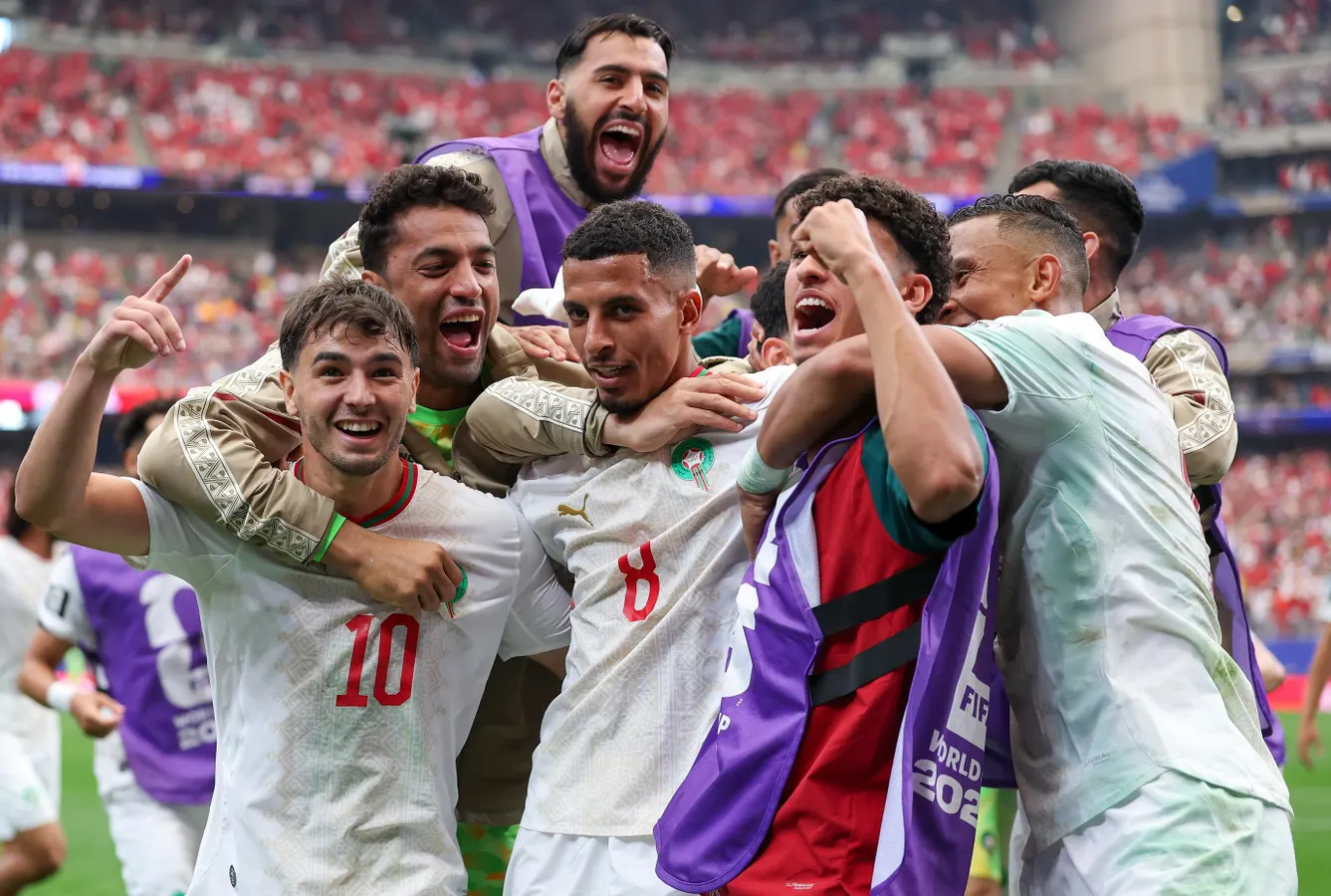

HOUSTON, TEXAS – JULY 04: Azzedine Ounahi #8 of Morocco celebrates with teammates after scoring his team’s second goal during the FIFA World Cup 2026 Round of 16 match between Canada and Morocco at Houston Stadium on July 04, 2026 in Houston, Texas. (Photo by Kevin C. Cox/Getty Images)
Getty Images
Morocco are already Africa’s history makers, but one more win would elevate them beyond the continental lens they’ve been viewed through up until now.
As The Atlas Lions prepare for their quarter-final clash with World Cup favourites France, they know victory would propel them to a level where they’d have to be considered as a new member of the global soccer elite.
Their semi-final run in Qatar four years ago was notable for becoming the first African and Arab nation to reach the final four and their progress to the quarter-finals this time has earned them a World Cup knockout win record that is on par with the combined number of victories ever achieved by African sides.
But this isn’t simply a story of a golden generation enjoying its moment in the sun. Morocco’s recent success is down to a federation’s approach bearing fruit, so showing they can compete with – and beat – a member of the world’s established elite in a second consecutive World Cup will draw an important line in the sand.
Beating Les Bleus would be particularly special because so much of what the North Africans have built has grown out of its links to France, Spain and other major European nations.
These connections aren’t simply from finding players within the Moroccan diaspora, though. That proactive identification of talent is a key part of their rise, with 19 of 26 players in their 2026 World Cup squad born outside the nation, but they’ve had to buy into a national identity and system that was put in place long before their arrival.
The Moroccan masterplan
That plan began nearly two decades earlier with the launch of the Mohammed VI Academy, a national initiative to modernise football in Morocco as part of a wider nation-building project.
Led by Nasser Larguet, a Moroccan coach who had spent most of his career working inside some of France’s most successful academies, the academy instilled a methodology that eventually created better facilities and coaching in the country.
When Larguet became FRMF’s technical director in 2014, that system became part of the national football programme, with a uniform approach introduced across all men’s, women’s and futsal teams at every age group – giving those European learnings a Moroccan personality.
That is what we’re seeing the results of now. Players brought into the Morocco national team environment, whether from the diaspora or produced in the homegrown programme, understand the tactical philosophy that is helping them compete at elite level.
The World Cup semi-final in 2022 was followed up by winning the under-20s World Cup in 2025 and this summer’s run. The amount of turnover within the senior team in that time shows this is no flash in the pan, with the likes of Azzedine Ounahi produced by the national player pathway and France-born star Ayyoub Bouaddi declaring for Morocco at only 18 years old.
What have this Moroccan side achieved?
Recent on-pitch success helps to build momentum, but it’s been delivered by a coaching system that is embedded within the Moroccan game.
At the last World Cup, coach Walid Regragui bought into the idea, making his side resilient and hard to beat as they reached the semi-finals. Earlier this year, they became African Cup of Nations champions after a controversial ending to the final with Senegal – although that result is being contested.
But for all Regragui’s success, replacement Mohammed Ouahbi is even more closely aligned to the national team DNA, having been in charge of the victorious under-20s side prior to stepping up.
This tactical ideology is what gives Morocco an edge, understanding what works so well in Europe and adapting it to their player pool.
In fact, their approach means they may be the best suited side left in the tournament to beat France. Defensively strong enough to stifle their talented attackers, with the technical ability to pierce their backline on the counter.
Should they beat Mbappe and co, they would join an esteemed group of nations to have reached back-to-back semi-finals and wouldn’t have anyone left to fear for the rest of the tournament – their position in the world’s elite secured.
And with the 2030 World Cup co-hosted by Morocco, Spain and Portugal, there will be growing expectation that they’re set to stay there, flying the flag as a global force, not just for their continent.










Leave a comment