


Topline
The northern lights may make an appearance along the U.S.-Canada border Wednesday, according to the National Oceanic and Atmospheric Administration, which has forecast mild auroral activity.
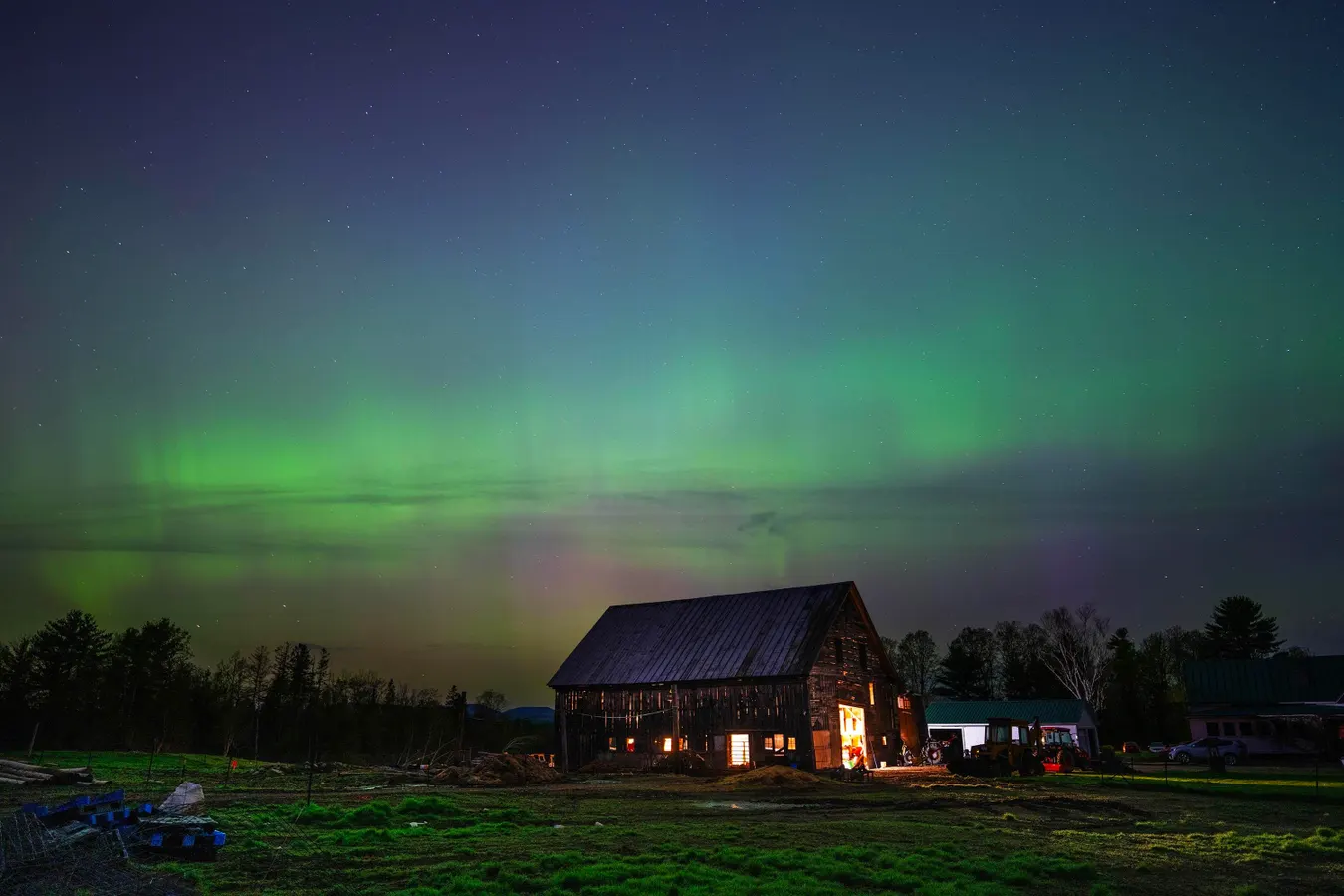
The northern lights fill the sky with green ribbons of electrical charged particles over the barn and pastures at Greaney’s Turkey Farm in Mercer, Maine.
Photo by Michael Seamans/Getty Images
Key Facts
A Kp index of four is forecast for Wednesday night, meaning the aurora may be “quite pleasing” to view for observers in the right places.
Geomagnetic storms, which can strengthen auroral showings, are not expected to materialize Wednesday night.
The mild activity will weaken by Thursday night, which NOAA forecasts a Kp index of three for.
Where Will The Northern Lights Be Visible?
NOAA’s forecast shows a chance for northern stretches of Washington, the northern tip of Idaho, northern Montana, North Dakota, northern South Dakota, northern Minnesota, northern Wisconsin and the Upper Peninsula of Michigan. The chances of catching the lights there will be relatively low compared to Alaska, with visibility likely increasing the farther inland observers are.
Wednesday’s aurora forecast.
NOAA
What’s The Best Way To See The Northern Lights?
Observing the sky between 10 p.m. and 2 a.m. can generally improve chances of seeing the natural phenomenon. High vantage points and places with little to no light pollution can also help observers.
What’s The Best Way To Photograph The Northern Lights?
Low apertures can help if devices are capable of using them. Wide-angle lenses are encouraged for traditional cameras while flash should be avoided, and smartphone users should switch their device’s camera to night mode when taking photos. Tripods can help all camera types take photos of the northern lights.
Key Background
June has been a somewhat busy month for northern lights showings, even as the sun gets farther away from the peak of its 11-year solar cycle reached in 2024. The event has created favorable conditions for northern lights showings, though auroral activity is forecast to significantly wane by 2027.
Further Reading
Aurora Dashboard (NOAA)
















Leave a comment