


Topline
The northern lights may make yet another appearance along the U.S.-Canada border this week, with the National Oceanic and Atmospheric Administration forecasting mild auroral activity in some of the northernmost U.S. states Saturday night.
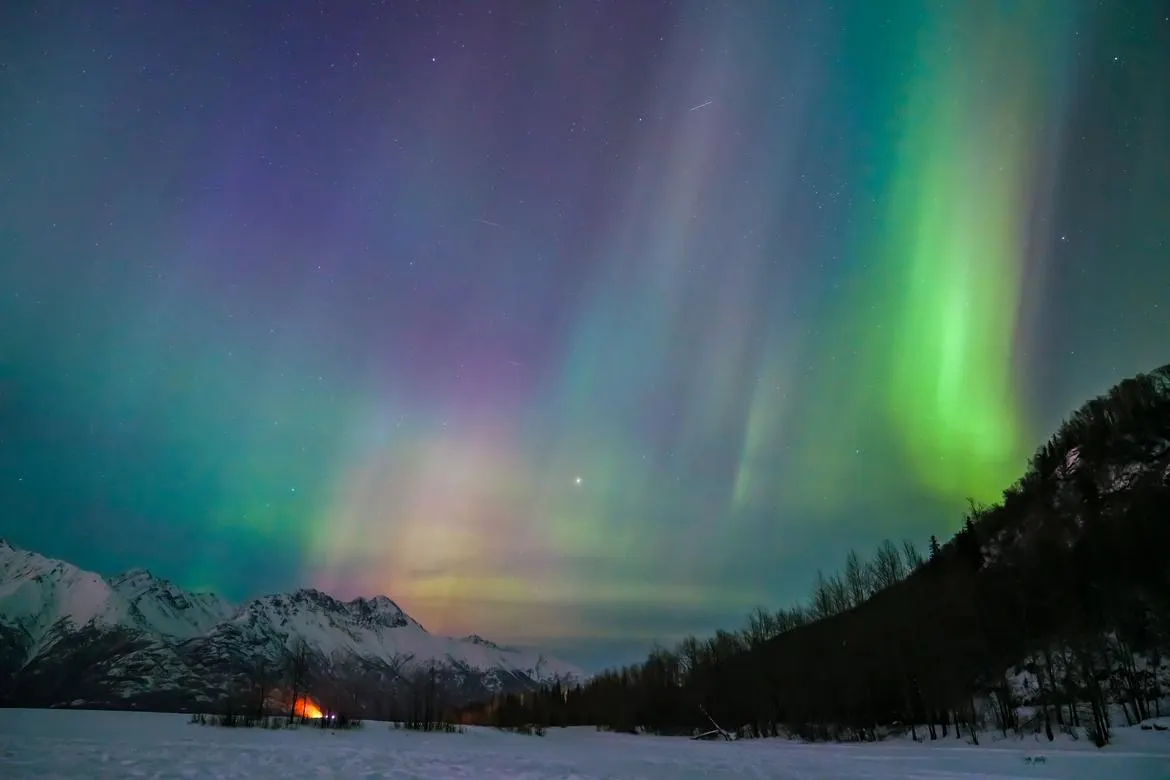
Northern Lights illuminate the night sky with vivid purple and green hues above a distant cityscape following a strong solar storm coinciding with the spring equinox in Fairbanks, Alaska, United States, on March 20, 2026.
Photo by Hasan Akbas/Anadolu via Getty Images
Key Facts
NOAA’s forecasted Kp index of four means the northern lights may be “quite pleasing” to look at for observers in the right areas on Saturday night.
No geomagnetic storm impacts are expected Saturday following a moderate storm that was forecast Friday night.
If current forecasts hold, observers in the northern U.S. will not have another chance to view the aurora borealis Sunday night, when the Kp index drops to three.
Where Will The Northern Lights Be Visible?
As of late Saturday morning, there are “low” chances of seeing the northern lights in northern Washington, the northern tip of Idaho, northern Montana, North Dakota, northern South Dakota, northern Minnesota, northern Wisconsin and the Upper Peninsula of Michigan. Much of Alaska, as usual, will have a much better chance of northern lights visibility.
Saturday night’s aurora forecast.
NOAA
What’s The Best Way To See The Northern Lights?
Viewing the northern lights from high vantage points and places with little to no light pollution can improve chances of seeing them. The aurora is typically most active between 10 p.m. and 2 a.m. Little to no moonlight can also help visibility, and Saturday night’s waning crescent will bring just that with the moon only being 3% illuminated.
What’s The Best Way To Photograph The Northern Lights?
Tripods can help stability for all camera types, while smartphone users should avoid flash and use night mode when snapping photos. Low apertures can also help if devices are capable, as can wide-angle lenses on traditional cameras.
Key Background
There have been several northern lights showings throughout the month of June so far despite the sun getting farther away from the peak of its 11-year solar cycle in 2024. The benchmark has triggered frequent northern lights showings since then, though auroral activity is expected to lessen the more time passes from the cycle’s peak.
Further Reading
Aurora Dashboard (NOAA)
















Leave a comment