


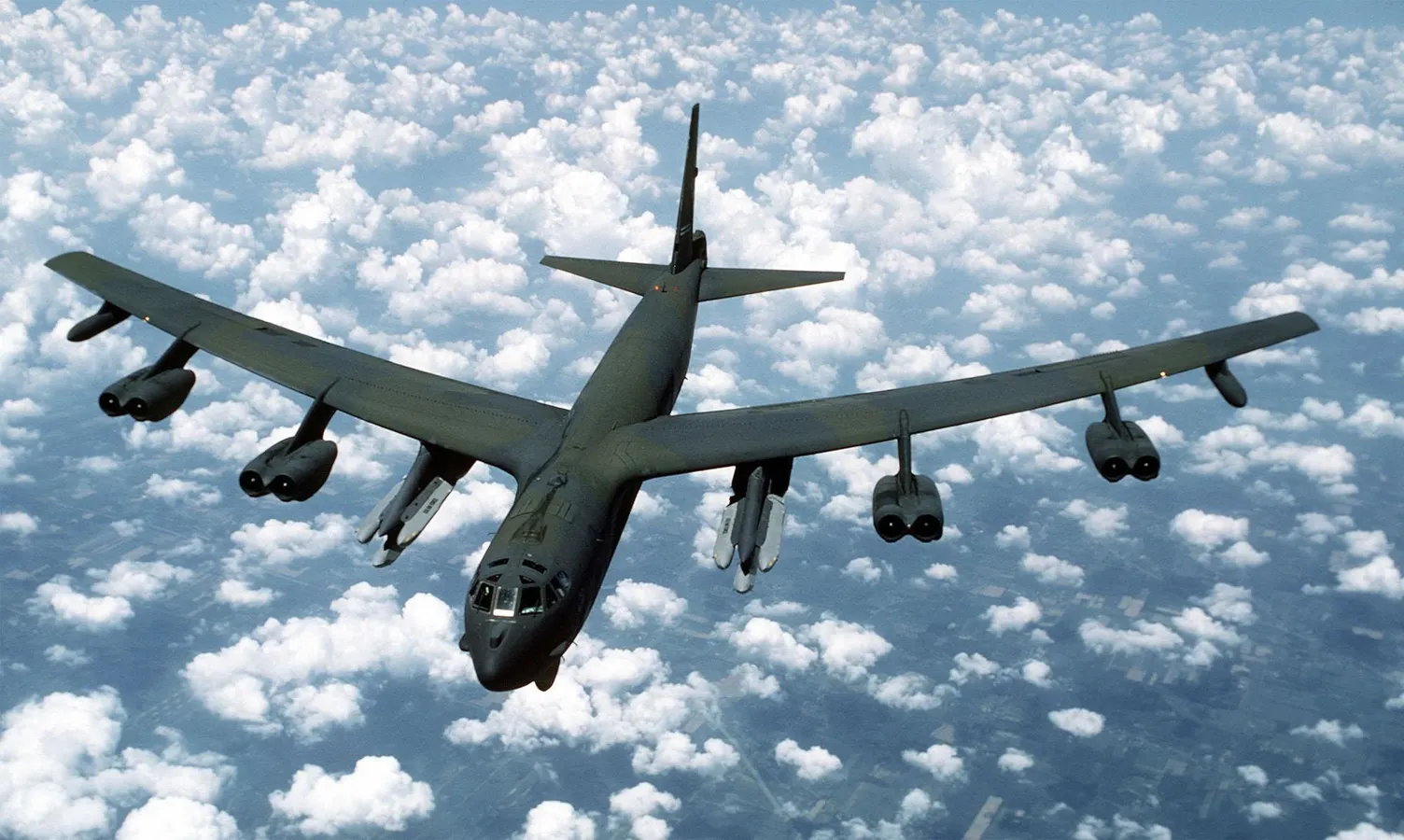

An air-to-air front view of a B-52G Stratofortress aircraft from the 416th Bombardment Wing armed with AGM-86B Air-Launched Cruise Missiles (ALCMs). (Photo by USAF)
Getty Images
The Boeing B-52 Stratofortress has been the workhorse of the United States Air Force’s bomber fleet and a cornerstone of the country’s nuclear triad for more than seven decades, and current plans call for the long-range strategic bomber to remain in service through the 2050s. To ensure that the remaining fleet of 76 B-52s can go the distance, the aircraft are being modernized and updated.
On Tuesday, the U.S. Air Force confirmed that it reached two critical acquisition decisions, including Milestone B approval on June 1 for the B-52J Commercial Engine Replacement Program, which will enable the upgrade to progress to the development stage; and Milestone C approval on August 21 for the B-52 Radar Modernization Program. That later approval signaled the green light for the radar updates on the B-52 to begin production.
“These back-to-back milestones reflect the maturity of both programs and the strong partnership between the B-52 Program Office, Boeing, Rolls-Royce and Raytheon,” said Brig. Gen. Timothy Spaulding, portfolio acquisition executive for Bombers and director of the Air Force Life Cycle Management Center’s Bombers Directorate, in an Air Force press statement. “These programs are delivering the propulsion reliability, sensor capability and electrical power needed to keep this legendary bomber viable, lethal, and supportable well into the future.”
Two B-52 Stratofortress bombers have been designated as dedicated testing aircraft and are currently flying operational missions following depot maintenance. Each will begin the modification process at Boeing’s San Antonio facility later this year, where they will receive the CERP and RMP modification concurrently.
The Air Force added that the effort to modernize the Stratofortress is essential to the future capability of the aircraft and is organized around four key functions, including “aviate, navigate, communicate and eliminate.”
Aviating the B-52
Under CERP, the remaining B-52s will have their original Pratt & Whitney TF33 low-bypass turbofan aircraft engines that were developed in the late 1950s replaced with the commercial-derivative Rolls-Royce F130 engines, which have already accumulated tens of millions of flight hours.
The U.S. Air Force first selected the F130 powerplants in September 2021, with plans to deliver the first lot of B-52H modified aircraft – redesignated the B-52J – by the end of 2028. According to a Government Accountability Office report from July of this year, CERP has faced significant delays and cost increases, but Air Force officials have maintained it is working on a stable schedule.
One issue has been that the engine upgrade is a complex process that calls for updates to the flight deck area, struts and nacelles. To address the issue, Boeing and Rolls-Royce employed digital prototyping to integrate the engines and make other changes before any physical modifications were made.
Beyond the engines, the program will see other critical support subsystems receive a modernization, including the hydraulic pumps, cockpit displays, flight systems and generators that increase electrical power capacity.
“The June 1 Milestone B decision established the program’s first official Acquisition Program Baseline and authorized entry into the Engineering and Manufacturing Development phase,” the Air Force explained, noting that the total acquisition cost was established at $20.2 billion, which included funding for research, development, test and evaluation, procurement, and military construction.
Of the $20.2 billion, $2.6 billion has been spent since 2018, the service acknowledged. The upgrade effort has also sought to avoid technical risk, which included extensive wind-tunnel testing that identified inlet airflow distortion. That required engineers to redesign the nacelle and inlet, which was validated following extensive testing, with the critical design review between Boeing and Rolls-Royce completed in May 2026.
Other engine testing has continued.
“CERP is a critical investment in the enduring credibility and capability of the B-52 force,” added William Bailey, performing the duties of the assistant secretary of the Air Force for Acquisition, Technology and Logistics. “By establishing a stable cost and schedule foundation, we are positioning the B-52 to provide reliable, long-range strike and deterrence capacity for decades to come.”
The new engines are roughly 30% more fuel-efficient, eliminate the iconic black smoke trail, and are expected to last the rest of the jet’s service life without an overhaul.
The Air Force Seeks to Communicate and Eliminate
The air service also announced that beyond propulsion and radar, the B-52 fleet would receive other upgrades, including to its “survivable command-and-control communications platforms,” notably the Extremely High Frequency terminals, along with its conventional beyond-line-of-sight capabilities. That included the Hybrid SATCOM.
The Cold War-era long-range bomber will also include weapons integration updates that will allow it to carry and deploy the latest models of the Long-Range Anti-Ship Missile and Joint Air-to-Surface Standoff Missile. The Air Force further acknowledged that the B-52 will continue to serve as a test platform for the U.S. military’s hypersonic weapons.
The U.S. Air Force has 76 operational Boeing B-52 Stratofortress bombers, with 58 operated by the 2nd Bomb Wing at Barksdale AFB, Louisiana, and the 5th Bomb Wing at Minot AFB, North Dakota. An additional 18 Stratofortress aircraft are in the reserve force, operated by the 307th Bomb Wing at Barksdale AFB.














Leave a comment