


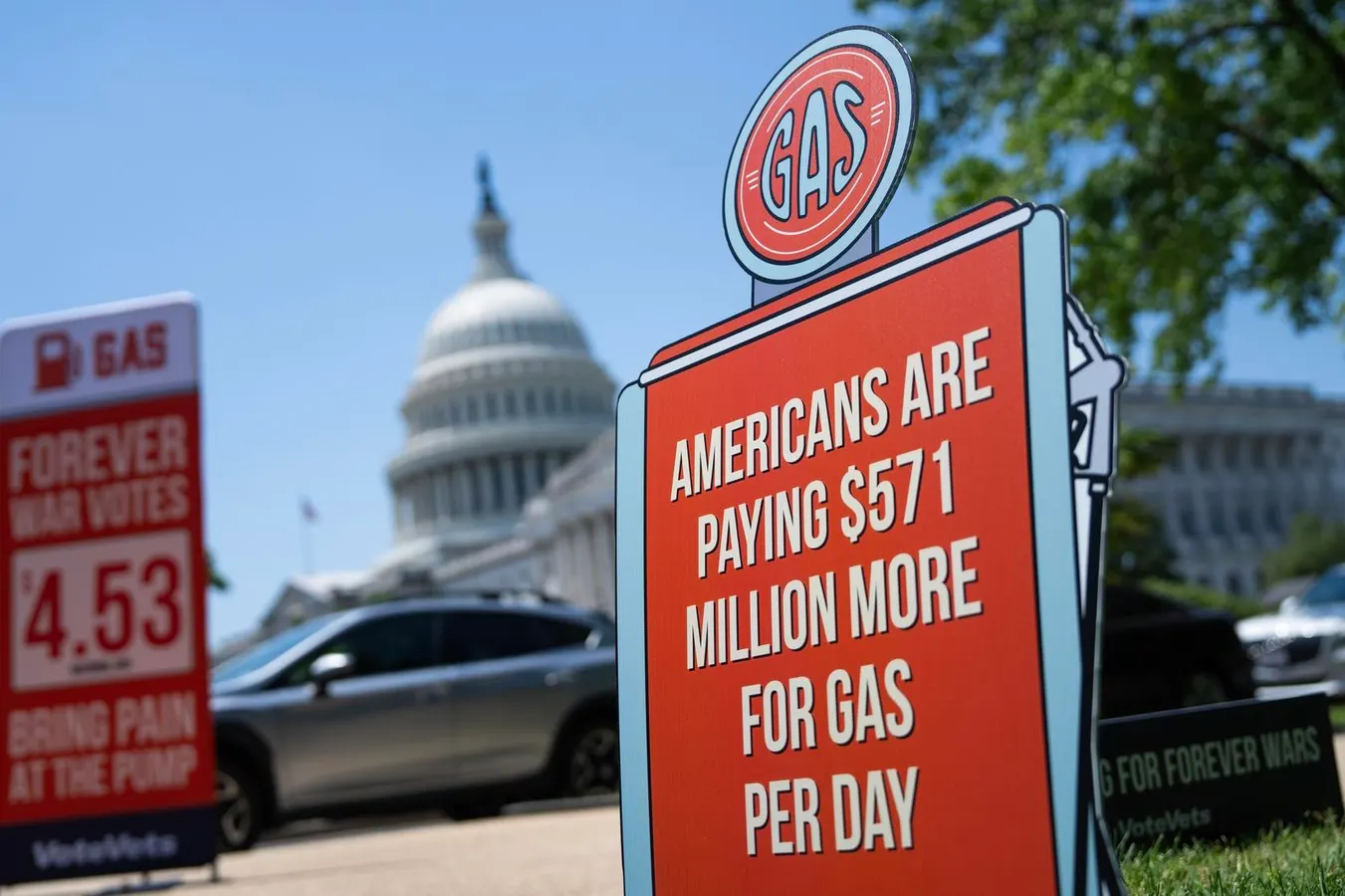

High gas prices have been a persistent effect of the war with Iran.
CQ-Roll Call, Inc via Getty Images
As the United States enters its seventh month of fighting with Iran it is imposing significant near and long-term costs. It’s not just the loss of US personnel and the resources expended to date, but other strategic costs are mounting and the bill will come due.
The Huge Defense Bill Is Getting Larger
There are a wide range of estimates on the war’s financial toll but all point to a significant outlay. Secretary of Defense Pete Hegseth has publicly acknowledged that the US has spent around $38 billion so far, including the cost of day-to-day operations, the forward deployment of thousands of US troops, and the expenditure of thousands of conventional and precision munitions.
This estimate, however, does not cover damage to US military and diplomatic facilities in the Middle East. News media reports indicate that nearly two dozen US military facilities in the region, along with valuable military equipment positioned in hangars and on vulnerable runways, have sustained serious damage from Iranian missile and drone strikes. Similarly, there have been multiple attacks on US diplomatic facilities since the war began, including strikes in Baghdad, Saudi Arabia and Kuwait. The price to replace damaged military hardware, including dozens of aircraft, and repair, harden, and relocate affected facilities and personnel will cost many billions of dollars.
To help defray these initial costs the Trump administration is seeking a nearly $90 billion supplemental budget, with about $67 billion to pay for Iran war costs. Keep in mind that this is on top of the Trump administration’s record-breaking $1.5 trillion defense request for 2027.
Broader Economic Hits Are Evident
Rising security costs are hardly the only financial impact of the war. For example, because of the curtailed flow of energy through the Strait of Hormuz, US gas and diesel prices are roughly 30% higher now than before the war, costing Americans an additional $500 per US household since the war began in February.
Given the collapse of the US-Iran memorandum of understanding and Iran’s ongoing campaign to assert control of the strait, most experts anticipate that commercial shipping through the strait is unlikely to reach pre-war levels for at least the rest of this year and perhaps longer, keeping oil prices high.
Meanwhile, increased energy prices are helping drive up US inflation, erasing most workers’ wage gains in 2026. The war has also helped trigger higher than expected US interest rates, raising the cost of borrowing for most Americans.
And while the US economy has been hard hit, the global impact has been worse. According to the World Bank, year-on-year global growth is expected to fall from 2.9% to 2.5% in 2026, with the possibility that growth could plummet to just 1.3 percent if the emerging global energy crisis triggers a shock to global financial markets.
The bank has also lowered growth forecasts for nearly two-thirds of countries because of the war, with Middle Eastern countries likely to absorb a particularly significant blow because of falling energy revenues. And has been well documented, the global fertilizer scarcity caused by disruptions in strait traffic are causing lower crop yields around the world, tightening food supplies, and, inevitably, raising food prices.
Iran’s Regional Influence Is Expanding
Apart from the economic toll, there are several other emerging—and worrisome—consequences from the conflict. Iran, for example, is paradoxically poised to emerge from the war domestically damaged but in a stronger regional position than it enjoyed at the outset, with its conventional military nearly crippled but its ballistic missile and drone arsenal, as well as its proxy network, largely intact.
The Jerusalem Post reports that Israeli defense officials have been shocked by Iran’s ability to reconstitute its badly damaged military capabilities at this point in the war, including its ballistic missile arsenal. This tracks with recent reporting from The New York Times citing US intelligence estimates that Iran’s ballistic missile inventory remains at about 70% of its pre-war level.
While US airstrikes have significantly set back Iran’s nuclear program, Iran shows no signs of turning over its remaining stockpile of enriched uranium and still maintains its deep technical expertise (especially pertaining to advanced centrifuge development) with which it could potentially restart its program in the future.
Perhaps most ominously, Iran has demonstrated its ability to effectively threaten the strait through a combination of missile and drone strikes, proxy attacks on commercial shipping and the emplacement of sea mines. This has enhanced Tehran’s influence over its Gulf neighbors, as well as spooked the global energy market; thus far the Iranian regime has shown no inclination to relinquish its control of the strait during on-again, off-again diplomatic talks.
America’s Gulf Allies Are Scrambling
Not surprisingly, the conflict has caused widespread damage to Persian Gulf energy and civilian infrastructure, the cost of which is causing unprecedented strains in US-Gulf relations. According to reporting by The Washington Post, US allies throughout the Gulf are increasingly frustrated by the White House’s inability to manage the conflict diplomatically, with some reportedly beginning to consider whether it’s still wise to host US military installations. They undoubtedly fear that the presence of US facilities increases the likelihood of being targeted by Iranian missiles and drones.
Meanwhile, Gulf states have recently accelerated their purchases of interceptor missiles and UAVs, point defense systems and precision missiles, with many of these deals signed with US defense firms.
Several Gulf states are also strengthening their counter-drone collaboration with Ukraine and may look over the next few years to expand partnerships with European and South Korean defense suppliers if relations with the US weaken further in the wake of the war.
Some analysts point out that the mutual defense pact signed earlier this month by Saudi Arabia, Turkey and Pakistan reflects their growing dissatisfaction with Washington. It also highlights these nations’ intention to broaden their security partnerships and reduce their reliance on the US.
While Other US Alliances Are Fraying
Unfortunately, the Iran war is not only damaging US-Gulf relations but is infecting US relationships more broadly. Consider, in recent months the Trump administration has continued to lash out at European partners for failing to support the US military campaign against Iran, even calling it a failed loyalty test and threatening to, in response, withdraw some of the nearly 70,000 US troops based in Europe.
Similarly, President Trump expressed frustration last week with longtime ally South Korea’s unwillingness to join the Iran fight, threatening to scale back joint military exercises with South Korea and fueling concerns in Seoul about the reliability of US security guarantees.
While much of this back-and-forth is likely rhetoric and diplomatic pressure versus a concrete policy shift, the president’s words are nonetheless having an impact abroad and any resulting deterioration in US relations with NATO and South Korea stemming from frustration over the Iran conflict would represent a major war cost.
A final unintended effect of the conflict is that Russia is reportedly leveraging it to provide Iran—with which it has had longstanding defense ties—with military intelligence and targeting assistance, while benefitting from America being bogged down in yet another Middle East crisis. Putin understands that every precision weapon the US fires against Iran is one less that can be offered to Ukraine in its deadly conflict with Moscow. For its part, China appears less interested in gaining an advantage from the war than managing the potential economic harm to the global trading system and its economy.
Sadly, The War’s Toll Will Likely Deepen
There is a chance that the administration’s latest effort to intensify economic pressure on Iran, which is triggering a steep economic decline and causing major pain on the population, will eventually trigger Iranian concessions and a diplomatic breakthrough. That would be the best case scenario in reopening the strait and capping the cost of this war. However, I, unfortunately, don’t believe that’s the most likely outcome. Rather, Iran’s leaders appear emboldened by the war’s current trajectory—even threatening to go on the offensive soon if the US blockade of the strait isn’t ended—and apparently believe they can withstand the war’s economic consequences far longer than the US.
As I mentioned previously, this increases the likelihood of a costly frozen conflict that grinds along with continuing economic disruption, spasms of fighting, and episodic diplomatic negotiations which in the end never allows the Trump administration to meet its declared pre-war aims nor achieve a final resolution of the war.
Therefore, while the Iran war’s price in US blood, treasure and diminished global standing is already high, the American public should brace itself and understand that what it has experienced so far may only be a downpayment on the conflict’s ultimate cost.
All opinions expressed in this commentary are solely those of the author.















Leave a comment