


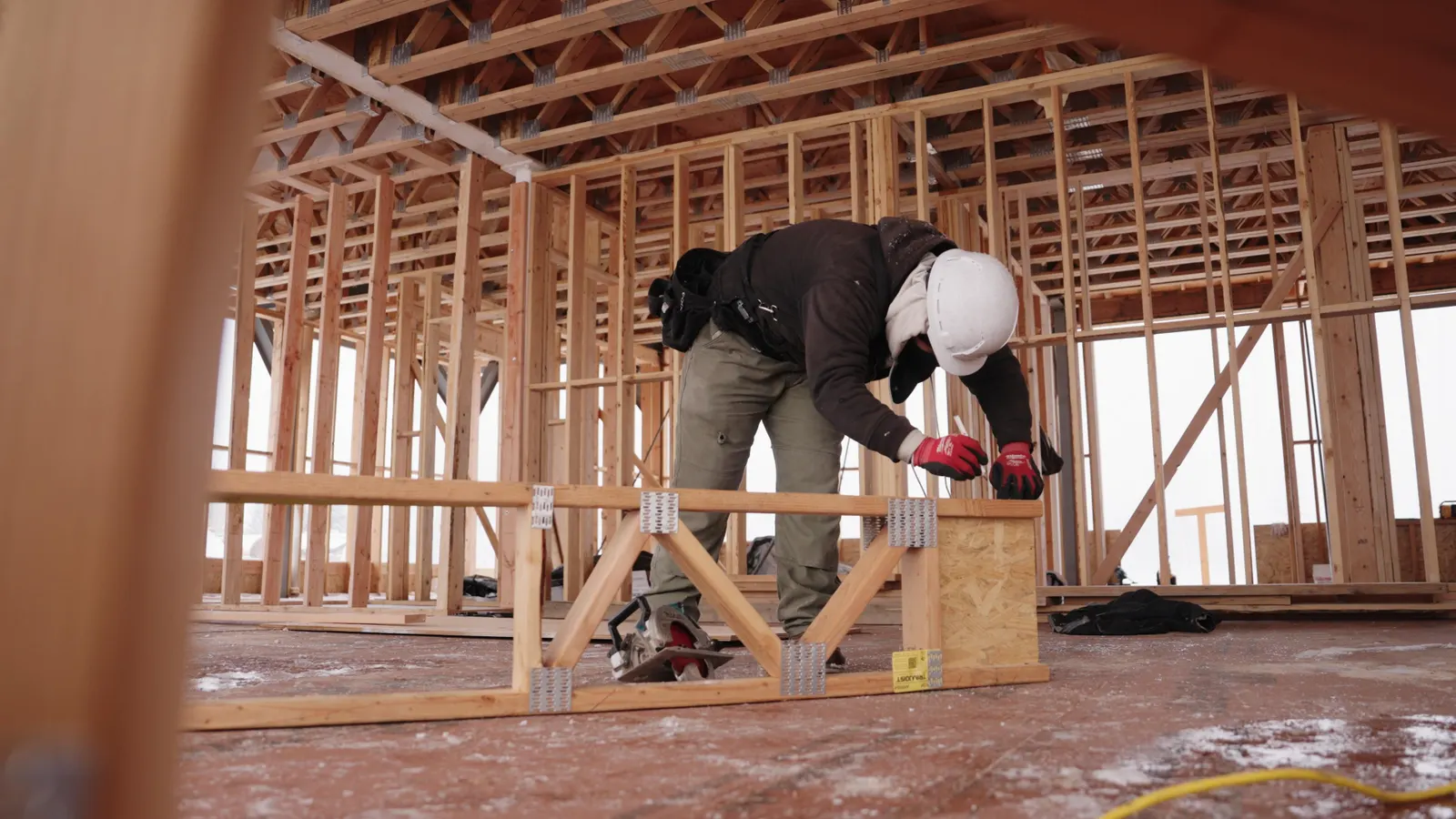

TrimJoist invented an open web truss system that can be stocked to ease supply chain issues and that is easier and faster to install, saving builders time and money.
TrimJoist
As every cost factor in the homebuilding process inflates, stakeholders in the process are doing the math and understanding how to take a part in lowering costs. Product manufacturers are owning their part and developing new product solutions that can shave off time and cost.
“We are in a neat moment in the building industry,” said long time industry veteran Alex Gillespie. “We don’t like the way things are, we are frustrated by the tools that we have, and we hate change, so we are caught in a conundrum. Forced through labor shortages and performance requirements and necessity, we are adopting or open to adopting new ideas and technologies more than I have seen in 35 years.”
After being a builder plus working at a lumber yard in the U.S. and in Japan, Gillespie now serves as chief product officer at HydroBlok, a cement board alternative that simplifies construction and speeds installation.
“If you buy a new home today and look at the punch list and the warranty challenges, it has gotten to a point that you can see that builders are getting pressured into change with long lists of punch list items,” he said.
Part of what HydroBlok does is simplify energy and performance-based building codes for an opportunity for a successful installation with lower skilled labor, and which means that the weatherization is done correctly to protect the home from warranty issues.
The dissection of a Hydroblok wall shows the advanced construction and efficiency and the ease of the installation.
HydroBlok
Providing lower cost product has to be holistic, so HydroBlok is tracking job sites to learn regional nuances in construction techniques that will improve its installation. HydroBlok offers about an 85% reduction in fasteners that translates to a reduction in time, material and risk. Plus, it increases the building envelope’s R-value.
“By condensing it all to one layer, it’s a 4 to 1 touch point reduction,” Gillespie said. “It also improves energy efficiency—50 to 60% of what you pay goes to heating and cooling and it can be reduced by 25%, which is a meaningful reduction.”
The product also received International Code Council approval for a direct-to-stud install.
“This is one of the most disruptive changes to exterior wall construction in decades,” Colin House, HydroBlok’s CEO said in a press release. “The industry has been moving toward more complex walls driven by energy codes and continuous insulation requirements, and HydroBlok Direct-to-Stud changes that equation. Builders can now remove a layer from the wall — simplifying stucco installation while achieving a built-in path to energy-code compliance — all with a single integrated system.”
Gillespie currently is working to quantify the reduction in both the builder’s insurance and homeowner’s insurance from his product. By using cold formed steel, he estimates that insurance would be reduced by 50% because of its fire resistance, moisture resilience, durability, and disaster recovery performance. It also doesn’t need sheathing, so it isn’t exposed to mold, rot or mildew.
The company is bringing manufacturing to Arizona from overseas in an automated facility that will be fully online this year.
Solutions Not Building Products
Not only are startups bringing innovative solutions to builders, but so are 360-year-old building product manufacturers like Saint-Gobain.
“The largest theme for R&D and innovation is to be a solutions provider to the customers,” said Todd DiNoia, the company’s vice president of innovation and R&D. “We are investing heavily in building sciences to bring them into design and constructability to get to solutions innovation.”
One product that is of particular focus is the One Precision Assembly (OPA) that brings materials together into one panelized solution for a builder.
“The skilled labor shortage is what we hear most often, which is why we have gone to OPA to help with that,” DiNoia said.
On a separate track, Saint-Gobain is bringing advanced training to contractors in the field with its Resilience360 program that teaches building science and installation on whole-home performance, moisture management, and advanced exterior protection.
Building Product Innovation
Panel manufacturer, Plantd, is a newer company that has made big in roads with production builders by investing in new materials that can offer 1.4 times greater strength and twice the moisture resistance of standard OSB, without changing the installation processes.
The company also helps build supply chain security with a vertically integrated model that controls everything from agriculture to the finished panel, so builders have predictable pricing in a category that is known for volatility and price swings.
Another innovative product that is changing the process for a faster build and more flexible supply chain is TrimJoist. It produces open-web floor joists that completely redefine a typical floor joist that needs to be precision measured and custom ordered.
“If a builder orders a custom floor joist, it is a four to six week lead time,” said the company’s COO, Brian Thomas. “They have to measure, place an order and if the walls move from that, it has to be recut. With ours, it can be cut that day, so we can reduce the time crews are on site and they can move on to service the next job.”
The innovative, open web system gives the product, and the process, a whole new spin.
“From the manufacturing side, we want to have teamwork, and everyone working as an orchestrated team,” Thomas said. “You put your name and guarantee on something when you pass it to the next person, fostering teamwork and building respect from person to person in the value chain. It’s different on the job site where subcontractors get into their own silos. When people leave, they don’t care what happens next.”
TrimJoist helps tie it all together like a manufacturing process. The truss has open ends, so it’s easier and quicker to run electrical work, duct work and plumbing.
Skyler Thomas, whose dad invented the product, now serves as vice president of strategy and growth and has found a market opportunity in modular and multifamily projects. Depending on the market and the amount of space needed for HVAC equipment, TrimJoist can slim down to just a 9.5″ dimension to keep the floor cavity as small as possible.
Since it doesn’t have to be custom measured, the product also can be stocked.
“It performs like a truss and it installs like an I-joist,” Skyler said. “That’s unique because it can be stocked at common lengths which makes it readily available. So, we don’t build to project, we build to inventory.”
In ProtoTown, Texas, two brothers are working on innovative panels that install like solar panels and convert the sun’s heat into air conditioning. The company, AtmosThermal, is working to cut the cost of air conditioning equipment in half, and then there are no energy bills, said CEO Evan Lipofsky and his brother Blake who serves as CRO.
They are setting up manufacturing now and doing pilots with industrial facilities that will inform the company’s future.
Technology Delivers Building Product Efficiencies
Not only are the physical products evolving, but so are the technologies surrounding them. As a big box retailer, Lowe’s most often is servicing home improvement pros, but it recently announced investment to provide product and services for the new construction pro.
For both audiences, it focuses on creating efficiencies with technology, such as AI-driven material lists that can simplify estimating, save time and help them respond faster. Its AI-powered tools can convert handwritten notes, photos, and spreadsheets into orders in minutes, which not only saves time but also reduces manual entry and the errors that can come with it.
Lowe’s also has invested in Blueprint Takeoffs and its Pro Extended Aisle as other AI-based tools that help expedite the process from planning to purchase.
At a different scale, TradeTrax has technology to provide job site metrics that improve the speed and profits of new home. One metric the company tracks is cycle time.
For builder with 10,000 home completions, reducing cycle time by 15 days would create capacity for about 1,250 more homes annually — a 12.5% increase without adding land, overhead, or infrastructure.
Those lower home build costs can give builders discipline without eating into margins. Plus, when a builder’s invested capital turns faster, they can develop more communities for the at the same cost, particularly in entry level and affordable markets.
Henry Dziuba, CEO at TradeTrax, explains how the math to get there is more nuanced than most builders are tracking.
For example, a builder’s head of procurement focuses on lowering the cost of materials by finding the cheapest trade and not necessarily to cut the build time. They may find lower cost trades, but the lower cost trade may take three extra days to complete the task.
“The three extra days is a cost that most builders don’t recognize,” Dziuba said. “Cycle time with production builders would cost at least $300 per day. That three days of poor schedule performance at $300 per day is $900. So, the $500 savings from finding a cheaper trade cost $900 in carrying costs.”
TradeTrax is uncovering those insights to find efficiencies in the build schedules.
“How many builders celebrate reduced cycle time, but it could actually be fewer homes being built?” Dziuba asked.
A lot of builders are capturing metrics such as if the trade finished on time or late, but without an associated causation, or if it started on time, or what the size of the crew was. Builders need more data to understand valuable insights, such as if the task was ready for the trade, or why it wasn’t ready.
“Framing is a great example of the volatility,” he said. “We analyzed a 10-day framing task on 100 homes, and 30% of the time the job finished on time, but 33% of the time, the job ran late. That’s all we capture in today’s world. The majority of the time, the task finishes early, but what happens when it finishes early? It sits empty for the three days that it was done.”
TradeTrax will give visibility to the early completes and get the project ready for the next trade, which reduces costs and increases efficiency. Plus, the trade benefits by not wasting time driving to jobs that aren’t ready.
Beyond the Build
It’s a blue ocean of opportunity for efficiencies in the home building space.
Saint-Gobain is including digital and AI into its research for smarter and quicker design experiments with fewer iterations.
“We have a long history, 360 years, adding up to a lot of data and documentation,” DiNoia said. “AI is upscaling our research and it’s able to summarize things in different ways.”
The company also is searching for suppliers with innovative materials for its initiatives to lower embodied carbon to meet its goals to be carbon neutral by 2050–another huge impact that will help builders build better.
Gillespie also sees the pressure from labor shortages and affordability challenges extending beyond the costs of building the home to heating and cooling the house and to insurance costs. He predicts that energy demand in Texas will go up another 70% in the next dozen years, which puts pressure on building products to perform more efficiently.
Plantd panels can store carbon, creating the perfect trifecta of supply chain resilience, affordability and sustainability.
The building product development process has dozens of openings for improved sustainability, higher efficiency and stronger technology adoption. The future promises high levels of change at a quick pace.















Leave a comment