


Topline
State election officials will be able to mail ballots to voters as usual for the November midterms, as the Supreme Court ruled Monday to keep the U.S. Postal Service’s controversial new rule on mail-in ballots blocked ahead of the midterms—avoiding potential chaos if the rules had changed at the last minute.
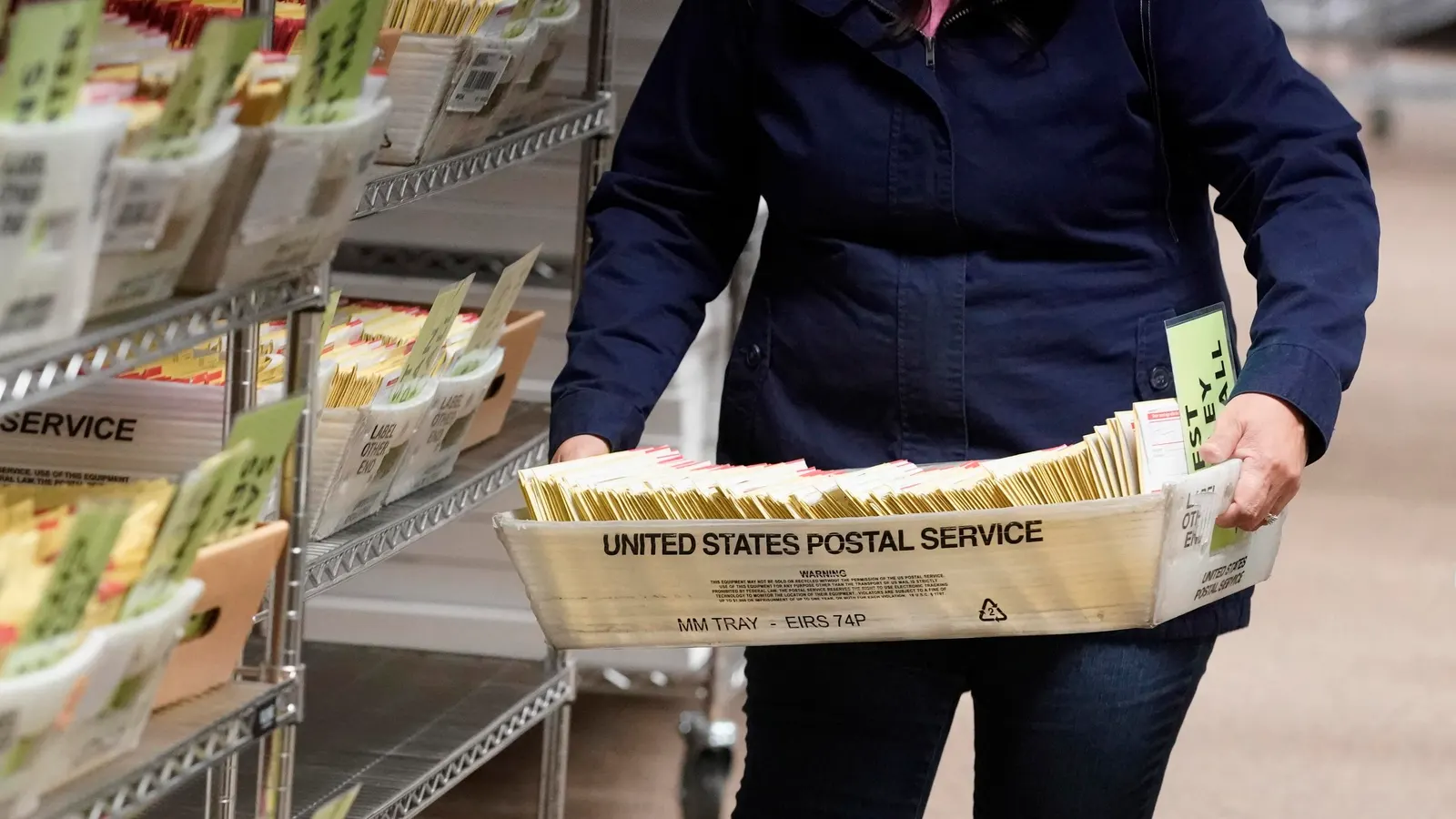
An election worker moves a container of mail-in ballots to be processed in Salt Lake City, Utah, on November 4, 2024.
AFP via Getty Images
Key Facts
The Supreme Court ruled to uphold Judge Indira Talwani’s ruling that paused the Postal Service’s mail-in ballot rule for the November midterms as litigation remains ongoing, the latest twist in an ongoing back-and-forth over whether the rule can take effect.
The justices’ ruling means USPS’ rule will not be in effect for the November midterms.
USPS’ new rule, which was finalized late last month, required state election officials to submit voters’ information to a new federal database in order to send out mail-in ballots, imposing a new system where all ballots receive special barcodes, and postal officials will not mail ballots to voters if the barcodes don’t show the voter has been federally cleared.
The rule prompted widespread fears that it could potentially make it harder for Americans to vote by mail—those concerns were bolstered by an anonymous whistleblower at USPS, who alleged the system was being hastily implemented and could result in widespread issues with ballots being rejected and not sent to voters.
The court’s majority wrote that the Trump administration is unlikely to succeed it its effort to challenge the federal court’s previous order, although conservative justices Samuel Alito and Clarence Thomas dissented.
The Supreme Court’s decision came after the justices previously ruled 6-3 on Aug. 24 to let the new rule take effect—but their reasoning was based on the rule not being finalized yet, which is no longer the case.
What to Watch for
The dispute at the Supreme Court is over a preliminary injunction that barred USPS from moving forward with its rule as the litigation plays out, and is not a final order on the legality of the rule. The case is still playing out in the lower court, meaning there could still be future decisions on the USPS rule and whether it’s legal, though the Supreme Court’s order is likely to stay in place as voting for the midterms is carried out.
What Does This Mean For Voters’ Mail-In Ballots?
The court’s ruling allows states to keep sending out mail-in ballots normally, without having to get them cleared through the federal system. Voters also do not need to do anything differently. The ruling also avoids potential complications that may have arisen from the rule taking effect as several ballots have already been sent out. Mail ballots account for nearly a third of all votes cast.
What Does The USPS Rule Say, And Why Is It Controversial?
The USPS rule, which was borne out of President Donald Trump’s executive order on mail-in voting, creates a new federal database that all state and local election officials must use if they want to mail ballots out to voters, as well as new standards for ballot envelopes. Before they can mail out a ballot, election officials must submit the voter’s name, address and the barcode their ballot will be associated with. They can then use the mail to send out the ballot as usual—but if a postal worker finds the ballot hasn’t been approved through the database, it cannot be sent through the mail and will be mailed back to the elections office. The USPS has said it will only use the database to register voter information and will not take any steps to determine whether that voter is eligible to vote, and states are still solely responsible for determining which voters in their state can vote by mail. The anonymous whistleblower who raised concerns about the USPS rule has criticized the IT system that was created to implement it, alleging it was “rapidly built and minimally tested” and could be prone to widespread issues. The whistleblower also flagged a “zero percent fail rate policy” USPS adopted for scanning the ballots, which means that if even one barcode in a batch of 10,000 ballots did not scan properly, all 10,000 would be rejected and mailed back to election officials. There’s a high likelihood of there being issues with barcodes due to the rushed IT system, the whistleblower alleged, warning the new system risked “catastrophic failure which could derail the midterm elections.”
What About Future Elections?
This dispute over pausing the USPS rule only concerns the rule as it applies to the upcoming November midterm elections, and does not concern future federal elections in 2028 and beyond. That means it’s still up in the air whether the rule could be in effect after November, and will depend on how the case is ultimately resolved and whether courts decide the rule is lawful. The USPS policy also only applies to general elections, so it will not be used for primary elections in 2028 regardless of whether or not it’s upheld in court.
Key Background
Trump’s order for the USPS to create the federal database is part of the president’s broader attacks on mail-in voting, which he has falsely linked to fraud despite repeatedly voting by mail himself. The Supreme Court’s ruling was the latest in a string of back-and-forth court orders over the rule’s fate, with lower court judges initially blocking the policy in June and August before the Supreme Court ruled Aug. 24 that it should take effect. The Supreme Court argued in its first ruling that the lawsuit against the USPS policy had been brought too soon, before the rule had actually been finalized—an argument that was already outdated by the time the justices ruled, as the USPS finalized the rule days earlier. That meant the Democratic state attorneys general and voting rights groups that challenged the rule could file fresh legal complaints that took aim at the final rule, now that the Supreme Court’s concerns were no longer valid. Talwani blocked the USPS rule temporarily for 14 days in response, and later issued a more lasting order. The judge wrote in her ruling blocking the policy that implementing the rule at the last minute, when states don’t have enough time to comply with it, would mean “disenfranchisement … is practically inevitable.”














Leave a comment