


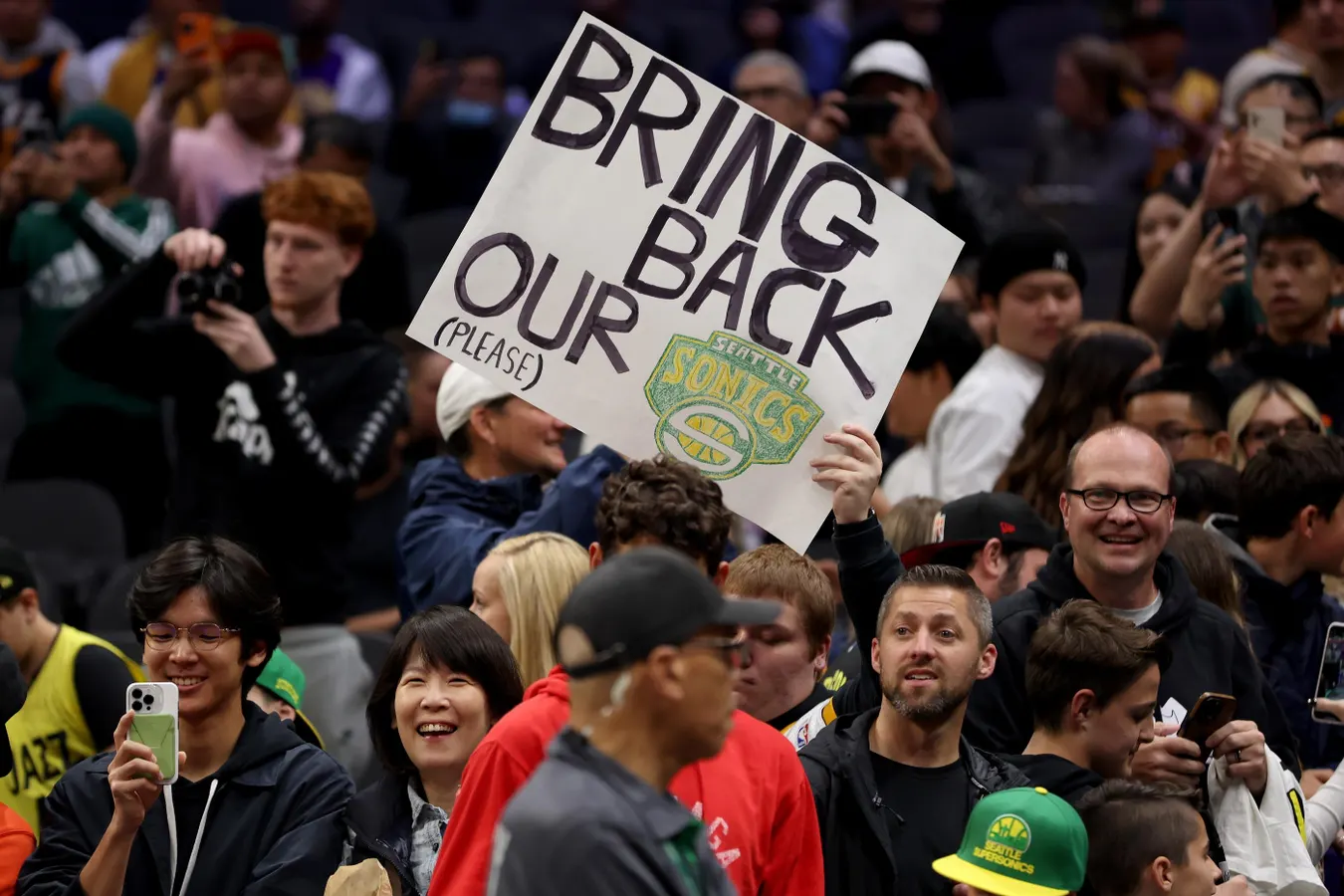

SEATTLE, WASHINGTON – OCTOBER 10: A Seattle Sonics fan holds a sign before the Rain City Showcase in a preseason NBA game between the LA Clippers and the Utah Jazz at Climate Pledge Arena on October 10, 2023 in Seattle, Washington. (Photo by Steph Chambers/Getty Images)
Getty Images
NBA expansion still isn’t guaranteed after the latest Board of Governors meeting this week.
However, based on reporting from ESPN’s Shams Charania, the process is still very much alive and could even be nearing a conclusion.
NBA Commissioner Adam Silver has previously said that the goal is to have the expansion issue resolved by the end of the year as the league has been seriously exploring the Seattle and Las Vegas markets as candidates since March.
Charania’s reporting on Tuesday stated that the next round of bids for the Vegas team, in particular, were due on Thursday, with final bids due shortly thereafter. Expectations were that the bids were in the $10 billion range for Vegas – a number that is likely bolstered by the recent $12.5 billion sale of the Los Angeles Lakers (to Bob Iger and Josh Kushner).
Also notable, however, is that the Seattle bid is expected (via Charania) to be in the $7 billion range. And as previously covered, the Seattle process reportedly lacks the level of competitive bids that Vegas has, and is not as far along as its potential expansion counterpart.
On the other hand, Seattle already has a venue ready in the Seattle Kraken and Seattle Storm’s home, Climate Pledge Arena. That city does not have the same flexibility that Las Vegas does to build a new NBA-specific arena. So any bidders would be doing so with the goal of inhabiting that venue (possibly making it a less appealing prospect).
That stipulation makes sense. Yet what doesn’t, at least when compared to previous expansion bids across North America sports, is the potentially differing expansion fees that these franchises will command.
SEATTLE, WASHINGTON – JULY 21: Photograph of the stage at Gas Works Park for the NHL Expansion Draft on July 21, 2021 in Seattle, Washington. The Seattle Kraken is the National Hockey League’s newest franchise and will begin play in October 2021. (Photo by Christopher Mast/NHLI via Getty Images)
NHLI via Getty Images
Expansion Fee History
In most other instances, expansion franchises entering a Big Four league at the same time have paid the same fee.
For as much as franchise values can significantly differ within a given league, the value of joining would seemingly be the same – at least initially.
Even in the case of a slightly staggered expansion process, like the NHL most recently had with the Vegas Golden Knights (initiated payments in 2016) and the Seattle Kraken (initiated payments in 2018), the difference was $150 million. And Seattle wouldn’t actually join until 2021.
Here, the NBA is potentially adding those same two cities at the same time (the 2028-29 season). And the expansion fee gap could be at least 42%, if the $7 billion and $10 billion figures wind up coming to fruition.
That differs significantly from previous additions in the NBA, when the Toronto Raptors and (then) Vancouver Grizzlies each paid $125 million. And the most recent two-team expansions in the NFL and MLB also collected the same fees for both teams.
An exception which features recent examples, though, is MLS.
Not only has Major League Soccer added franchises at a torrid pace over the last 15 years (10 new teams since 2017), but it’s also had some differing fees. But even those discrepancies – like Atlanta United’s $70 million expansion fee versus Minnesota United’s $100 million despite both joining MLS in 2017 – could be partly be chalked up to the year between those franchises were awarded.
SEATTLE, WASHINGTON – DECEMBER 07: A Seattle Supersonics fan dressed as Bigfoot is seen during the game between the Gonzaga Bulldogs and the Kentucky Wildcats at Climate Pledge Arena on December 07, 2024 in Seattle, Washington. (Photo by Steph Chambers/Getty Images)
Getty Images
Seattle Complications For NBA
There haven’t been any public statements about the city of Seattle or any ownership group there receiving a discounted rate to eventually return the SuperSonics. Yet, given how long information expansion and relocation conversations have been going on between Seattle and the NBA, that and the (nearly) game-ready venue could factor in.
The NBA is also in a strange place around expansion where franchise values have soared at such a rate that even the $5-6 billion expansion figures estimated last summer feel outdated today when measured against the Celtics and Lakers sales.
So more than any league actively engaging in expansion conversations, the NBA sort of has the luxury of calling its shot on cities, and then seeing what comes back. Once it became clear that money was no object in Vegas, but there was a clear ceiling in Seattle (especially when the Super Bowl champion Seahawks were concurrently for sale), the choices were accept that or potentially walk away yet again and hope it could get more from another metro area.
If Seattle can’t get past $7 billion, though, what are the odds that smaller cities with smaller corporate bases could?
Credit the NBA for not just setting an expansion fee rate (as the NHL recently did) that effectively caps what owners can make by adding two teams. But allowing the fees for Seattle and Las Vegas to differ as much as they might here would seem to create an immediate imbalance between the two.
Or, on the other hand, it could simply create ample gray area for future franchise valuations and expansion fees to exist in; with the opacity allowing them to rise to wherever the market later dictates.
















Leave a comment