


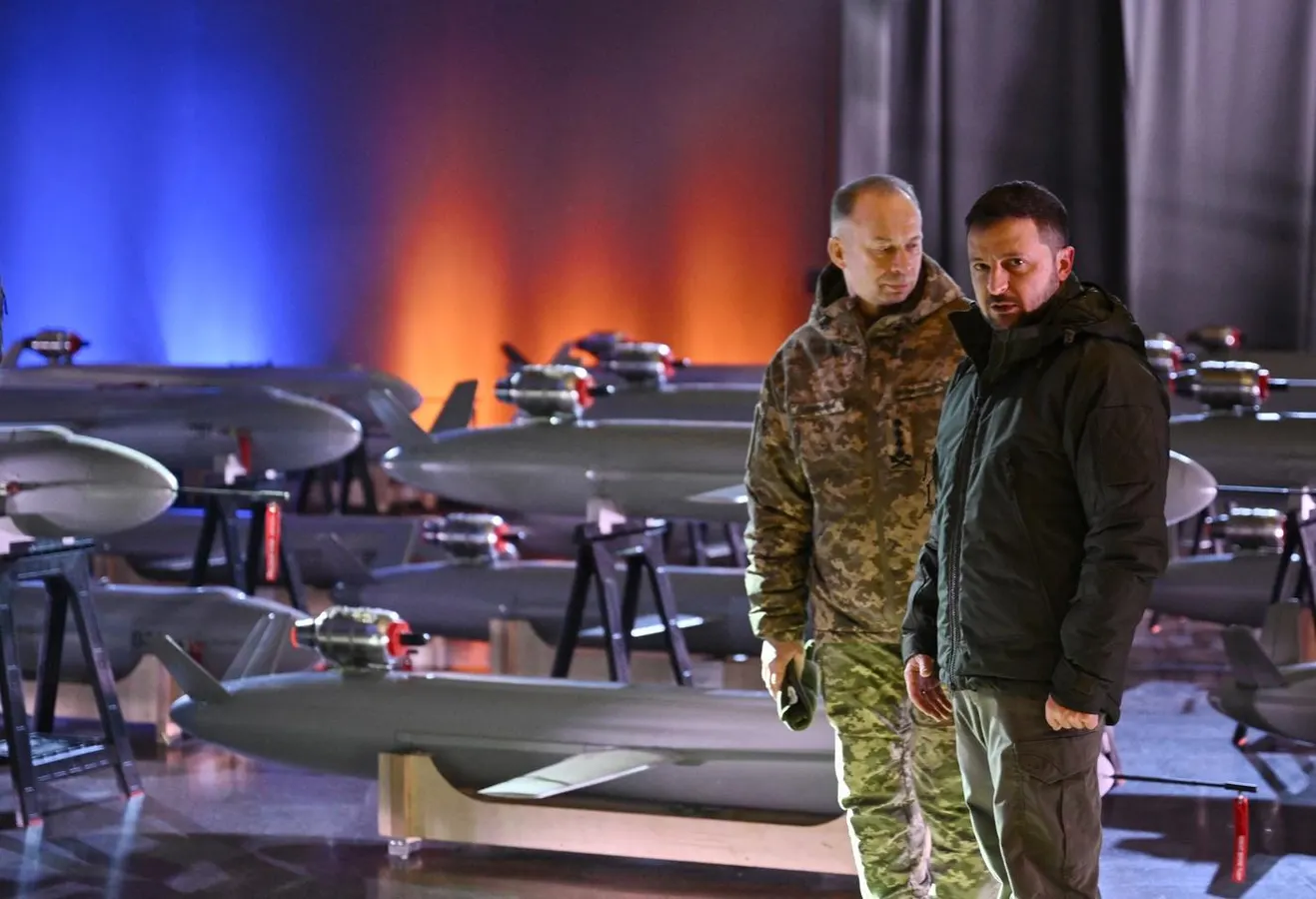

TOPSHOT – Ukrainian President Volodymyr Zelensky (R) and Commander-in-Chief of the Armed Forces of Ukraine Oleksandr Syrsky (L) speak next to the first batch of Ukrainian made drone missiles “Peklo” (Hell) delivered to the Defence Forces of Ukraine in Kyiv on December 6, 2024, amid the Russian invasion of Ukraine. December 6, 2024 marks the 33th anniversary of the Armed Forces of Ukraine. (Photo by Genya SAVILOV / AFP) (Photo by GENYA SAVILOV/AFP via Getty Images)
AFP via Getty Images
The Changing Character Of War
Last week the future arrived twice. Russian soldiers surrendered to Ukrainian drones and a Ukrainian maritime drone launched interceptors to counter a Russian Shahed. Given these two never-before-seen military developments, it’s no surprise that former National Security Advisor H.R. McMaster commented that we have entered a new era of warfare. While the nature of war—a military means to achieve a political end—has not changed, the character of war is changing before our eyes. There are many new technologies underlying this changing character of war such as the increasing capability of LLMs and a proliferation of sensors from space, but none exemplifies this changing character more than drones. And no conflict has brought this more to the forefront than Ukraine.
Ukrainian soldier with the UFORCE Nemesis drone
UFORCE
Fundamentally, drones are changing how conflict unfolds.
- Increased lethality: drones represent the largest source of casualties in Ukraine, estimated to be about ¾ of all casualties.
- Lower cost weapons inflicting significant and asymmetric damage: a drone costing $1,000 can destroy a tank that costs millions; a maritime drone can sink a Russian ship costing hundreds of millions. With Operation Spiderweb, the Ukrainians put dozens of drones behind enemy lines to cause billions of dollars in damage to the Russian strategic bomber fleet.
- Proliferation: produced at industrial scale, volume itself becomes the weapon, saturating defenses beyond their capacity to respond. Ukraine plans to produce 7-10 million drones this year and Russia plans to produce more than 6 million. (The U.S. produces about 1/50th of that volume.) Rather than classifying drones as new defense platforms, Secretary Hegseth suggested that drones should be treated like bullets: inexpensive and expendable. Additionally, their low-cost has made drones available to non-state actors as well as large militaries; drone attacks from non-state actors increased from 6 to 91 groups in 2018-2023.
- Defender’s advantage for territory denial: drones alter the ratio of force required to overcome an entrenched defender. According to Admiral Sam Paparo, Commander of the U.S. Indo-Pacific, the historical ratio of 3x an attacking force to overtake a defender may now be up to 10x.
- Battlefield transparency: there’s no place to hide with every position being visible—day and night—emitting a targetable RF signature.
- New counter measures: Electronic warfare’s importance has risen dramatically as a first line of defense against drones with a relentless cycle of jamming and other counter strategies such as fiber-optic drones. Incoming drones require a layered defense of counter-UAS techniques—both kinetic and non-kinetic.
- Autonomous operations means that increasingly humans do not need to fly drones since they can be equipped with onboard navigation and targeting capability.
- AI combined with autonomy will enable a single operator to control many drones at once in a swarming configuration. Swarms will execute entire missions without human intervention.
The overarching lesson from Ukraine, as analysts at West Point note, is that this isn’t just a new weapon—it’s ushering in a new era of warfare. The closest historical analogy may be the tank, introduced during World War I, which broke the murderous stalemate of trench warfare. As an armored vehicle, the tank restored offensive maneuver: crossing no-man’s land under fire and crushing barbed wire all while being impervious to enemy machine guns.
Tank crossing a British trench on its way to attack, Thiepval, September 1916. (Photo by Daily Herald Archive/National Science & Media Museum/SSPL via Getty Images)
SSPL via Getty Images
Recent Breakthroughs In Drone Warfare
Use of autonomous systems has changed a number of CONOPs (the military’s term for how new technology is used in practice to create an effect) but two uses last week highlight significant breakthroughs. First, Ukrainian ground and aerial drones alone captured a Russian position without putting any Ukrainian soldiers in harm’s way. Russian soldiers who were isolated in dispersed positions surrendered to Ukrainian drones using cardboard signs rather than face systematic elimination.
Second, Ukraine’s 412th Nemesis Brigade intercepted a Russian Shahed-type drone using an interceptor launched from an unmanned surface vessel, the first such aerial intercept from a sea-based unmanned platform in the history of modern warfare.
The 412th Nemesis Brigade operates UFORCE’s Magura V7-class unmanned surface vessels and has been developing a “Middle Strike” capability combining FPV drones, naval platforms, and aerial interceptors. The brigade’s approach has drawn comparisons to a technology startup rather than a conventional military structure. Its chief of staff describes their philosophy as “fail fast, build new prototypes, test and scale—or put it in the box and move on.” (Shield Capital co-led the first institutional investment round in UFORCE.) Deploying maritime surface drones to launch interceptor drones is novel and strategic since it extends interception zones over water allowing threats to be engaged before they cross land.
UFORCE’s Magura autonomous surface vessel
UFORCE
The Slow Crawl To Adopt Drones In The U.S.
Despite the proven utility of drones on the Ukrainian battlefield, for too long in the U.S. military, drones have been a niche military curiosity. During my time leading the Defense Innovation Unit, we led the sourcing process for an Army drone program called Short-Range Reconnaissance. The program started in 2017, with an acquisition objective of 5,880 drones, which still has not been realized. In 2024, the Pentagon announced the Replicator program to deliver thousands of low-cost drones in the Pacific theatre with a budget of only $½ billion. Last year, Secretary Hegseth announced the drone dominance program and doubled the budget to $1.1 billion to purchase 300,000 drones by 2027. In contrast, as noted above, Russia and Ukraine will each produce between 6 and 10 million drones this year.
The U.S. military is finally on a path to catch-up with this month’s announcement of a $74.2 billion budget for drones and counter-drone systems for next fiscal year. This graphic from the defense acquisition analysis firm Obviant shows the breakdown of the Administration’s request.
Breakdown of $74.2 Billion Drone Dominance Budget Request
Obviant
Military leaders have articulated the need to move quickly to field drones at scale but without a budget of this size, there simply was not alignment of budget to strategy. Confirming this direction in speaking about the future of warfare at a Vanderbilt defense conference this week, Chairman of the Joint Chief Gen. Dan Caine said that autonomous weapons are going to be a “key and essential part of everything we do.”
Chairman of the Joint Chiefs of Staff General Dan Caine speaks during a news conference at the Pentagon in Washington, DC, on March 19, 2026. Oil and gas prices soared Thursday after Iran hit the world’s largest liquefied natural gas (LNG) facility in Qatar and threatened to destroy the region’s energy infrastructure, and US President Donald Trump warned of a furious US response if such attacks continued. (Photo by Mandel NGAN / AFP via Getty Images)
AFP via Getty Images
The Future Is Exploiting Unmanned Systems
The war in Ukraine has changed everything. Three-quarters of battlefield casualties now come from drones and Russians are surrendering to machines. The future character of warfare is unmanned, cheap, and relentless.
The U.S. military can leverage the lessons from companies like UFORCE—built on the hard-won innovations of Ukrainian combat-proven drone operators and now with presence in London, Kyiv and Washington. But Ukraine is a land war and America’s next fight may be oceanic. The Pacific additionally demands autonomous surface vessels and underwater drones operating across vast maritime distances. Companies like SeaSats are building these unmanned vessels today with the ability to cross the Pacific undetected using solar power and perform autonomous missions. The future is autonomous: surface vessels (ASVs) on the water that launch aircraft or interceptors, underwater vessels (UUVs) that hunt submarines, and smart mines—all without endangering sailors.
SeaSats unmanned surface vessels
SeaSats
More important than the new technology itself is the ability to produce at scale. With the larger budget, the Pentagon must be more aggressive with contracts, the only truly reliable signal in our capitalist economy for expanding supply and growing the supply base itself. Building a trusted domestic supply chain, free of Chinese components, is also as urgent as the need for the drones themselves.
New business models will also contribute to the supply increase, like Vector, which can replace slow Pentagon acquisition cycles with its warfare-as-a-service model to provide warfighters the latest technology and the training to use it.
Vector supplied drones are ready to be supplied at scale
Vector
The drone era isn’t coming, it is already here. The race is on to determine whether America adopts this technology fast enough to ensure it’s the winner in this new era rather than an ill-prepared laggard. The Administration’s budget request is a promising sign that the U.S. military is ready to embrace this autonomous future.
UFORCE, Obviant, SeaSats and Vector are all investments of Shield Capital














Leave a comment