


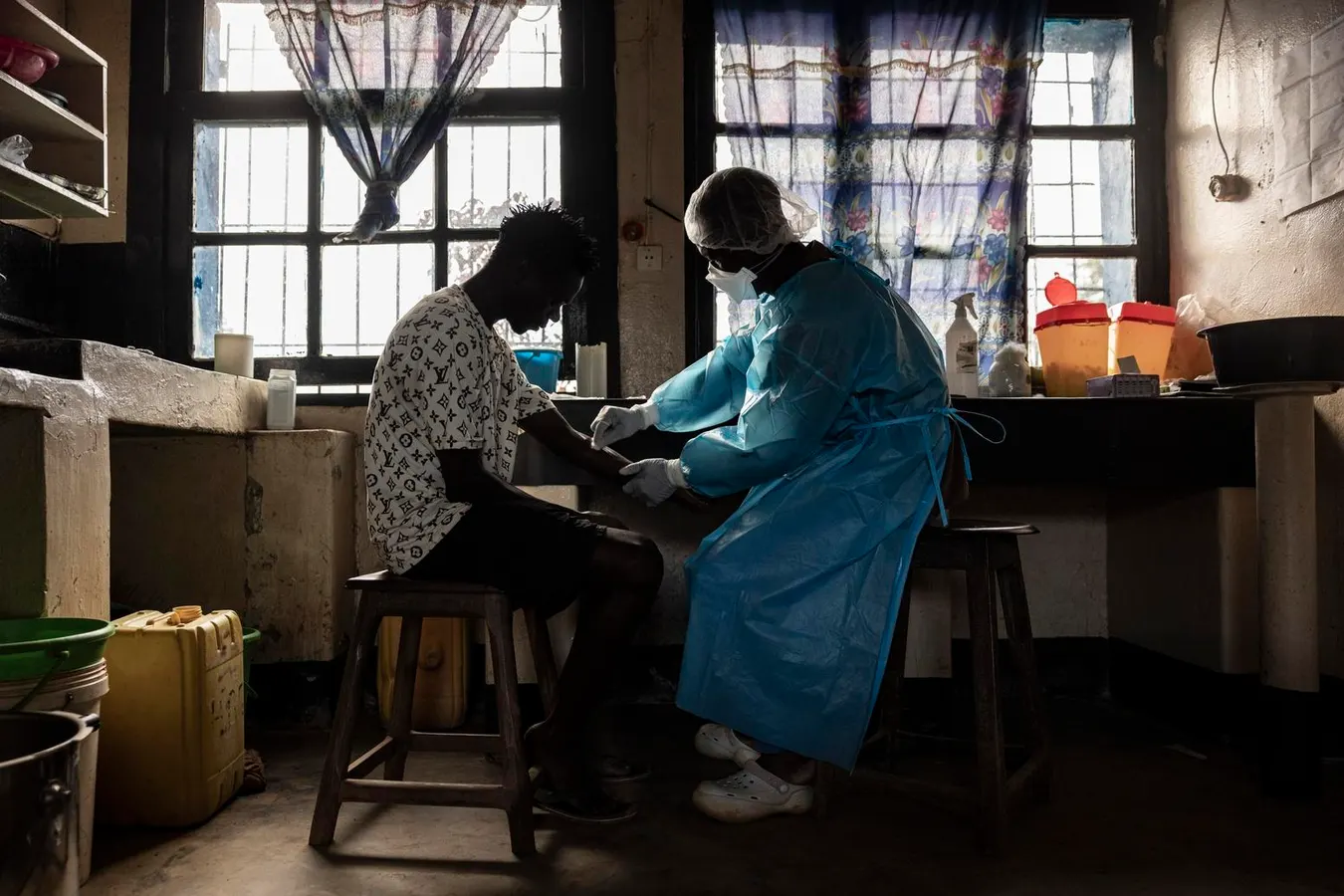

MONGBWALU, DEMOCRATIC REPUBLIC OF CONGO: A patient prepares to have blood drawn for a test at General Referral Hospital of Mongbwalu during the Ebola outbreak response in Mongbwalu, Ituri province, eastern Democratic Republic of Congo, on May 20, 2026. The World Health Organization (WHO) has declared the Ebola outbreak in the Democratic Republic of Congo (DRC) and Uganda a “public health emergency of international concern,” as the death toll and number of confirmed cases continue to rise. The current epidemic is caused by the Bundibugyo virus, one of several Orthoebolaviruses that can cause Ebola disease, and for which there are no approved vaccines. Global health officials have expressed grave concern over the capacity to contain the outbreak in a region already facing a humanitarian crisis, with highly mobile populations displaced by conflict and economic factors. (Photo by Michel Lunanga/Getty Images)
Getty Images
The Ebola outbreak in the Democratic Republic of the Congo (DRC) has produced at least 7,200 confirmed cases and nearly 3,500 deaths. It is the deadliest Ebola outbreak in DRC’s history and the second-deadliest ever recorded.
Containment is still within reach. The World Health Organization (WHO) says the outbreak could be brought under control within about three months if enough resources are mobilized. Yet only 60 percent of what the WHO says it needs for the response has been raised.
We know how to fight Ebola: find cases, test quickly, trace contacts, isolate and care for infected patients, protect health workers, conduct safe burials and earn the trust of communities. In DRC, armed conflict, displacement, as well as difficult terrain and weak health infrastructure make every step harder. An estimated 70 percent to 80 percent of new cases have no known epidemiological link, evidence that surveillance is chasing transmission.
Government has to lead. In August, the State Department, working with Congress, announced an additional $242 million for Ebola response and preparedness, bringing direct U.S. assistance above $512 million. The United States is the largest financial contributor to the response.
Transmission electron micrograph (TEM) of an Ebola virus virion.
getty
Yet epidemics ignore budget cycles. A field team may suddenly need transportation to reach an isolated community, phones to trace contacts, a generator for a laboratory, protective equipment for health workers or local staff to begin work immediately. Large public commitments can coexist with small, urgent gaps.
The CDC Foundation exists for moments like these. Congress authorized its creation in 1992 as an independent nonprofit to connect CDC with private and philanthropic resources. It remains the sole entity authorized by Congress to raise private funds in support of CDC’s mission and work. Its role is practical: pair the reach and expertise of public health with private and philanthropic resources that move with greater speed and flexibility. That is what public-private partnership should look like in a crisis.
Public agencies bring scientific expertise, authority, logistics and the ability to operate at scale. Philanthropy and private sector support add greater speed, flexibility, innovation and resources that help address urgent needs as they emerge. When those capabilities are brought together, they accomplish more than any one sector on its own.
During the 2014–16 West Africa Ebola epidemic, for instance, the CDC Foundation mobilized nearly $57 million from more than 1,600 donors. This funding helped establish emergency operations centers in Guinea, Liberia and Sierra Leone, strengthen surveillance and laboratories, provide communications equipment and transportation, and support local workers engaged in contact tracing and other frontline work.
Residents take to the streets to raise awareness of Ebola prevention in Beni, North Kivu Province, eastern Democratic Republic of the Congo DRC, Aug. 21, 2026. (Photo by Xinhua via Getty Images)
Xinhua News Agency via Getty Images
The clearest example involved an Ebola vaccine trial in Sierra Leone. CDC was preparing the trial, but federal funding would be unavailable for several months. The Foundation committed up to $2.5 million in philanthropic funding so work could begin on staffing, infrastructure, communications, equipment and cold-chain capacity. The trial moved ahead while the larger federal funding process played out.
That is the particular value private philanthropy brings to an epidemic. It puts money behind a well-defined need while the window for action is still open. A relatively small amount of capital, deployed early, will accelerate a far larger public effort. Government and private partners are more effective when each focuses on what it does best.
The same kind of flexible funding is needed now to provide support for urgent needs identified with public-health partners on the ground.
A laboratory specimen that reaches the right place a day earlier changes what happens next. So does protective equipment that keeps a health worker in the field, or communications equipment that helps a surveillance team find a contact before that person infects others. These expenditures are small beside hundreds of millions in government assistance. Their value lies in where and when they arrive.
Infographic with map of northeastern Democratic Republic of Congo showing areas where Ebola cases have been reported as August 30, 2026, according to the country’s health ministry and the World Health Organization (Graphic by Paz PIZARRO and Jonathan WALTER / AFP via Getty Images)
AFP via Getty Images
This is a moment for American philanthropy and the private sector to move alongside government. The public response supplies scale. Partnerships can close gaps, speed action and help frontline teams adjust as the outbreak changes.
CDC assesses the current risk to the American public as low. Keeping it low means controlling the outbreak at its source. The outbreak’s continued spread highlights the need to rapidly expand proven Ebola response strategies, including faster identification of cases and contacts, greater testing capacity, stronger infection-control practices in health facilities, safe and respectful burials, improved cross-border monitoring and coordination, and sustained engagement with affected communities. That saves lives in DRC, reduces the danger of wider regional instability and protects Americans at far lower human and economic cost than confronting a larger epidemic later.
We already know how to fight Ebola. The question is whether we move fast enough to stop it.













Leave a comment