


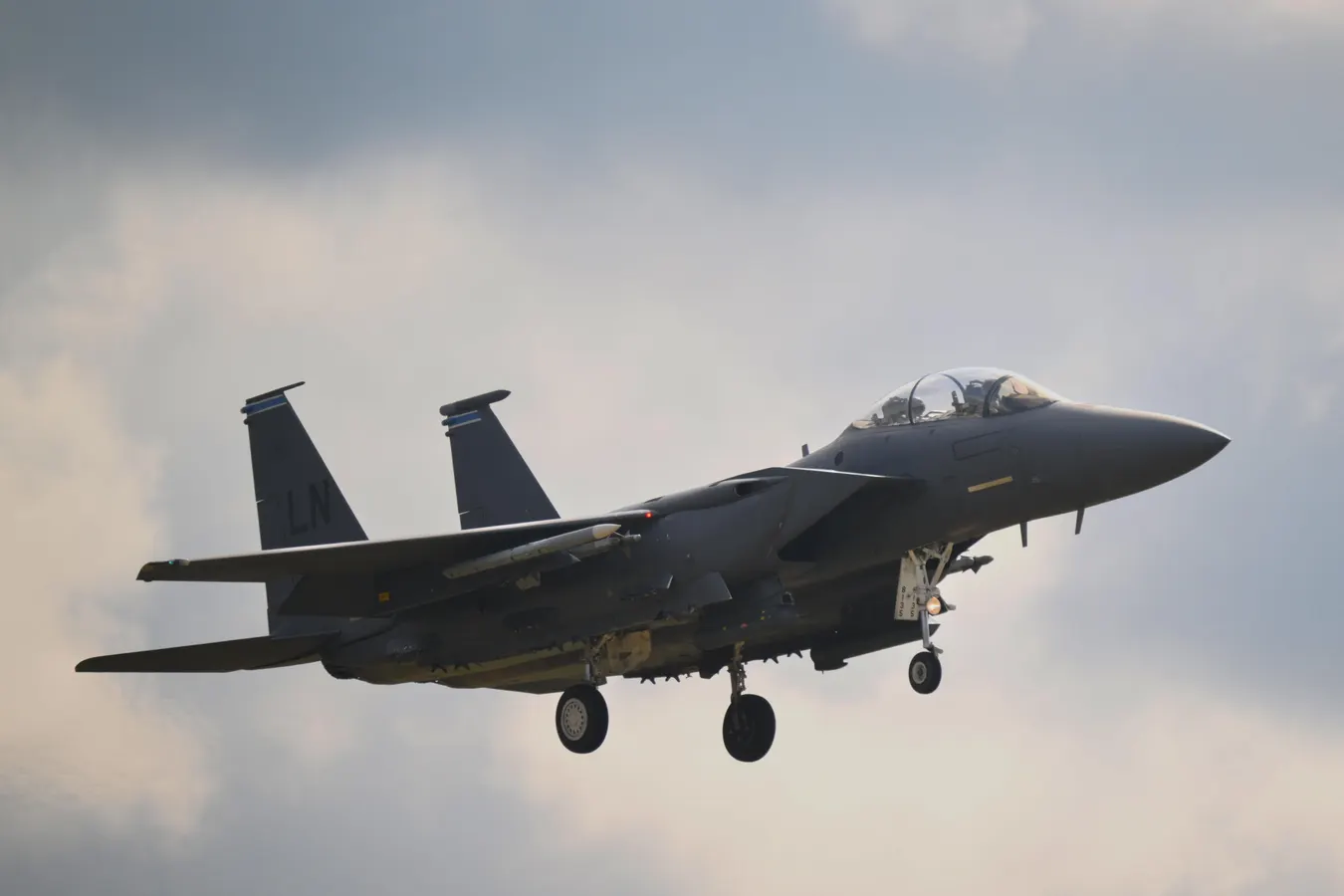

The U.S. Air Force F-15E Strike Eagle fighter aircraft (Photo by Dan Kitwood/Getty Images)
Getty Images
The United States Central Command confirmed on Sunday evening that three United States Air Force F-15E Strike Eagle twin-engine fighters were shot down over Kuwait, “due to an apparent friendly fire incident.”
This incident marks the first confirmed loss of U.S. combat aircraft in the ongoing “Operation Epic Fury” against Iran, which began in the early hours of Saturday morning.
“During active combat—that included attacks from Iranian aircraft, ballistic missiles, and drones — the U.S. Air Force fighter jets were mistakenly shot down by Kuwaiti air defenses,” CENTCOM added. “All six aircrew ejected safely, have been safely recovered, and are in stable condition. Kuwait has acknowledged this incident, and we are grateful for the efforts of the Kuwaiti defense forces and their support in this ongoing operation.”
CENTCOM stated that the “cause of the incident is under investigation. Additional information will be released as it becomes available.”
A video first published by The New York Times purported to show one of the F-15E Strike Eagles spiraling out of control before crashing near the city of Al-Jahra in Kuwait.
The Kuwaiti Defense Ministry announced that “several U.S. military aircraft” had crashed, but it did not acknowledge that its air defenses had been involved.
Past F-15E Strike Eagle Losses In War Zones
The McDonnell Douglas F-15 Eagle has long been noted for its impressive “undefeated air-to-air” combat record, with more than 100 victories and no losses. Most of its victories have been with the Israeli Air Force, which has operated the F-15 Eagle since the late 1970s.
However, there have been previous losses of F-15E Strike Eagles from ground fire, including surface-to-air missiles and anti-aircraft artillery.
Two U.S. Air Force F-15E Strike Eagles were confirmed to have been shot down by Iraqi ground fire in the 1991 Gulf War, with another F-15E lost in the 2003 Iraq War.
Taliban forces also claimed to have shot down a Strike Eagle in July 2009, killing both crew members, but U.S. officials stated the crash was due to “improper cross-check” during a routine training flight.
The last F-15E Strike Eagle to be lost during a combat operation was in 2011 in Libya, near the eastern city of Benghazi, while enforcing the United Nations-mandated no-fly zone established for Operation Odyssey Dawn. That crash was officially attributed to a high-altitude maneuver performed with a significant, uneven, and unbalanced bomb load.
F-15E Strike Eagle Is Hatched
The F-15E Strike Eagle is a derivative of the original combat-proven F-15. It was designed with a ground-attack capability that wasn’t present in the original Eagle.
American airforce F-15 C fighters flying over a Kuwaiti oilfield which had been torched by retreating Iraqi troops during the Gulf War. (Photo by MPI/Getty Images)
Getty Images
The F-15 was originally developed with lessons learned during the Vietnam War, and it replaced the U.S. Air Force’s aging fleet of multirole McDonnell Douglas F-4 Phantom IIs, which served in both an interceptor and fighter-bomber role. Yet, the capabilities of the Eagle focused mainly on air-to-air capabilities rather than on the ground-attack.
Even as the original Eagles were being hatched, however, designers at McDonnell Douglas saw the potential for a two-seat variant that could take on a dual role, serving as both an air-to-air/air-superiority aircraft and a ground-attack aircraft. Engineers “quietly” introduced basic secondary ground attack capabilities, which enabled the F-15 to serve as a possible successor to the General Dynamics F-111 Aardvark.
That decision was later to prove serendipitous for the aerospace firm, after the U.S. Air Force considered a McDonnell Douglas proposal recommending the development of a twin-seat variant of the F-15 Eagle that could serve in an air-to-ground attack role.
A two-seat TF-15A trainer that had previously been used to test conformal fuel tanks was employed as a demonstrator in the early 1980s. It took part in the Air Force’s Dual-Role Fighter competition against the General Dynamics F-16XL, which had been developed from the F-16 Fighting Falcon.
In 1984, the Air Force announced that the F-15E had been chosen as the winner, in part because of its lower development costs and a belief that its twin engines gave it future growth potential. The McDonnell Douglas offering provided a greater range and could carry a larger payload in its ground attack role.
Multirole Capabilities
The F-15E Strike Eagle was developed with new avionics to support its multirole capabilities. Its front cockpit also featured redesigned controls, including a wide-field-of-view head-up display and three CRT displays, providing the pilot with navigation, weapons delivery, and systems operations data. The rear seat was occupied by the Weapons System Officer, who would oversee four multi-purpose terminals for radar, weapons selection, and the monitoring of enemy tracking systems.
The Strike Eagle first entered service with the 40th Tactical Training Wing at Luke Air Force Base in 1988, and initial operational deliveries followed the 4th Tactical Fighter Wing at Seymour Johnson AFB, North Carolina.
The Strike Eagle’s Impressive Combat Record
The F-15E made its combat debut in Operation Desert Storm in 1991, where its primary mission was to destroy Iraqi “Scud” mobile ballistic missile launchers. Since then, the F-15E Strike Eagle has been at the forefront of nearly every major U.S. military air campaign, having seen action in Operation Enduring Freedom and Operation Iraqi Freedom during the Global War on Terror.
As of this month, the United States Air Force had 218 F-15E Strike Eagles in its total inventory, with current plans calling for the fleet to be gradually reduced to just 99 upgraded aircraft.
The remaining Strike Eagles will be upgraded with a new electronic warfare suite, the Eagle Passive/Active Warning and Survivability System, developed by BAE System. According to the U.S. Air Force, the EPAWSS “substantially improves pilot situational awareness with the capability to autonomously detect, identify, and locate threat systems, and then deny, degrade, and disrupt those same threats.”
A USAF McDonnell Douglas F-15E Strike Eagle lands at RAF Lakenheath on July 22, 2025 in Lakenheath, United Kingdom. (Photo by Simon Galloway/Getty Images)
Getty Images
The first F-15E to receive the EPAWSS upgrade entered service in January 2025. However, it is unclear whether any of the Strike Eagles currently employed in Operation Epic Fury have received the upgrades, or if the loss of three of the aircraft will impact the Air Force’s plans to retire some of the older warbirds in the fleet.














Leave a comment