


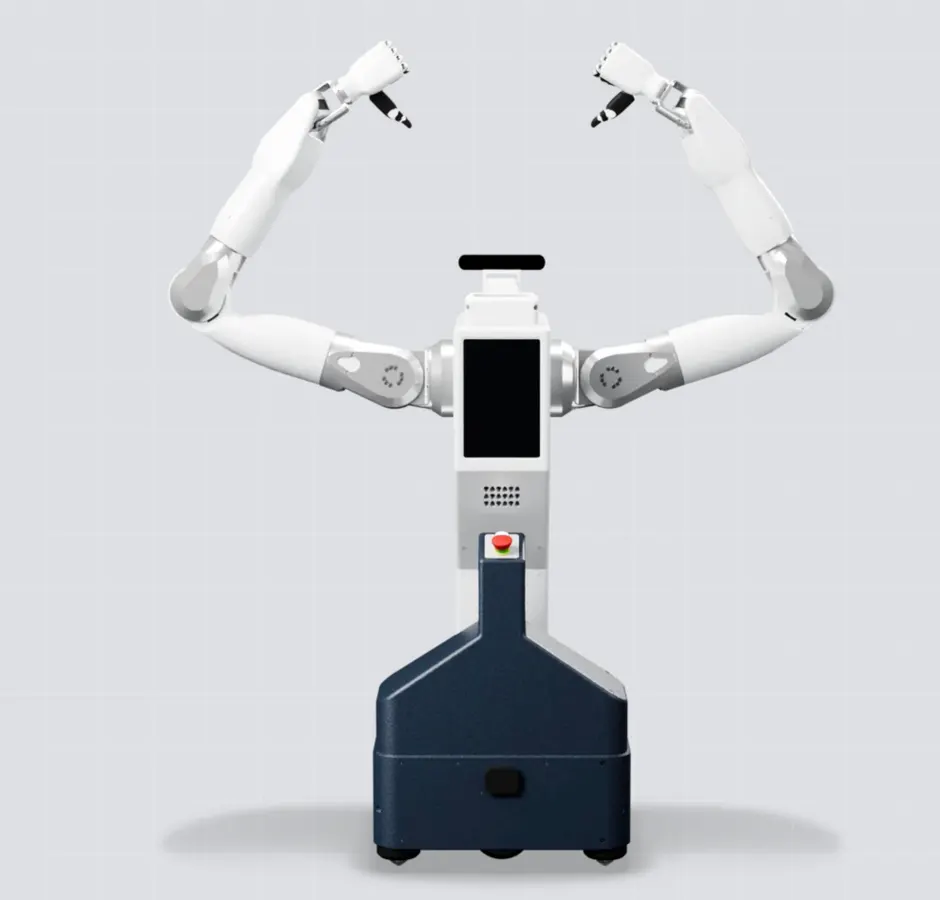

Feather is a (vaguely) humanoid robot launched by a small team in California that has raised under $10 million.
John Koetsier
A California-based startup officially launched yesterday with a vaguely humanoid robot on wheels that costs $29,990, $7.6 million in pre-seed funding and something most pre-seed hardware startups can only dream about: actual revenue.
The company is Feather Robotics, and it already has more than $1 million in revenue, according to the founders.
“We built a new kind of robot for the underdogs,” the company said on X. “Today, robotics is stuck between ~$100k systems and low-cost robots not meant to survive deployment.”
Feather is not the only small robotics company building interesting and relatively cheap humanoids. Last month I wrote about Nori A3, a wheeled humanoid assembled in San Francisco by a small team that sells for just $1,688. And HumanoidMegaHub just reported that PrimeBOT is selling two home robots in China starting at about $2,750.
Plus, of course, Unitree’s R1 starts at $4,900.
All of which means that there are now multiple options for cheap and surprisingly capable mobile robots that can execute fairly sophisticated behavior and even, in some cases, do real work.
Not long ago, a capable robot with two arms and a mobile base was a six-figure purchase, and building one was a multi-year, venture-scale project. Still today, robots at the top end of capability easily run $100,000 plus, like the top-end robots that Faraday Future just launched. But small teams are being surprisingly successful at designing, building and shipping robots in a year or less, at prices that would have looked absurd just a few years ago.
Technically, Feather is classified as a bimanual mobile manipulator. It has two fairly long seven degree of freedom arms with a one-meter reach that sit on a torso that rises and drops 60 centimeters, about two feet, which lets it pick up things off the floor or a high shelf. Feather rides on a wheeled base that moves in any direction at up to essentially normal human walking speed. In total, Feather has 23 degrees of freedom.
The robot weighs 105 kilograms, and sports dual hot-swappable 48-volt batteries that are good for a surprising 10 hours of operation, according to Feather’s spec sheet.
The robot’s hands are swappable: you can get six-DoF hands or parallel-jaw grippers.
In a twist, so is the brain: customers can pick Nvidia Jetson compute ranging from Nano to Thor. This is fairly novel: essentially Feather Robotics is saying that they’ll build the body, and you can choose your own compute and physical AI model. Where most robot companies build the body and the AI models that run it and enable it to do useful work, Feather Robotics is building only the body. Customers can choose AI models from Nvidia, Skild, Physical Intelligence, or pretty much any other they find useful.
“You can’t buy a Tesla robot today and develop on top of it,” co-founder Hoa Mai told TechCrunch. “We realized that this is not how most companies became successful. Hardware players like Nvidia or Apple started with a product that worked and was deployable, and then they added complexity over time.”
Making the intelligence layer essentially somebody else’s problem allows a small robotics team to focus on hardware. That’s a novelty, but we’ll likely see more companies sprout up like this, given there are now multiple credible robot foundation models to choose from. And that teams are finding innovative ways to cheaply build and ship new robots.
For example, in a paper posted to arXiv, Nori founder Antonio Li and colleagues explain that their robot, A3, is built on commodity serial-bus servos, the cheap kind that tend to burn out when they stall. That’s partly how they’ve achieved their incredibly low price point. Rather than buy better motors and make the robot more expensive, the team wrote protection software that prevents the burn-out. They also pull grip-force estimates out of the servo’s own current readings instead of adding force sensors, saving even more money. The result, according to the paper, is that Nori’s robot bears only a fifth of the parts cost of the cheapest comparable research platform.
“The capabilities usually lost at this price are recovered in software rather than by buying more expensive parts,” they write.
Parts are also cheaper now: Goldman Sachs found that humanoid manufacturing costs fell 40% in a single year thanks to increasing scale and commoditization of key components. And, teams fight cost with simplicity: wheels rather than legs, for example.
Feather makes simplicity a core design philosophy.
“Robotics has a compounding-error problem,” the company says on its website. “With critical systems connected in series, every additional part introduces another potential point of failure.”
Reducing parts makes things simpler, more reliable, and cheaper.
Feather says its robot has already been successfully working in the field for the past year in manufacturing, food service and other verticals. The company’s co-founders are Hoa Mai, who previously sold a humanoid startup to 1X, and Parsa Bakhtiari, a former Tesla Model 3 engineer. BuilderVC, Geometry, SEED Innovations and Virgo VC joined Gradient Ventures in the round.
















Leave a comment