


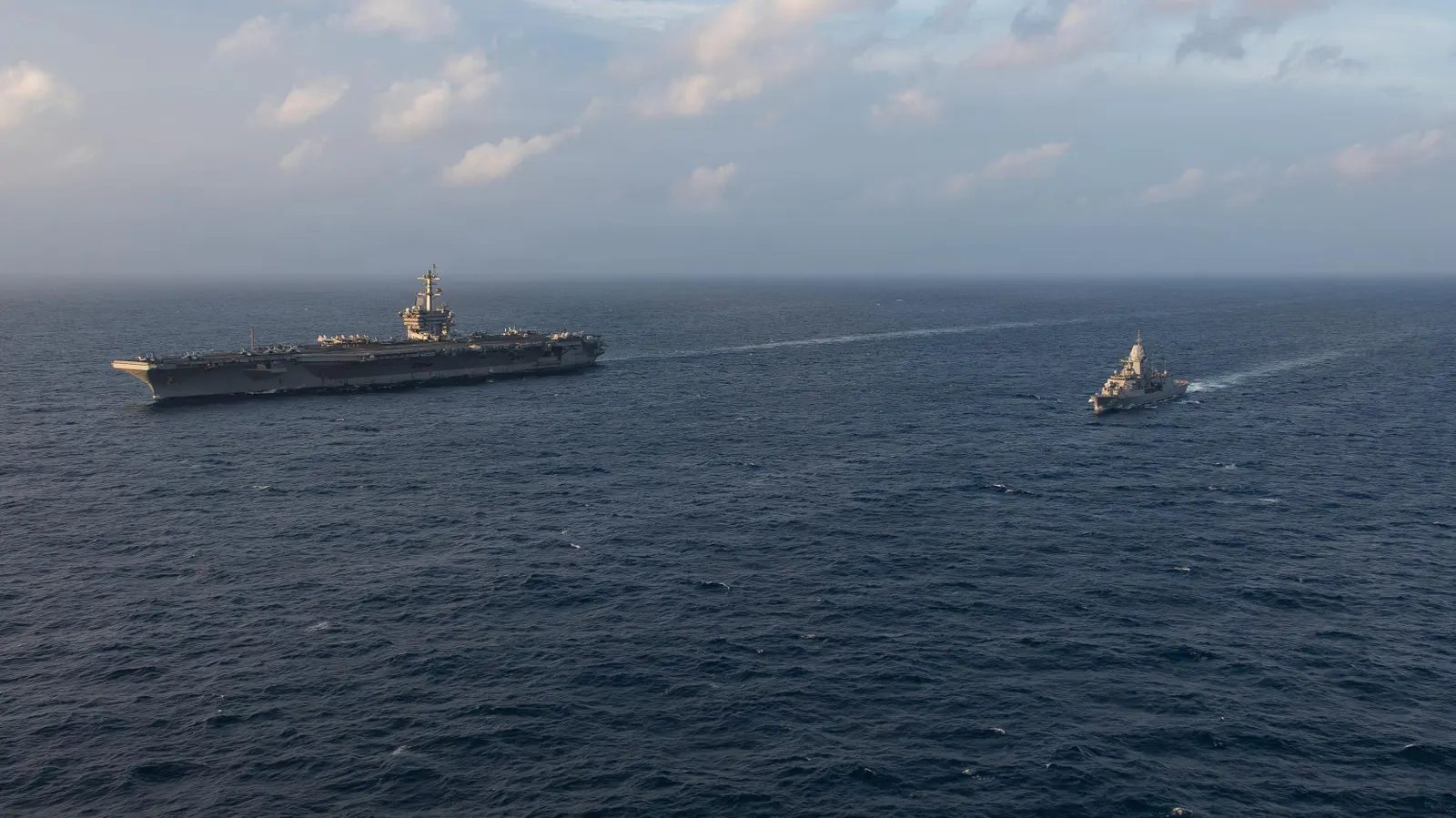

Royal Australian Navy Anzac Class frigate HMAS Perth (FFH 157) sails alongside Nimitz-class aircraft carrier USS George Washington (CVN 73) in the South China Sea, Aug. 11, 2026.
(U.S. Navy photo by Mass Communications Specialist Seaman Anthony Vilardi)
The United States Navy has dispatched the forward-deployed supercarrier USS George Washington (CVN-73) to the Middle East, with preparations now underway. The warship departed its homeport of Yokosuka, Japan, on May 23, 2026, and is currently the only aircraft carrier available that can be redirected to the region. It could take a week for the vessel to reach the Arabian Sea.
The Wall Street Journal first reported that CVN-73 would be dispatched to relieve the USS Abraham Lincoln (CVN-72), one of the U.S. Navy’s San Diego-based Nimitz-class nuclear-powered aircraft carriers, which has been deployed for 265 days as of Thursday.
Voyage Of The Damned
CVN-72’s mission has been twice extended, but in addition to the prolonged time away from home, it has only made two brief port calls in more than eight and a half months. The time away from port has resulted in far from ideal conditions on the fifth Nimitz-class aircraft carrier. Last week, reports circulated that the crew was dealing with moldy showers, clogged toilets, and shortages of food and necessities such as toothpaste, deodorant, and soap.
The situation aboard the warship has continued to make headlines this week, with additional reports that multiple sailors had attempted to jump overboard.
One sailor went overboard and was quickly rescued.
Lawmakers Questioning The Lengthy Deployments
The troubles aboard the USS Abraham Lincoln have caught the attention of U.S. lawmakers, who have called upon the Pentagon to address the issue.
“There have been widespread reports of shortages of basic supplies, water contamination, plumbing issues, deteriorating mental health, deck safety concerns, and disruptions in the mail system, which have caused many care packages in route to the ship to be lost in transit for months,” Senator Richard Blumenthal (D-Conn.), a member of the Senate Armed Services Committee, wrote in a letter to Secretary of Defense Pete Hegseth and Acting Secretary of the Navy Hung Cao.
“These reports warrant immediate attention, but they also raise a broader question: whether the Navy can sustain the operational tempo now being demanded of its carrier force, particularly as this Administration repeatedly commits U.S. forces to conflicts of its own choosing and increasingly relies on aircraft carriers to sustain those operations,” the letter continued.
Blumenthal’s sentiments were echoed by Senator Ruben Gallego (D-Ariz.), who wrote in a post on X, “I’m pushing for an official, bipartisan oversight visit to the USS Lincoln. It’s clear Donald Trump, who avoided active duty himself, couldn’t care less about the health and safety of our service members. Congress needs to do its job and hold this administration accountable.”
A Hole In The Pacific Again!
Dispatching CVN-73 to the Middle East will, at least temporarily, solve one problem, but it will create another. The United States Navy will be without a carrier in the Western Pacific to serve as a deterrent to China, at least until CVN-71 could head out.
The United States Navy faced a similar lack of presence in the Indo-Pacific during much of 2024, as it regularly rotated its nuclear-powered supercarriers to the region to confront the Iranian-backed Houthi militants in Yemen. The group resumed its attacks on commercial shipping in the Red Sea earlier this week, which could leave the USS Abraham Lincoln and the USS George H.W. Bush (CVN-77), the other aircraft carrier now operating in the Arabian Sea, spread even thinner.
















Leave a comment