


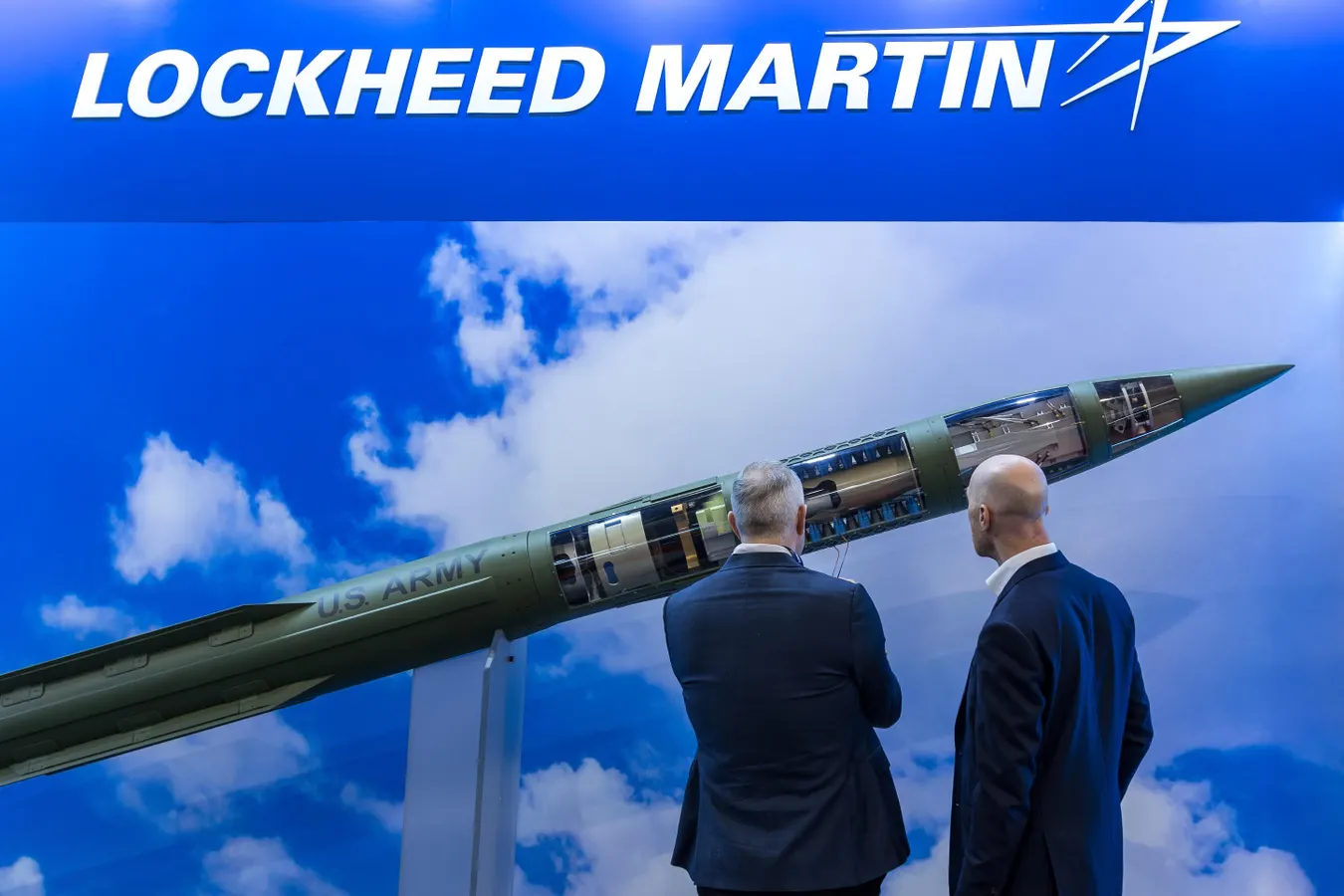

The Lockheed Martin PAC-3 Missile Segment Enhancement (MSE) displayed at the company’s stand during the inaugural edition of the Brussels European Defence Exhibition & Conference (BEDEX) on March 13, 2026 in Brussels, Belgium. (Photo by Omar Havana/Getty Images)
Getty Images
General Motors played a massive role in World War II’s Arsenal of Democracy, where it converted more than 100 plants to defense production and delivered over $12.3 billion in war material. The Detroit automaker’s military and defense-facing subsidiary GM Defense is again supporting the American defense sector.
It was announced on Thursday that GM Defense delivered the first batch of mission-critical components to aerospace giant Lockheed Martin to support the PAC-3 Missile Segment Enhancement interceptor missile program, less than a month after a formal contract was signed between the two firms.
“We’re proud to support production of this country’s critical defense capabilities,” said Stephen duMont, president and CEO, GM Defense, in a media statement.
“Our partnership with Lockheed Martin leverages GM’s precision-fabrication expertise and ability to manufacture with quality at scale. We look forward to putting these strengths to work in support of our nation’s security and the people who protect it,” duMont added.
Twenty-Two Day Delivery
The delivery of such components for the Patriot Advanced Capability-3 MSE can take months to years, and GM Defense’s ability to provide such a rapid turnaround was seen to signal its commitment to the defense industrial base. The aerospace and defense firm has sought to rapidly increase production of the PAC-3 MSE, along with the Terminal High Altitude Area Defense interceptors and Precision Strike Missiles – all vital rocket systems that can take months to build.
Lockheed Martin has invested upwards of $9 billion to scale up output for the PAC-3 MSE, THAAD, and PrSM across more than 20 U.S. sites. The partnership with commercial manufacturers such as GM Defense is part of the effort to accelerate component production and to expand overall industrial capacity.
The aerospace firm signed a formal contract with the Detroit firm on August 6, and the initial batch of PAC-3 MSE housing components was delivered on August 28. GM Defense was able to quickly leverage its advanced casting and machining capabilities to meet the exacting defense specifications.
“This extraordinary 22‑day turnaround underscores Lockheed Martin’s relentless focus on execution – delivering for our troops faster, with greater capacity,” explained Tim Cahill, president, Lockheed Martin Missiles and Fire Control. “Our partnership with GM Defense is a concrete example of how we’re merging world-class commercial manufacturing with defense supply chain and production practices and rapidly translating that into battlefield readiness for the United States.”
Both Lockheed Martin and GM Defense have confirmed they will further expand the partnership and apply commercial practices across munition programs.
U.S. stockpiles of the air defense and strike ordnance have been significantly diminished in recent years, as Washington supplied Ukraine with PAC-3 MSE interceptors to defend against Russian missiles and drones in the ongoing war. The U.S. conflict with Iran further depleted those stockpiles, and Lockheed Martin and other defense firms have warned that it could take years or longer to replenish the missile stockpiles
GM Defense Rolling Forward
Beyond the partnership with Lockheed Martin, GM Defense – along with Ford Motor Company and BC Customs – is now developing a prototype vehicle for the U.S. Army’s Heavy Infantry Squad Vehicle (ISV) program in June.
GM Defense has suggested its offering for the competition will be a militarized variant of the Chevrolet HD 3500 truck, a heavy-duty, one-ton pickup that was also developed for massive towing, heavy hauling, and commercial-grade work. The trucks are available with either single rear wheel (SRW) or dual rear wheel (DRW) configurations.
The prototypes will undergo operational assessment and developmental testing by the Army Test and Evaluation Command, with a final production contract for the winning design expected to be awarded in September 2027. The U.S. Army announced it will procure up to 606 of the ISVs.















Leave a comment