


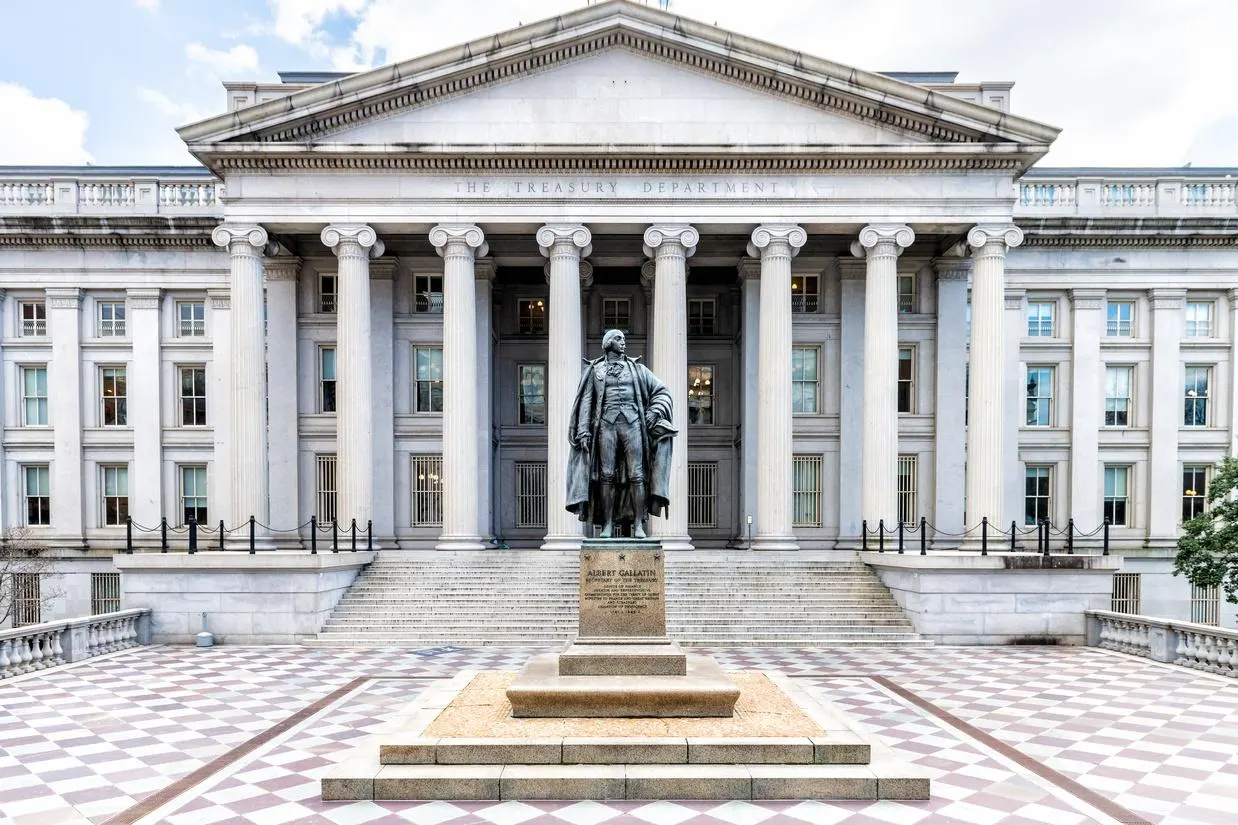

Washington DC, USA – March 9, 2018: Exterior architecture on national mall of Department of Treasury, statue of Gallatin
getty
The U.S. Treasury Department announced a plan on Aug. 19 to expand its long-term bond buyback program by raising the purchase cap for a single operation from $2 billion to at least $4 billion. The first buyback conducted under the new cap on Sept. 10 went even further. The Treasury offered to purchase up to $6 billion of bonds with a remaining maturity of 10 to 20 years, three times the amount under the old cap. However, it ended up buying less at its operation, only $5.2 billion of the $10.5 billion dealers offered. On top of that, the 10-year yield still rose to a three-year high of nearly 5% the same day.
For investors, these changes raise one question: what does it mean for their portfolios when the government buys back the bonds it has itself issued? The program’s scale may be too small to move the entire economy, but some investors—especially those who own the bonds the Treasury is buying back—are likely to benefit from it.
What Are U.S. Treasury Buybacks?
A Treasury buyback means the government purchases securities it has itself issued before they mature. The current program launched in May 2024 and has two goals. First, it provides “liquidity support” by giving dealers a predictable opportunity to sell older, harder-to-trade bonds. Second, buybacks help the Treasury manage its cash balance around large tax-receipt inflows and debt payments.
Every dollar spent on buybacks translates directly into one dollar of new government debt issuance, since the government runs a deficit and has no surplus funds available for purchases. Buying back debt with borrowed money merely replaces one debt with another and does not eliminate any debt burden.
How Do U.S. Treasury Buybacks Work?
Alongside its quarterly borrowing plan, the Treasury publishes a preliminary schedule of buyback operations. Each operation targets a specific maturity bucket. Approved participants, including primary dealers, submit offers to sell at a price and the Treasury accepts the offers it considers attractively priced and purchases bonds up to the published cap. The program includes purchases of intermediate- and long-term Treasury securities that have been outstanding for some time since issuance, as well as inflation-linked bonds. Newly issued securities and Treasury bills are excluded.
Issuing short-term bills (T-bills) maturing in less than a year to buy longer-term bonds shortens the average maturity of the total outstanding debt. T-bill financing is not a built-in feature of the buyback program, but it can be inferred from the Treasury’s August 2026 borrowing announcement. The announcement states that the sizes of regular intermediate- and long-term bond auctions will be kept unchanged and that seasonal or unexpected borrowing needs will be met by adjusting T-bill issuance. This suggests that additional buybacks will be financed by increasing T-bill issuance.
How Treasury Buybacks Impact Different Asset Classes
Replacing long-term bonds with T-bills tends to push bond prices up and press long-term yields down, while the effect on short-end supply is the opposite. The table below summarizes the effects likely to arise under this financing model, other factors held constant. The risk level column describes each asset class’s exposure to the buybacks.
| Asset class | Expected Price/Yield Impact | Portfolio Risk Level |
| Long-term Treasury bonds | Buybacks of long-term bonds reduce the supply available to investors, which tends to push prices up and press yields down. | Moderate or slightly higher. If investors interpret the buybacks as a sign that the government is prioritizing borrowing costs over inflation, they may demand higher yields. Long-term bonds would suffer the biggest price shock. The buyback operations themselves are small in size, however, so the risk lies in how investors interpret them. |
| Intermediate-term bonds and broad bond funds | A decline in Treasury yields can raise the prices of these investments, but the return depends on what securities the fund holds. | Low or moderate. Funds bought in the hope of continued government purchases can face losses if operations are scaled back or inflation concerns push yields up. |
| Short-term cash and T-bills | Additional T-bill issuance to finance the buybacks can raise T-bill yields slightly and improve money market fund returns. | Low. If inflation caused by the buybacks exceeds the rise in short-term yields, investors’ purchasing power erodes even if they earn more interest. |
| Stocks and Equities | A decline in long-term rates can raise investors’ assessment of companies’ future profits and thereby stock prices. | Low or moderate. Expectations of continued purchases can push valuations to a level the operations themselves cannot sustain. If the buybacks fail to press yields down, stocks are exposed to risk at that point. |
| Gold and commodities | A decline in real rates increases gold’s appeal, because investors forgo less income by holding a non-yielding asset. However, the effect of buybacks on commodity prices is, on the whole, neither clear nor consistent. | Low. If gold or commodities have been bought on the expectation of inflation or a weakening dollar, there is a risk of losses if neither materializes. |
| Mortgage-backed securities | A decline in Treasury yields can raise the prices of mortgage-backed securities and also contribute to lower mortgage rates. | Low. If buybacks press mortgage rates down and trigger a refinancing wave, investors’ principal may be returned early and have to be reinvested at a lower yield. |
Key Structural Differences: Treasury Buybacks Vs. Federal Reserve QE
Both quantitative easing and Treasury buybacks remove long-term bonds from the market, but the payment structure is different. With QE, the Fed creates central bank reserves—funds that banks hold at the central bank. The Treasury, by contrast, pays from its own cash account, and its purchases do not create reserves in the same way.
A closer precedent for the bond buyback program is “Operation Twist.” In it, the Fed sold shorter-term Treasuries and bought longer-term ones without expanding its balance sheet. Researchers at the Federal Reserve Bank of San Francisco have estimated that the 1961 Operation Twist lowered long-term Treasury yields by about 0.15 percentage points. That program, however, differed in scale from the current buybacks, and the market environment is another important factor.
Some economists believe that a broader shift toward T-bill issuance can ease financial conditions, because T-bills are closer to cash than longer-term debt. So although Treasury buybacks structurally resemble Operation Twist, they can also ease financial conditions through some of the same channels as QE.
How Treasury Bond Buybacks Impact Your Investment Portfolio
Because the program is small relative to the $31.8 trillion Treasury market, the buybacks will likely only raise the prices of the individual bonds the Treasury purchases, and they will not deliver a lasting boost to the broader bond or stock markets. The signal sent by the expansion, however, can have wider effects. When the Treasury announced the expansion of bond buybacks in August, some economists warned that the government’s borrowing needs are taking precedence over price stability. Those who share these concerns may interpret the expansion as a sign that policymakers are increasingly willing to tolerate inflation.
Fixed Income: Long-Term Bonds And Broad-Market Funds
Research shows that buybacks lower the trading costs of the bonds being purchased and support their prices. If the buybacks stir inflation concerns, however, investors may demand higher yields, which can lead to falling bond prices. As yields fluctuate, long-term bonds face larger price swings—so-called duration risk. For funds holding government and corporate bonds, the effect is determined by how much exposure the fund has to the Treasury’s target bonds and how sensitive its holdings are to interest rate changes.
Stocks And Equities
Stocks feel the effect of buybacks partly through the discount rate used to value future profits. Other factors held constant, a decline in rates raises the present value of those profits. Earnings prospects and the extra return investors demand for taking risk, however, can overwhelm small changes in the supply of government debt. An improvement in bond trading conditions is not, by itself, a reason to pay a higher price for stocks.
Money Market Funds And T-Bill Rates
When the Treasury issues T-bills to pay for buybacks, those who buy T-bills directly or through government money market funds help finance the buybacks. Additional T-bill issuance can raise their yields and allow funds to earn more on new purchases. Funds that lend cash against Treasury collateral may also benefit from higher lending rates. The final return is determined by each fund’s holdings and fees.
Commodities And Precious Metals
As real rates fall, gold’s appeal grows, since declining real yields reduce the opportunity cost of holding a non-yielding asset. Buybacks can be a tailwind for gold by pressing bond yields slightly lower, but the dollar’s performance and safe-haven demand are more important factors.
Portfolio Strategies During Active Treasury Buyback Cycles
Additional T-bill issuance to finance the buybacks can allow money market funds to earn higher returns on new purchases. Those who need funds within one to two years can take that return without having to reach for longer-term bonds. If the buybacks succeed, owning intermediate-term bonds can bring modest price appreciation, but if inflation expectations strengthen, large positions will suffer. By holding a mixture of bonds with different maturities, in which a portion matures every year, you can diversify the risk of locking in a yield at the wrong time.
As for stocks, do not chase growth companies or stable dividend stocks merely because the buybacks might lower interest rates. The potential benefit depends on how much yields fall and whether investors have already priced in the decline. Elevated inflation expectations can, on the contrary, push yields up and hurt stock prices.
Before adjusting your portfolio based on a buyback announcement, go through the following steps:
- Read the Treasury’s buyback schedule together with its issuance plan.
- Compare the results of the operations against the published purchase caps.
- Check your portfolio’s duration and your near-term cash needs.
- Compare any improvement in money market fund yields with the income you can lock in with intermediate-term bonds.
- Before moving funds into stocks or gold, consider whether their prices have already priced in the decline in yields or the rise in inflation caused by buyback expectations.
















Leave a comment