


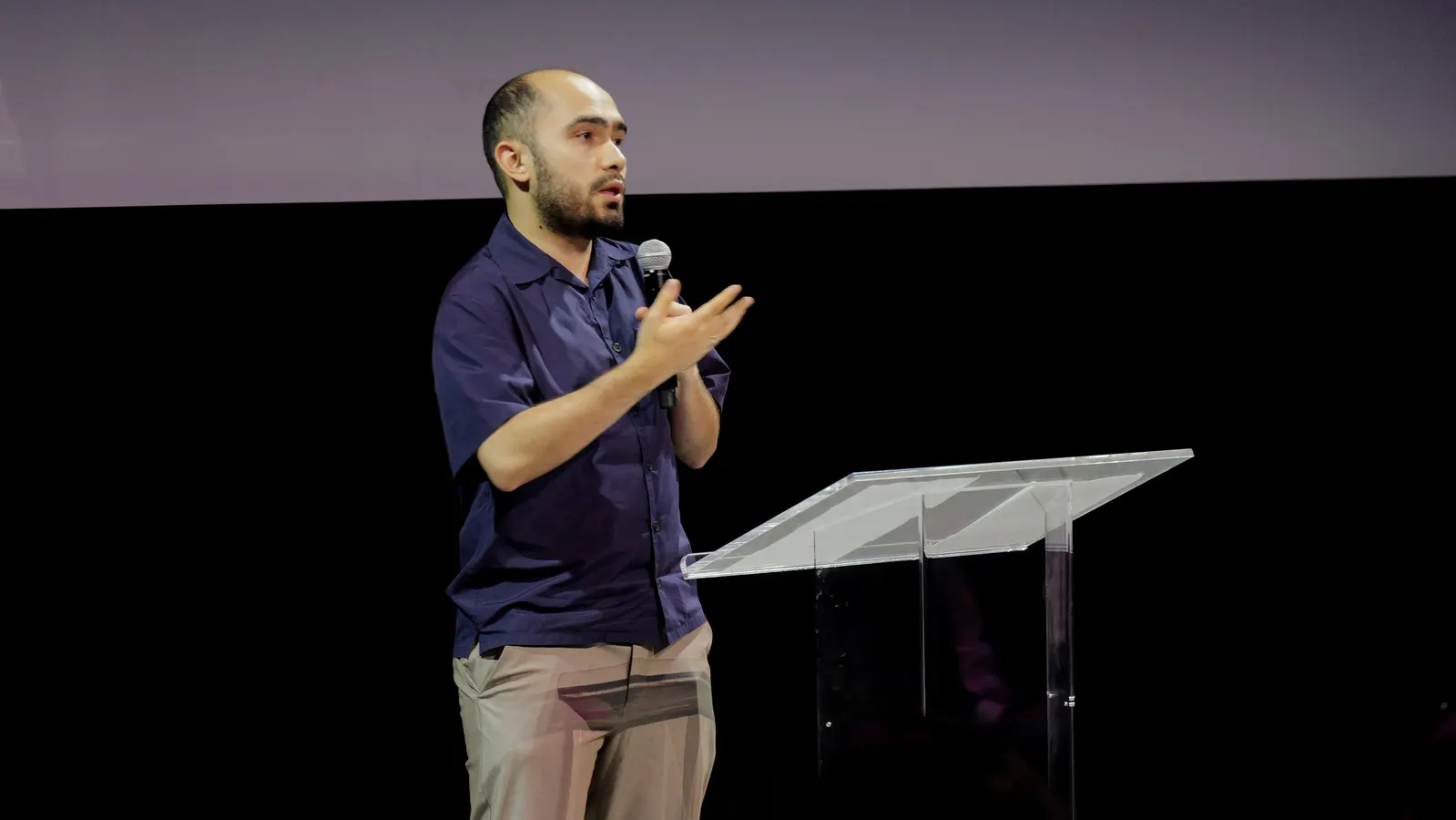

NEW YORK, NEW YORK – AUGUST 05: Alex Mashrabov speaks as Higgsfield AI presents the world’s first fully AI-generated feature film: The Cully Hill Boys at The Glasshouse on August 05, 2026 in New York City. (Photo by Craig Barritt/Getty Images for Higgsfield AI)
Getty Images for Higgsfield AI
I attended the world premiere of Higgsfield’s The Cully Hill Boys in New York City on August 5. This 110-minute feature is the world’s first AI-generated film starring the licensed likenesses of real celebrities, and a history-making event that we’ll be unpacking for a long time. I was invited as an industry practitioner. Knowing Higgsfield’s work, my expectations were high. The film not only exceeded my expectations, it shifted them. The question is no longer how good an AI-generated film can be. The question is how many more great pieces of work we’ll get to experience thanks to AI. From now on, talented and hard-working creatives around the world have a reference point to tell themselves: No matter how wild and “traditionally” expensive my vision is, I can make it a reality at the highest quality and at a lower cost than ever before.
The fact that, just a few minutes into the movie, I stopped looking for technical errors and was swept away by the story, the visual realism, and the experience’s raw sensorial and emotional pull was what made me realize we’re entering a new era.
Every frame was generated with AI, which makes this, in strict technical terms, a new form of entertainment. Yet the experience was recognizably cinema. That double identity is what made the evening historic: a new medium arrived already fluent in the language of the old one. And still, the most consequential innovation of the night never appeared on screen. It was written into the contracts and business formalities that made this a promising and scalable operation.
NEW YORK, NEW YORK – AUGUST 05: Ray J, N3on, and Matt Kiatipis attend “The Cully Hill Boys” New York Screening at The Glasshouse on August 05, 2026 in New York City. (Photo by Joy Malone/Getty Images)
Getty Images
AI Filmmaking Speaks and Honors the Language of Traditional Cinema
The digital cast consists of four real entertainers: two-time UFC champion Israel Adesanya, MMA veteran and actor Quinton “Rampage” Jackson, livestream creator N3on, and streetball athlete Matt Kiatipis. Their licensed likenesses bring to life the story of three struggling East London rappers whose plan to shoot a music video unravels when a stolen boat full of loot lands them between rival crime syndicates. The story steals the show, while the underlying technology supports every second with uncanny photorealism, real physics, lifelike performances, and a general atmosphere that just envelops you from beginning to end.
Timothy W. Planagan spent roughly five years writing the screenplay, which became a Feature Screenplay Finalist at the 2026 London Independent Screenplay & Film Awards. It also appeared on The Black List, an annual survey of Hollywood’s most-liked unproduced screenplays, where Higgsfield discovered the project and licensed the rights for an AI adaptation. “Like most screenwriters, you spend years wondering if your script will ever make it to the screen,” Planagan said in the statement announcing the premiere.
Using a horizontal, collaborative creative model, nine directors developed sequences concurrently under the leadership of emerging filmmakers Aitore Zholdaskali and Adilet Abish. The production’s specialized Asset Department brought together experienced film professionals—including costume and production designers—with newly defined technical roles, such as generative artists and photo and film editors responsible for refining AI-generated frames and maintaining visual consistency. The company told me that around 40% of the 28-person team had no AI experience but a traditional production background. Yet through Higgsfield Academy, the company’s free public curriculum, they were easily onboarded to the AI tools. This suggests traditional craft translates into AI-native production faster than the industry assumes.
The Economics of AI Film Production: A Tenfold Leap in Scale
Higgsfield shared with me exclusively, in an email exchange after the premiere, that the total production budget was approximately $2 million, with about $1 million allocated to AI compute. The team generated roughly 1,000 production-ready assets across more than 100 locations, all in 4K, in four weeks. The company’s reference point is its previous feature, Hell Grind, a 95-minute film produced for about $500,000 that required about 100 assets. By that measure, Higgsfield multiplied its production scale roughly tenfold in a matter of months. The company also notes that independent films of comparable ambition typically demand one to two years and budgets above $20 million. Those comparisons are Higgsfield’s own figures, but even generous discounting leaves a cost structure that no studio CFO can ignore.
The film is not headed for a conventional theatrical run; Higgsfield told me it was created to demonstrate its flagship product, Cinema Studio 4.0, to studios, agencies, and brands.
AI Likeness Licensing: Consent As Commercial Architecture
The precedent that matters most is contractual. Each cast member provided two inputs, high-resolution photographs and voice recordings, captured under agreements covering compensation, permitted scope of use, and script approval before production began. Every performer reviewed the full screenplay and their character profile. Higgsfield told me that all source assets were permanently deleted within 30 days of wrap and that its agreements bar the company from retaining, training on, or licensing that data to third parties.
The film operationalized principles the industry has spent three years fighting to establish. The 118-day SAG-AFTRA strike produced Hollywood’s first AI consent provisions, requiring advance notice and compensation before a performer’s digital replica can be used. Congress is now moving to give that principle the force of law via the NO FAKES Act of 2026 (S. 4591), which would create a federal intellectual property right over every individual’s voice and visual likeness, enforceable against unauthorized replicas wherever they appear. What labor won at the bargaining table and lawmakers are writing into statute, The Cully Hill Boys converts into commercial practice.
In fact, the market is already organizing around that conversion. The premiere’s announcement notes that the agencies representing N3on and Kiatipis now offer AI likeness licensing alongside sponsorships and endorsements, treating a client’s AI avatar as a managed line of business instead of a standing vulnerability. Since AI-generated images and videos became photorealistic and lifelike, a performer’s likeness has been something to defend; in this film, it became something to license.
What Remains Human in AI Filmmaking
Post-production, led and executed by humans, absorbed a substantial share of the four-week schedule. AI generation delivers raw material, and raw material still has to be assembled into a film. Dedicated photo and film editors refined the generated frames to preserve continuity across shots, sequences, and locations. Aitore Zholdaskali, Adilet Abish, and the directing team held final editorial authority. With nine directors working simultaneously, that editorial layer is what gave the film a single visual and narrative style. As in traditional production, creative decisions were made about voices, accents, sound effects, music, wardrobe, and so many other aspects that make up any film.
AI collapsed the cost and duration of producing images and sequences, while everything that turns that material into a film, from editorial judgment and pacing to sound, coloring, and finishing, remained in human hands and decided what audiences saw. That coupling of the disruptive and the conventional is how cinema has always absorbed new technology. CGI, for instance, was heralded by many as the death of realism before becoming the toolkit that expanded it. AI generation is now following the same path into that toolkit. AI, just like CGI, will be used, abused, and misused. It is the storyteller’s job to use AI, and any other technology, to serve the story.
“Building brand equity takes years of hard work for talent, and we are providing creators and studios a powerful new extension of it.” says Alex Mashrabov, CEO and Co-founder of Higgsfield. “By removing physical constraints and reducing production costs, we’re empowering filmmakers, creators, and studios to unlock a whole new talent pool and tell stories that were previously out of reach.”
Whether The Cully Hill Boys endures as a film is a verdict audiences will render in time. However, the industry precedent it establishes, whereby every face was duly authorized before being delivered through a brand-new storytelling technology, will outlast that verdict. Industries rarely retreat from cost structures and consent frameworks that have proven to work.












Leave a comment