


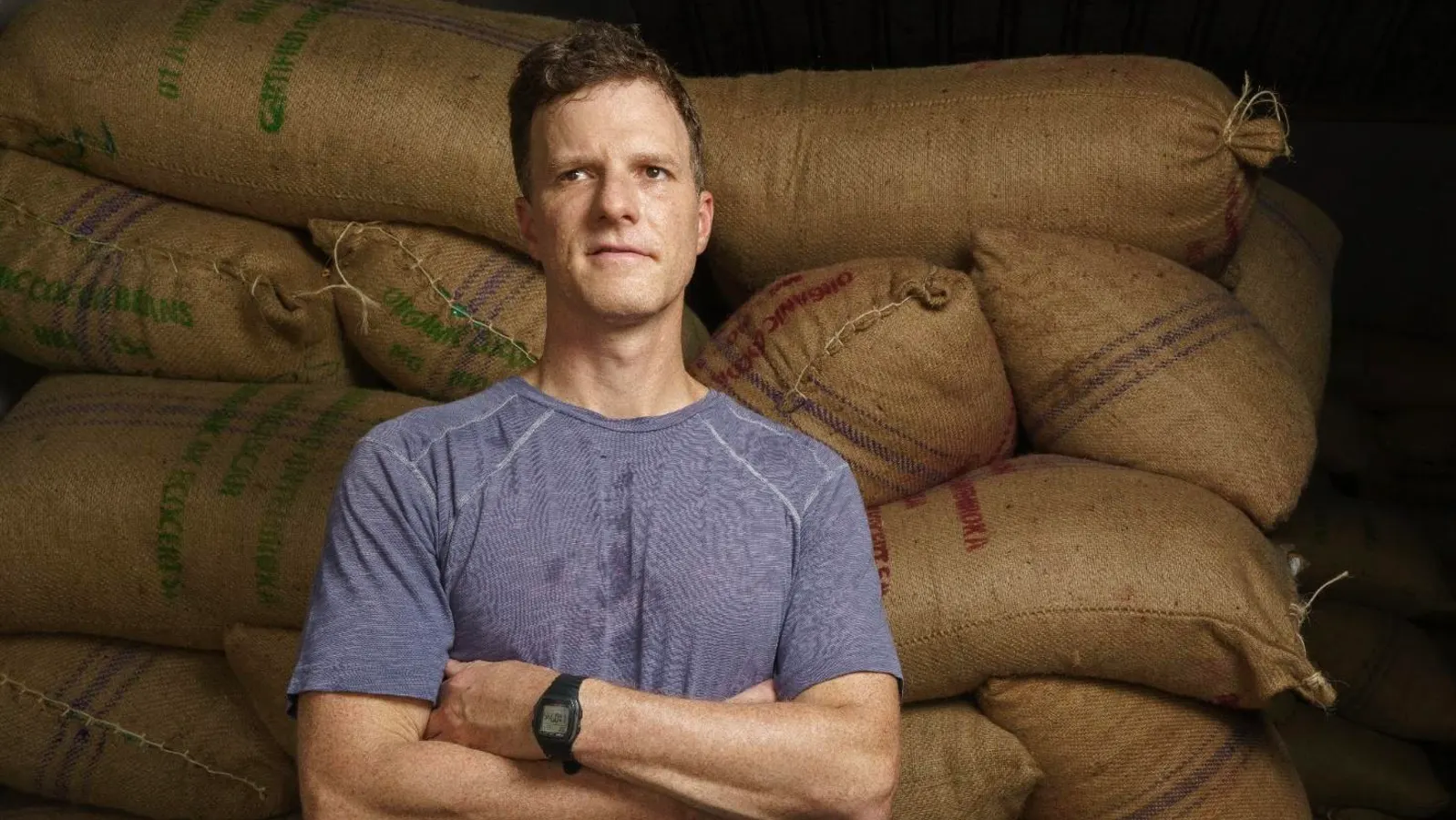

Beyond Good Founder and CEO Tim McCollum
Beyond Good
It’s approaching 11pm, and Tim McCollum lies flat on a shallow platform on a wild cocoa farm in Madagascar’s cocoa country. You can barely see him underneath the pitch black sky–there is no electricity–just some shimmering starlight creating a dim halo around his face.
But he meditates with his eyes glued shut, as he always tries to do when he travels to the other side of the world to the farm that he practically calls home; a place he has worked tirelessly to support through his chocolate and vanilla business, Beyond Good.
In his twenties, he would get to know the Malagasy people when he was sent as a Peace Corp volunteer to Madagascar, the deeply secluded and misunderstood country, similarly misunderstood as two of its primary exports: cocoa and vanilla.
Not chocolate, but cocoa. Chocolate is rarely made in Madagascar, but so much of its hero ingredient comes from there–cocoa, the mystifying fruit that grows along tree trunks before being processed into chocolate in other parts of the world.
Beyond Good is different. Beyond Good makes its chocolate in Madagascar, at the source of that ingredient, where its cocoa is grown–the only American company to do so. McCollum is showing that the most ethical ways to create a supply chain can also create the most resilient businesses–and the highest quality chocolate and vanilla.
“Vanilla and chocolate are the two most popular flavors in the world and represent a lot of what’s wrong with our food system,” McCollum tells me. “But if you look at them differently, they represent that everything that’s been wrong for so long doesn’t have to be.”
Tim McCollum founded Beyond Good in 2009
Beyond Good
From Vaza To Zooky
McCollum could barely point out Madagascar on a map when he applied to the Peace Corp. Little did he know how the country, and its people, would become part of the fabric of his being, and vice versa.
When he was a teenager in New Jersey, McCollum had a Peace Corp volunteer visit his classroom who set up a letter exchange program between his class and students in Togo. “I always remember the feeling of writing a pen pal, sending it, waiting two months, then getting a response in another language,” he says. “I can still visualize and feel the paper.”
Cocoa pods for Beyond Good chocolate
photo by author
Several years later, he volunteered in Mexico during summer break while studying at Denison University, teaching English. “That was my first real exposure to another culture,” McCollum says. “It opened up my eyes in a very positive way and I knew I wanted to capture that for a longer period of time.”
He did get another opportunity to experience another culture while studying abroad in Europe. “I was thinking about what I want to do with my life after college, sitting on top of a mountain in Scotland, and it just hit me,” he says. “I remembered writing those letters and the Peace Corp volunteer who came to our class.”
He got back home and applied to the Peace Corps. Because of the time he spent in Mexico, McCollum requested to be sent to Latin America. But months after submitting his application, a recruiter told him he would be placed in Madagascar.
“I remember being too embarrassed to ask the recruiter, ‘Is that that big island off the coast of Africa?’ I hung up the phone and drove to a Borders bookstore to find an atlas to confirm it.”
Madagascar vanilla vines
photo by author
At the time, in the late 1990s, the Peace Corp was just beginning to develop its program in Madagascar, so McCollum was one of the first Peace Corps volunteers to be sent to the massive island, teaching English in a town of about 10,000 people called Vohemar on the country’s Northeastern coast–vanilla country.
Today, Madagascar is an extremely underdeveloped country. Back then, it was significantly more underdeveloped.
“Day one, I was scared out of my mind…There’s no electricity, no way to contact anyone, and you hear wild dogs barking and fighting…I slept with an open knife underneath my pillow,” he says. “Then the sun comes up, like it always does, you look outside, and you see people walking, and you’re like, ‘I gotta get on with my life.’ That initial fear left very quickly.”
Underneath the sun of that brand new day, he kept hearing the word ‘ la vanille’ on every corner he turned.
“La vanille, la vanille, la vanille….I knew whatever this word was, it’s really important.”
It means vanilla, and that day, the price of vanilla was fluctuating. In a town where the economy is completely dependent on vanilla, that’s all that mattered in Vohemar in that moment.
The other word McCollum would hear constantly was ‘vaza:’ foreigner.
“Within three or four months, instead of calling me vaza, they’d call me ‘zooky’… brother,” he says. “That’s a very powerful thing that you don’t ever forget.”
Beyond Good chocolate bars
Beyond Good
A Mission For Madagascar
After two years of living in Madagascar, McCollum arrived back in the States on September 10th, 2001.
As information began to unravel over the next several days, his deep internal desire inside to create global impact rooted in the experience he just completed began to feel more urgent. “My first thought was, ‘whoever did this, they just don’t get what America is about…In a weird sense, this is why we have the Peace Corps,’” he remembers. “It starts somewhere in a village where someone gets exposed to ideas…face-to-face interactions, grassroots level, going into towns. At some point, that prevents bad shit from happening.”
Beyond Good Vanilla Beans, Extract and Powder
Beyond Good
After some decompression, McCollum landed a role at American Express, hoping that one day its travel department could expose him to other parts of the world again. But with every passing day, he couldn’t get Madagascar out of his head. “There’s not a day that went by when I did not think about some very good friends that I made,” he says, still feeling a calling to remedy the living conditions he witnessed there firsthand.
He remembers a wealthy foreigner who threw a simple music festival when he was living there, and would always think about the smiles it put on peoples faces. “They were talking about it for months,” he recalls. “I thought ‘if that guy’s being nice three days out of the year, what could you accomplish if you build a whole business with the goal of having an impact?’ I started to realize I could have a bigger impact on the extreme poverty there through business.”
That became the initial mission of Beyond Good, which at inception was named Madécasse. In 2009, McCollum started building the business on nights and weekends. American Express happened to offer him a job abroad around the same time, which was always his goal there. But instead of accepting it, he quit and fully committed to growing his startup with some money he won in a business competition.
McCollum at site of Beyond Good’s future chocolate factory
Beyond Good
He started by selling Madagascar vanilla into small boutiques in New York, and kept noticing a growing number of premium chocolate on shelves all with one thing in common: the origin of Madagascar.
“I had never associated cocoa with Madagascar before. I lived in vanilla country in the countryside where there are no refrigerators,” McCollum says. “I felt like it wasn’t right that these chocolate makers who had no personal connection to Madagascar were putting the name on it.”
His initial research led him to find only two chocolate factories in the entire country–cocoa is just an export–both of which only sold the chocolate locally, and one of which was about to go out of business because they couldn’t create enough demand. He got in touch with them to give them a platform to export that chocolate to the U.S. Beyond Good would now sell chocolate in addition to vanilla through this business model for the next decade.
Beyond Good’s chocolate factory in Tana opened in 2020
photo by author
As he grew the business in the meantime, McCollum saw how he strengthened the market by increasing demand for the product. He was then ready to take Beyond Good into a chapter that would begin the full realization of its mission. “The only way to make this work,” he said to himself, “is to start all over, and build a factory from scratch.”
In 2020, after years of construction, Beyond Good opened its new chocolate factory in Madagascar’s capital city on Antananarivo (or Tana, as locals call it). The factory alone now employs 100 people.
“It was a new day for the business,” McCollum says. “We’re proving that you can make some of the best chocolate in the world in the country that grows the cocoa. You can’t do that unless you’re vertically integrated.”
Cocoa Farmer Lalatiana Andrianarison
Beyond Good
Lalatiana’s Lemurs
Beyond Good has become the most traceable chocolate anyone can purchase at a mainstream store in the States–the only that makes chocolate right by its cocoa farms instead of shipping cocoa beans to other parts of the world to other chocolate factories.
Out of its 95 cocoa partners, its primary sourcing partner is Lalatiana Andrianarison, a sixth generation cocoa farmer who operates more than 50 hectares of cocoa near Ambanja, a city in Madagascar’s cacao country in the northwestern region of the island. Lalatiana’s farm has become Beyond Good’s main cocoa hub, and that place where McCollum calls home–the one where he meditates when he visits twice a year.
Lalatiana’s cocoa farm
Photo by author
McCollum and his team went around cocoa country introducing themselves to different farmers, and eventually met Lalatiana. More than a decade later, he has now become like family to him. “There’s something about his land that was very peaceful,” McCollum says. “Every time I come back, it’s hard to find the words. When I’m here I get to see what the business is really about.”
Lalatiana employs more than 50 people on his farm, which is more than he needs, but his partnership with Beyond Good has enabled him to be able to provide more jobs. The farmers who work for him don’t just manage the cocoa forest and harvest the cocoa pods, but they process the beans too–making “wet” or raw cocoa beans into “dry” cocoa beans–harvesting the beans, fermenting, and drying to make it ready for chocolate making–adding value to the product once it’s exported, while most farmers are just selling the commodity crop.
Biodiversity on Lalatiana’s cocoa farm
Photo by author
The biodiversity on Lalatiana’s cacao farm is beyond human comprehension. From chameleons blending into vanilla vines to spiders making webs on banana trees and wild hogs grazing bugs on the ground, this is beyond basic agroforestry. This land shows a true ecosystem that mother earth designed herself as the place where our food should be grown.
And there are lemurs too; more today than when McCollum first met Lalatiana.
Despite Madagascar having among the highest concentrations of biodiversity in the world, deforestation is a systemic problem throughout the country rooted in its poverty issue, as land is often cleared by civilians for basic necessities like rice and fuel. It has contributed to the endangerment of Madagascar’s famed lemurs. As McCollum began to learn more deeply about the cocoa supply chain, he realized that conservation through growing more cocoa trees could also become part of the company’s mission.
It started when McCollum was randomly offered a lemur to purchase during one of his trips to the country. Although it was a confusing proposition, he felt a responsibility. Inspired by conservation work at Lemur’s Park in Tana, he thought about taking the animal and setting it free in Lalatiana’s cocoa forest, but didn’t know if it would possibly endanger the animal further. It led to him earning a grant from Conservation International, which allowed him to send primatologists out to perform an elaborate survey of the farm to make sure it was safe.
Lemur at Lemur’s Park conservation site
photo by author
Not only was it safe to set the lemur free there, it was found to be a beyond good environment for lemurs to thrive.
“They found that five species are already living here,” McCollum says. “It became a landmark case in lemur conservation because it was the closest they documented lemurs living in close proximity to humans without conflict.”
Since then, McCollum has noticed that the lemur population at Lalatiana’s farm has significantly grown. More chocolate, more lemurs.
Land on Lalatiana’s farm is regularly converted to be better utilized as demand for Beyond Good’s chocolate grows. The more we buy this chocolate, the more trees the company is able to plant to meet that demand, which enables a stronger ecosystem for the critically-threatened lemurs to thrive.
McCollum testing chocolate at the factory
photo by author
Made At The Source
Making chocolate at the source results in a more resilient business, provides more opportunities for farmers, and creates more delicious chocolate.
Traceability impacts quality. If you purchase cocoa beans from a large distributor, you get whatever you’re given. Beyond Good is able to control the quality of its cocoa beans and make changes based on the outcomes it wants for its final chocolate product due to its direct relationships with farmers.
Tyler Sanderson (second from right) and Beyond Good employees
photo by author
The company is now growing faster than it has ever grown. “Our cocoa bean supply is rock solid,” McCollum says. “The factory is very operational. Volumes are stable. The supply chain always has room for improvement, but it’s definitely not holding us back.”
As the business has grown, Beyond Good has even started sourcing Ugandan chocolate as well. At the moment, those beans are being sent to the Madagascar factory, but the company is committed to making its chocolate as close to all of its sources as possible. That’s why it is now working on a new project building out another factory in East Africa, led by another former Peace Corp volunteer, Beyond Good’s Head of Supply Chain, Tyler Sanderson.
Workers packing Beyond Good chocolate
photo by author
“If you’re far from cocoa, you can’t actually understand the cocoa you’re purchasing,” Sanderson tells me. “We had a crazy cocoa crisis. I could not imagine navigating that from afar. If we were trying to navigate that from the U.S. we probably would have closed down. We’re now stronger than we were before it started.”
The jobs that Beyond Good provides for the Malagasy people have real impact. Every worker is extremely grateful to cocoa and vanilla as cash crops in the country for the sole sake that it provides them an income.
“It’s hard to get a job in Madagascar…the biggest change you can make in somebody’s life is providing them employment,” Sanderson says. “When I see a lady sorting cocoa, I’m so happy to see they have that opportunity. This person has a chance.”
McCollum at Beyond Good’s chocolate factory
photo by author
Beyond Good pays its cocoa and vanilla farmers a premium for their crop, upwards of 5%, an incentive provided by the company for the farmers to maintain its high standards; for example, meeting at least a 40% canopy cover and prohibiting deforestation.
“You can’t oversee the supply chain operation without also monitoring impact,” Sanderson says. “The company is bigger than Madagascar.”
Beyond Good demonstrates what ‘business for good’ means, which can in turn raise the quality of the product itself. Most food businesses work with the systems they are provided and work around it. Beyond Good has created its own. “Most companies would probably never want to take on what we’ve taken on, but most companies don’t start with the mission that we started with,” McCollum says.
“First and foremost,” he adds, “I want people to buy our chocolate because it’s a better quality chocolate bar. But as people get to understand what we do, there’s a growing sense that it’s more than just a chocolate bar.”








Leave a comment