


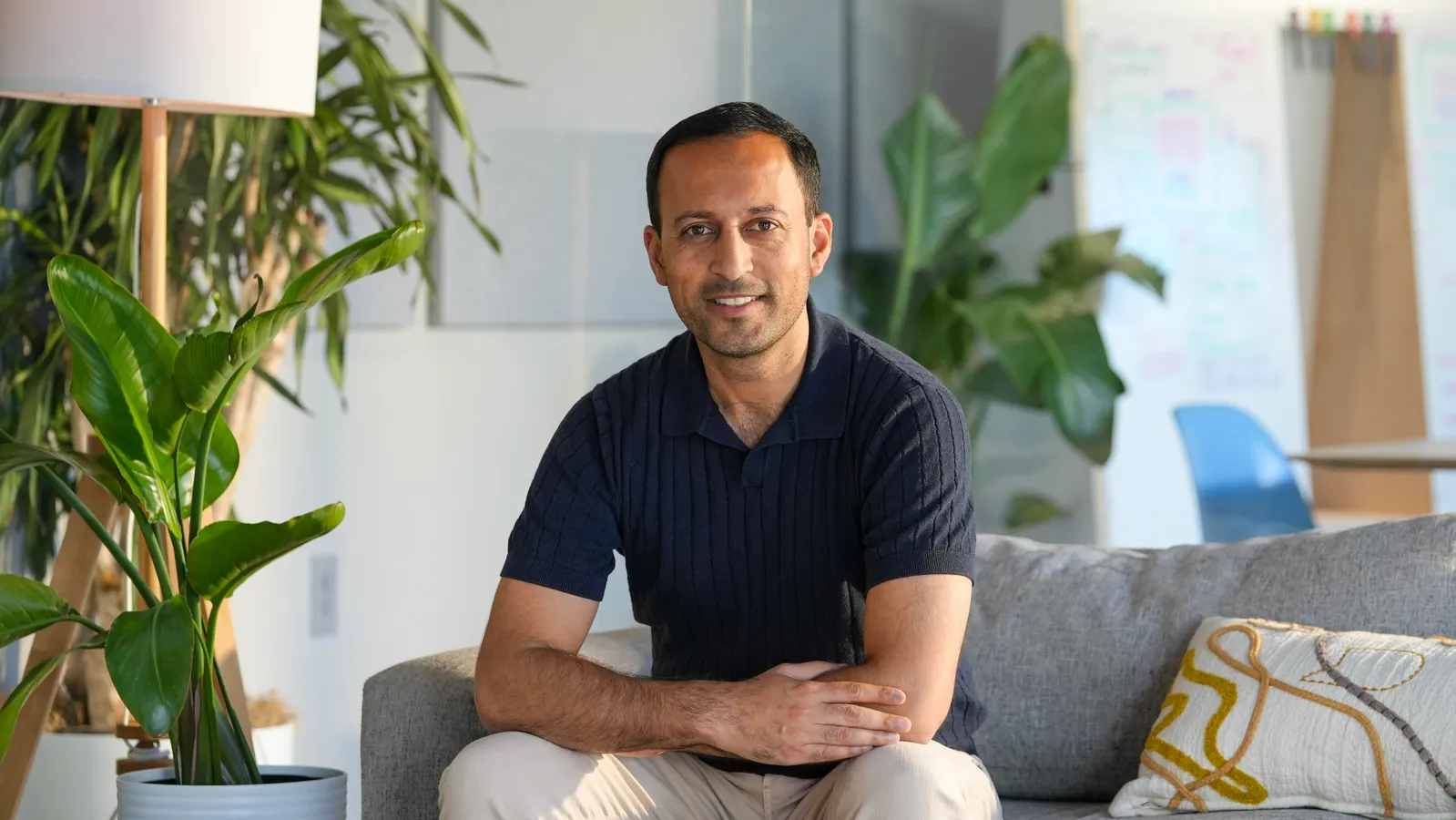
Gagan Biyani will lead the new Horowitz Andreessen Academy.
Richard Zheng
Gagan Biyani has spent most of his career trying to reinvent the way people learn. In 2010, he cofounded Udemy, which helped popularize on-demand video-based courses taught by experts. A decade later, he cofounded Maven, an online platform for live classes. Now, ironically, in the age of artificial intelligence, he’s going all-in on learning face-to-face. He’s starting a school where a bunch of ambitious young AI-focused builders will come together in person.
Founded by Biyani, the Horowitz Andreessen Academy, or HAA, is an unaccredited alternative to college being incubated by venture capital firm Andreessen Horowitz (also known as a16z), which is investing $35 million to launch it. The academy, based in San Francisco, expects to enroll about 50 students in a tuition-free, one-year founding class in fall 2027, then expand to a two-year program in 2028, when tuition is expected to be comparable to that of elite private universities. HAA is seeking approval to operate from California’s Bureau for Private Postsecondary Education, the state agency that oversees private postsecondary schools. It won’t award college degrees or credit.
“It’s the age of infinite doing,” Biyani tells Forbes of the philosophy behind HAA: AI allows individuals to accomplish things that once required more people, money or specialized expertise. But he thinks that puts a premium not just on technical skills, but on initiative and knowing how to deal with other humans. “In an AI-native world where AI is at everyone’s fingertips, there’s going to be more of an emphasis on human interaction,” he says. (That’s the same reason some in the university community believe humanities majors, which have seen enrollment slide in popularity, are poised to make a comeback.)
Instead of organizing students’ lives primarily around lectures, tests and grades, HAA is building its education around classes, co-ops and self-directed projects it calls “Pursuits.” Students will spend at least three months working full time inside a company. Founding partners Anthropic, Google, Meta, Nvidia, OpenAI, Palantir and Stripe will contribute in different ways, from helping shape the curriculum and providing technology and computing resources to offering hands-on learning opportunities. More than 40 additional companies have signed on as hiring partners for internships and full-time jobs.
The academy is looking for students with “proof of work”—young people who are “builders through and through,” says Biyani, high school graduates who say, “‘I don’t want to do another four years of this. I want to push myself forward.’”
I spoke with Biyani about what traditional colleges should learn from HAA, why AI may make people skills more valuable and whether Silicon Valley is romanticizing college dropouts.
Lisa Chambers: What does higher education need to change because of AI?
Gagan Biyani: You’ve got to embrace it rather than fight it, right? It’s here. It’s the new technology of the future—it’s the new laptop. You can’t ban it and say you’re preparing the students for the future. Those things are diametrically opposed.
You absolutely need to teach different skills because of AI’s existence. It’s not just teaching, OK, this is what an LLM does, this is how AI works, etc. That’s important. Of course, everyone’s going to try and teach people how to use AI. That’s fine. But what you need to do is teach a different mindset.
Chambers: What does that different mindset look like?
Biyani: One of the things AI provides—and it’s this great phrase that the a16z teaching’s been using—it provides access to infinite doing. AI allows you to do more and do more effectively, and that means that our young people need to be learning how to do things using the tools. It’s the culture of when you see a problem, do you go and solve it?
The other things you need to learn is people skills. Because in the age of AI, the computers are going to be able to do a lot more. There’s still 9 billion people on the planet, last I checked, and those people are a huge market. They’re the people you have to work with. We want to make sure that people skills and interpersonal skills are a core part of the curriculum.
Chambers: Why put so much emphasis on “Pursuits” and project-based learning?
Biyani: That is a much more effective way of learning for multiple reasons. One is we all know that project-based learning and application allows someone to sink into the information. The second is there’s much higher motivation. Especially when students get older, their motivation is a much bigger factor in whether or not they retain and learn information. Pursuits are particularly designed so that students learn things because they want to learn them.
They’ll have multiple pursuits at a time, and a lot of those things will involve interacting with people. Most of our classes are in person. We’ll have a physical campus. We haven’t announced our campus yet.
Chambers: Is HAA leaning into Silicon Valley’s mythology of the brilliant college dropout, like Mark Zuckerberg, who dropped out of Harvard, or Steve Jobs, who left Reed College after a year?
Biyani: We’re not just looking for rule breakers. We are looking for people who are willing to think critically about the rules, think critically about the system. But we’re not looking for people who break them for the sake of breaking them.
Chambers: OK, but students who choose HAA are choosing it instead of college, right?
Biyani: Well, to be clear, this is an alternative. To encourage them not to go to college or to go to college is not really relevant. There are tens of thousands of kids graduating from high school every year. Fifty of them are going to go here. What do I think the rest of them should do? A lot of them should go to college. Some of them should go to work. Some of them should start a company.
Chambers: Why build this outside an established university?
Biyani: The time is now. One of the most important reasons for doing this directly on our own is that we have the freedom to push the boundaries. For me personally, I’ve always been attracted to being on the bleeding edge and testing the boundaries and coming up with new and innovative ways to educate. I think we’re going to see a whole slew of these new types of schools, so there’s got to be the person out there. The way that I approach the world is, I have a vision for how I want the world to look, and I want to go and build that.
Chambers: What do you think an 18-year-old who does go to college should be learning in the AI age?
Biyani: If you’re going to go to a traditional college, you still want to optimize for getting experiences that make you a more valuable doer and builder in the modern society. You should go and do things with young other smart people and force yourself to take on challenges. Whether that challenge is trying to start a new type of political party, or write a book or create a band. And of course, in the technical realm…go build products that people actually want to use. Go engage in open-source communities. Go build robots or new types of LLMs. We are super excited for young people in this generation. We believe that the future is bright, that there will be an abundance of opportunities, both job opportunities and business opportunities in the future, and we want to prepare people for those unique opportunities that are coming in the next couple decades.
Want to be more successful? Subscribe to the weekly Forbes Careers newsletter to get insider tips and insights.













Leave a comment