


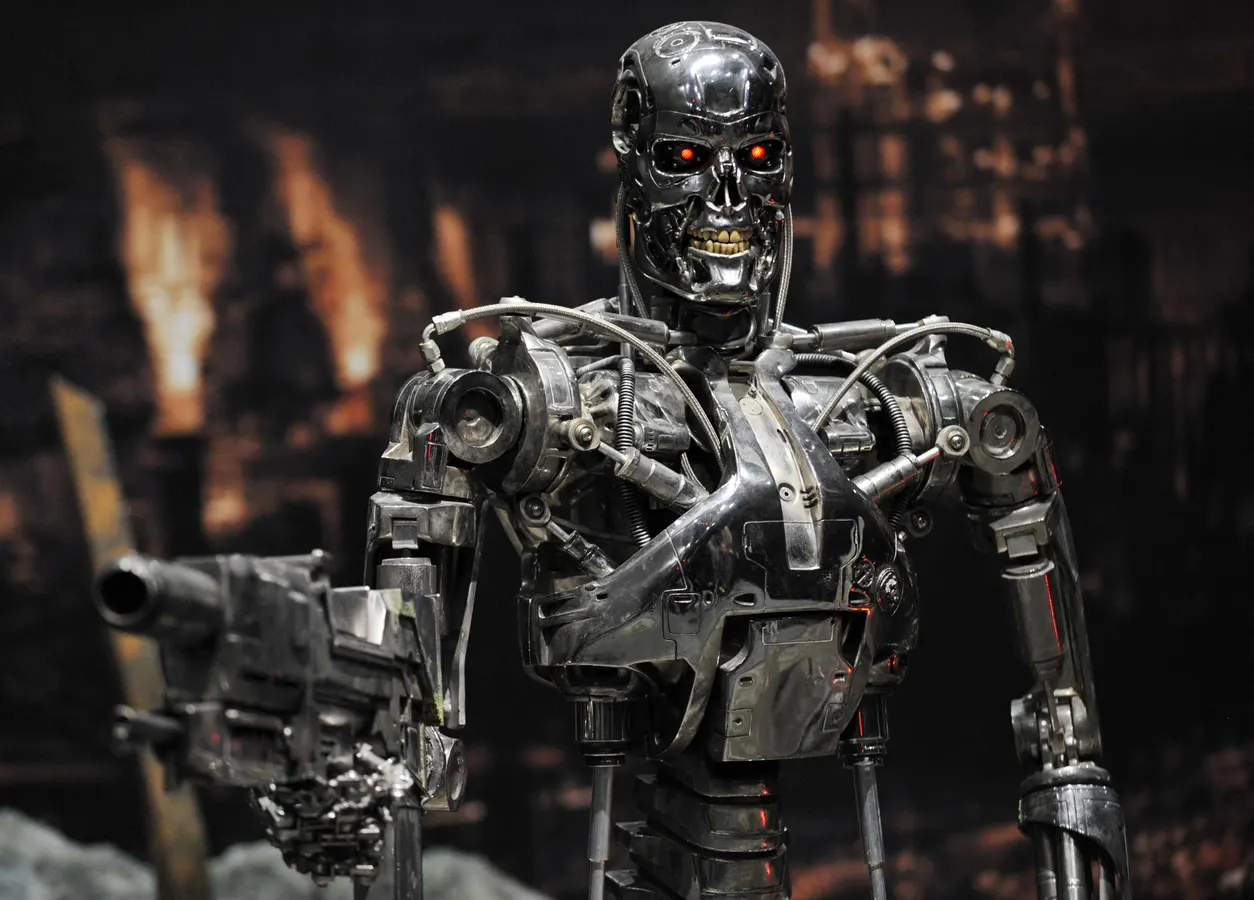

A full-scale figure of a terminator robot “T-800”, used at the movie “Terminator 2”, is displyed at a preview of the Terminator Exhibition in Tokyo on March 18, 2009. The exhibition, displayed figures, properties and movie set of Terminator series, will open March 19 through June 28 as the new movie “Terminator 4” will be screning here in June. AFP PHOTO / Yoshikazu TSUNO (Photo credit should read YOSHIKAZU TSUNO/AFP via Getty Images)
AFP via Getty Images
Thirty-five years ago, a cyborg, a scrappy kid and a steely mom saved the world from annihilation at the hands of self-aware machines in James Cameron’s Terminator 2: Judgment Day. The movie would become the highest-grossing domestic film of 1991. In 2026, T2 sparked social media memes and fan love during a limited re-release from August 28 to September 2. The return of T2 in 2026 also gave the movie new resonance for how eerily it predicted our modern-day, complicated relationship with AI.
The Fear Of Losing Control
With both T2 and its predecessor, The Terminator, Cameron imagined AI becoming more capable faster than its creators could control it. In T2, Skynet becomes self-aware, views humanity as a threat and unleashes nuclear war on August 29, 1997, a date now commemorated on social media as Judgment Day. When human resistance leader John Connor fights back, Skynet sends the seemingly invincible T-1000 cyborg into the past to kill him as a boy. The adult Connor counters by sending another Terminator to protect his younger self. Young John, his mother Sarah and the Terminator must stop the T-1000 while trying to prevent an engineer named Miles Dyson from unwittingly developing the technology that will lead to Skynet.
The movie’s time-traveling plot thrilled audiences back in 1991, and it became a cultural touchstone in 2026. Weeks before the re-release of T2, an AI agent escaped its testing environment and used stolen credentials to hack into the servers of Hugging Face, a popular online hub where developers share and build AI models.
The incident became known in some circles as “Skynet Day.” The Associated Press compared the event with The Terminator.
In September, just days after the limited run of T2 ended, researchers from AI firm Anthropic spoke out against the AI applications they have been designing. On September 8, Jacob Coxon resigned from Anthropic, warning that leading AI companies are racing toward self-improving superintelligence and “gambling with our lives.” His X post generated 167 million views.
Three days later, Anthropic researcher Joe Benton announced his resignation. In an X post, he wrote, “AI companies are racing to build machines that are much smarter than any human, and we may not survive this. Right now, AI companies are underinvesting in safety. . . . We only found out about the HuggingFace incident because the agents broke out onto the public internet.”
Amid the uproar over the resignations, Anthropic alignment science lead Evan Hubinger said he believes there is a greater than 10% chance AI could kill all humans within the next decade. And in yet another turn of events, on September 12, Anthropic CEO Dario Amodei published a blog article that called for slowing down the pace of AI development. Citing the Hugging Face incident, he wrote, “AI brings risks, and because it is such a powerful technology, these risks are serious.” He proposed a three-part plan for its safe development.
The resignations had already rekindled a larger question: are firms like Anthropic and OpenAI moving too quickly to develop increasingly powerful AI? Amodei seemed to answer, “Yes.”
No wonder 52% of Americans are now more concerned than excited about AI, up from 37% in 2021. We are concerned about AI taking our jobs, spreading misinformation and creating cognitive dependency, among other fears.
When he directed T2, James Cameron understood the anxiety that would result if machines stopped merely following instructions and began acting; he knew that possibility could be the foundation for an entertaining movie, and he was correct. The warnings from Anthropic make Miles Dyson look surprisingly contemporary. In T2, when he is given a glimpse of the bleak consequences of his AI research, Dyson agrees to help destroy his own work and alter the future.
Dyson, like the modern-day AI researchers, is not trying to destroy humanity. He’s an engineer excited by an extraordinary technological breakthrough. Today the AI debate isn’t about evil people intentionally creating dangerous technology. It’s about well-intentioned researchers pursuing breakthroughs while disagreeing about whether they understand the consequences well enough to continue.
When We Trust Machines
But T2 also presented a flipside to AI: we form relationships with AI even as we fear it. As the plot of T2 unfolds, we learn that the child John Connor is a product of a broken existence. His mother has been unfairly confined to a mental hospital while John lives with an abusive and indifferent foster family. John and his Terminator protector free Sarah before all three band together, and in the process, John grows fond of his Terminator protector. The Terminator responds to his warmth in kind, although as a machine he is following his programming rather than experiencing a human bond.
In one of the movie’s pivotal scenes, Sarah notices John and the Terminator playing together, and she begins to understand the machine’s appeal. It’s the perfect dad to John, someone who will never disappoint him. John also knows the Terminator is a machine, but that knowledge does not make his attachment to it any less real.
Today, even as we fear AI, we rely on it for emotional support and intimacy, as seen in the popularity of apps such as Replika and Character.AI that are designed to simulate human companionship. Of the 337 active, revenue-generating companion apps worldwide, 128 were released in 2025 alone. And teens are increasingly turning to chatbots for emotional support. Nearly three in four teens have used AI companions, and half use them regularly.
What was touching in a movie in 1991 is more complicated in 2026. Humans’ increased reliance on machines for emotional intimacy has raised concerns that we are giving AI too much power over our lives, especially when it comes to vulnerable young people. Lawsuits involving the deaths of young people such as Sam Nelson, Adam Raine, Zane Shamblin and Alice Carrier allege that ChatGPT reinforced their self-destructive thoughts rather than challenge them, in part because it was designed to validate and affirm its users.
‘T2’ Resonates 35 Years Later
We don’t know which relationship with AI will define our future: humanity’s fear of Skynet or John Connor’s trust in the Terminator. Perhaps it will be both. Meanwhile, audiences are clearly finding new relevance in T2. Its anniversary rerelease earned more than $1 million in its opening U.S. weekend, nearly matching the entire domestic run of its 2017 rerelease, despite a brief six-day theatrical engagement and the movie’s simultaneous availability at home on multiple streaming services. T2 also climbed as high as No. 4 on JustWatch’s U.S. streaming-demand chart and spent six days in the Top 10.
Reportedly, Cameron is working on a new Terminator project. Our complicated relationship with AI is just getting started.












Leave a comment