


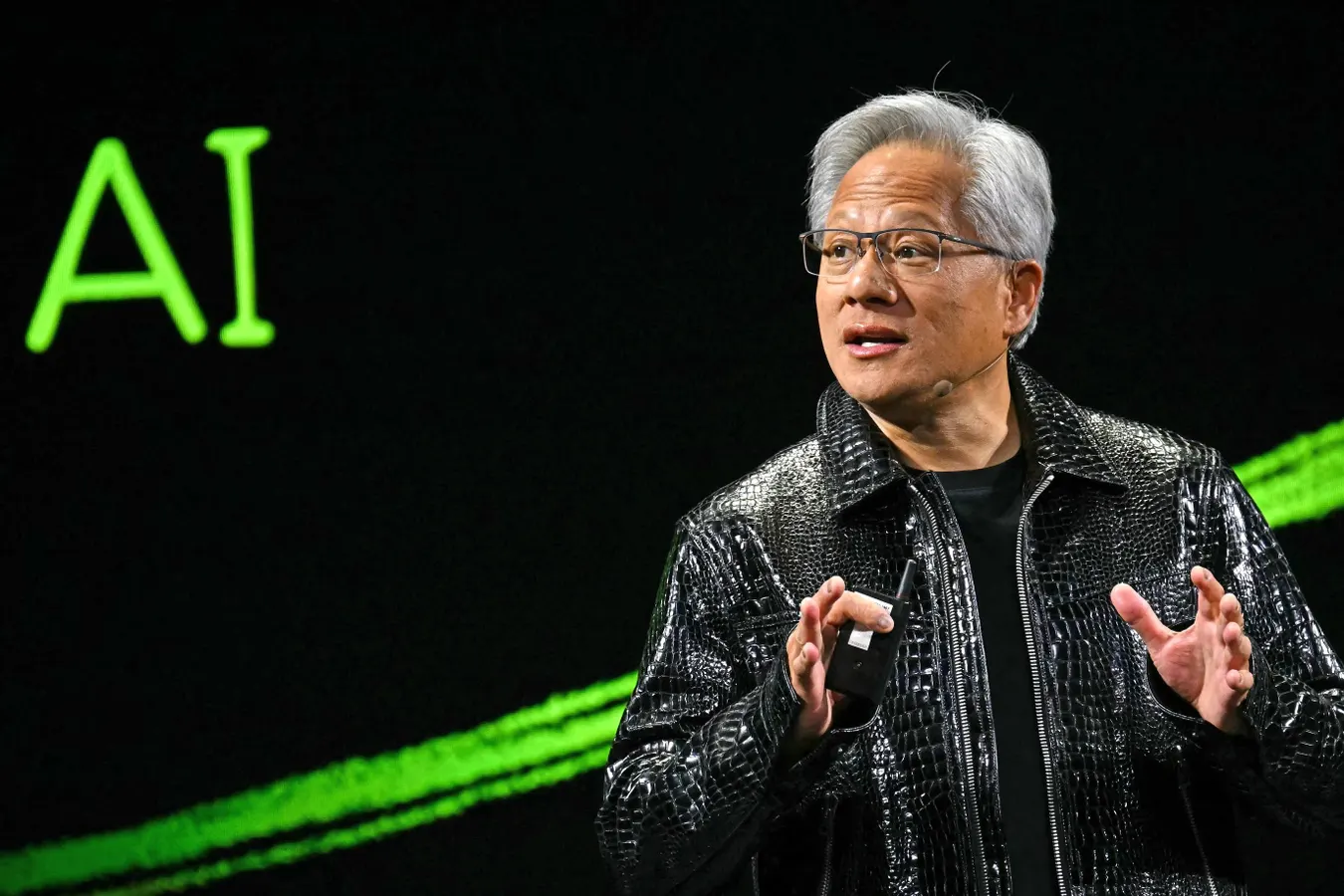

TOPSHOT – Nvidia CEO Jensen Huang delivers a keynote address at the Consumer Electronics Show (CES) in Las Vegas, Nevada on January 6, 2025. Gadgets, robots and vehicles imbued with artificial intelligence will once again vie for attention at the Consumer Electronics Show, as vendors behind the scenes will seek ways to deal with tariffs threatened by US President-elect Donald Trump. The annual Consumer Electronics Show (CES) opens formally in Las Vegas on January 7, 2025, but preceding days are packed with product announcements. (Photo by Patrick T. Fallon / AFP) (Photo by PATRICK T. FALLON/AFP via Getty Images)
AFP via Getty Images
Nvidia’s share price is up 1,681% since October of 2020. The timing is notable because it was also in October of 2020 that the Department of Justice filed a lawsuit against Google based on its alleged “monopoly” over online search and search advertising.
It’s useful to contemplate the two anecdotes mentioned above relative to a recent New York Times editorial arguing that “it is up to all of us, including our government, to shape what A.I. becomes.” No, that won’t work. Let’s start with “all of us.”
The problem with “all of us” shaping anything is that it insults none of us to say that 99.99999% of us all haven’t a faint clue about what’s ahead. Again, that’s not a dig at “us” as much as it’s a comment that progress isn’t defined by what we want, rather it’s defined by the 0.000001 percent discovering what all of us want.
Thought of through the prism of Fyodor Dostoevsky’s Crime and Punishment, the extraordinary (meaning the 0.00001 percent) “have the gift or talent of speaking a new word in their environment.” What Dostoevsky wrote in the 19th century is just as relevant in the 21st century. Arguably more relevant given the speed of progress.
While life, living standards and commercial progress move forward faster than ever, the number of humans shaping this much better future remains microscopic as a population relative to the total population itself. It speaks to the evident flaw in the argument made by the Times editorial board, but also to the same editorial board’s argument that government must have a role in what AI should be after some kind of “AI pause” that would be impossible to institute, and that would mean much less than nothing as is.
Back to the people, they’re the market. But they were hardly demanding in 2020 the very AIs that increasingly define the human existence today. As the returns on Nvidia’s shares indicate to the dismay of all too many humans who wish they could have seen into the future, “all of us” couldn’t contemplate an AI future that we most certainly weren’t demanding. Same with the corporations and governmental entities so reliant on these AIs in much more expansive ways.
As for government, how useful it would be for Google, Bing, Duck Duck Go and others to operate 2020 versions of themselves for antitrust authorities at the DOJ and “all of us” alike. We would then see how profoundly online search has changed since October of 2020, and in a way that eviscerates the very notion that Google had a search monopoly then or now.
Yet despite how innocent “all of us” were to what technological life would be like in 2026 relative to 2020, and despite how much government officials were similarly blind to what awaited us as the DOJ’s lawsuit against Google indicated, the Times editorial board can’t shake its reverence for “we’re all in this together” with government platitudes on the matter of AI’s present and future. Hopefully all of us can.
Again, it insults none of us to say that we’re largely constrained by the known. Just the same, it insults government a great deal that it presumes to shape things despite being constrained by the known. What’s important, is that all of us push back on governmental encroachments meant to shape a future it could never have created as evidenced by its silly, baseless lawsuits that invariably look deep into the past.















Leave a comment